
Your brain is constantly evaluating experiences. Is this good? Is this bad? Should I approach or avoid? These are some of the most fundamental computations any nervous system has to make, and they happen so fast and automatically that you barely notice. But somewhere in your head, there are neurons whose entire job is to label experiences with emotional value.
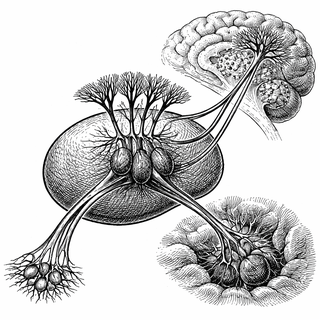
A study in Cell Reports identifies a brain region that most people have never heard of, the parafascicular thalamic nucleus, that contains two distinct neuronal populations for doing exactly this. One group of neurons responds to good things. Another group responds to bad things. And they project to completely different downstream targets, creating clean parallel circuits for approach and avoidance.
Meet the Parafascicular Nucleus (It's Been Hiding in Plain Sight)
The thalamus is that big cluster of nuclei in the middle of your brain that relays all sorts of information to the cortex. You've probably heard of some thalamic nuclei, the ones involved in vision or hearing or motor control. The parafascicular nucleus (let's call it PF, because nobody wants to say "parafascicular" more than necessary) isn't one of the famous ones.
Researchers working on emotional processing often focus on more glamorous regions like the amygdala or prefrontal cortex. The thalamus gets treated as mostly a relay station, passing information through rather than doing interesting computations itself.
But when the researchers behind this study looked at what happened in PF when animals experienced emotional events, they found something interesting. Both rewarding stimuli (like sucrose, which mice love) and aversive stimuli (like foot shocks, which mice hate) activated neurons in PF. This region was clearly paying attention to emotionally significant events.
The question was: how was it processing them? Were the same neurons responding to everything emotional, or was there some organization to the response?
Separate Populations for Separate Jobs
The answer turned out to be surprisingly tidy. PF doesn't have one population of "emotional event" neurons. It has two distinct populations that specialize in opposite valences.
Some PF neurons responded preferentially to appetitive stimuli, the good stuff. These lit up when good things happened. Other PF neurons responded preferentially to aversive stimuli, the bad stuff. They activated when something unpleasant occurred.
This wasn't just a subtle statistical difference in response profiles. These were genuinely separate populations with distinct functional roles. The brain had organized this region into parallel channels for processing positive and negative emotional information.
And here's where it gets really elegant: these populations project to different downstream targets.
Different Wiring for Different Purposes
The appetitive-encoding neurons in PF project primarily to the ventral tegmental area, or VTA. If you know anything about reward circuits, you know the VTA. It's a major hub for dopamine signaling and is central to how the brain processes rewards and motivation.
The aversive-encoding neurons, on the other hand, project to the periaqueductal gray, or PAG. This structure is involved in defensive responses, including fear behavior, pain processing, and fight-or-flight reactions.
So the architecture is: good things activate one population that talks to reward circuits, bad things activate another population that talks to defense circuits. Same brain region, opposite valences, different outputs. It's the kind of clean circuit logic that neuroscientists dream about finding.
Pushing the Buttons to See What Happens
To confirm that these circuits actually do what they appear to do, the researchers used optogenetics to artificially activate each pathway and see what happened to behavior.
When they activated the PF-to-VTA pathway, the appetitive circuit, mice showed more approach behaviors. They acted like something good was happening. When they activated the PF-to-PAG pathway, the aversive circuit, mice showed avoidance behaviors. They acted like something bad was happening.
This is about as clean a demonstration as you can get in systems neuroscience. You've got anatomically distinct populations with different projections, and when you turn each one on, you get the predicted behavioral outcome.
What This Might Mean for Depression
Here's where the findings start to connect to clinical concerns. After the researchers subjected mice to chronic stress (a common model for studying depression-like states), the activity patterns in these PF populations changed.
The way these neurons responded to emotional stimuli was altered in stressed animals, and these changes correlated with depression-like behaviors. This suggests that the thalamic valence circuits might be dysregulated in mood disorders.
If you think about depression as partly involving a shift in how the brain evaluates experiences, with positive things feeling less rewarding and negative things feeling more salient, then circuits that encode valence are exactly where you'd expect to see problems.
This doesn't mean PF is "the cause" of depression. Depression is way too complex for any single region to be the culprit. But it does suggest that these thalamic circuits might be part of the story and potentially offer new angles for understanding and treating mood disorders.
The Takeaway
The brain has dedicated hardware for labeling experiences as good or bad. This hardware isn't just in the obvious places like the amygdala. It's distributed across the brain, including in thalamic regions that haven't gotten much attention.
The parafascicular nucleus has been sitting there all along, quietly running its good-things department and bad-things department, sending information to the appropriate downstream circuits. Sometimes the interesting neuroscience is in the places nobody thought to look carefully.
Reference: Li M, et al. (2025). The distinct subpopulations in parafascicular thalamic nucleus encoding innate emotional valence. Cell Reports. doi: 10.1016/j.celrep.2025.116482 | PMID: 41171763
Disclaimer: The image accompanying this article is for illustrative purposes only and does not depict actual experimental results, data, or biological mechanisms.