
For decades, neuroscientists have been running a pretty simple playbook. Flash a light. Play a beep. Record the brain's response. Interpret that response as sensory processing doing its thing. Vision or hearing or touch, respectively.
A theory paper in Brain has some awkward news: a lot of what we've been measuring might not be sensory processing at all. Those big, beautiful brain responses might actually be something much less specific and much less interesting than we thought.
Oops.
The Problem With Sudden, Isolated Stimuli
Here's how a typical sensory neuroscience experiment works. You put someone in a quiet, dark room. You present a stimulus, a flash, a tone, a poke. Then you measure the brain response using EEG, MEG, or fMRI. The response is usually large, widespread, and easy to measure.
Researchers have been interpreting these responses as the brain processing visual, auditory, or tactile information. This is sensory cortex doing its job, right?
The authors of this paper beg to differ. They argue that sudden, isolated stimuli trigger two completely different brain systems, and we've been confusing them this whole time.
System One: The Sensory Highway
The first system is what neuroscientists usually think they're studying. It's called the lemniscal pathway, and it's the high-fidelity sensory channel that carries detailed information from your sense organs to primary sensory cortices.
This is the system that tells you exactly what you're seeing or hearing. It encodes precise features like color, pitch, texture, and location. It's the sophisticated, information-rich processing that we care about when we study perception.
System Two: The "Something Happened!" Alarm
But there's another system lurking in the data. The extralemniscal projections are a diffuse set of pathways that respond to sudden environmental changes regardless of which sense detected them.
Think of it as your brain's "something just happened" alarm. Light suddenly appears? Alarm goes off. Sudden sound? Same alarm. Unexpected touch? Alarm.
This system doesn't care about the details of the stimulus. It doesn't encode what happened. It just signals that something changed. And here's the kicker: in EEG recordings, this non-specific arousal response is huge. It often dominates the signal, especially for sudden, isolated, unexpected stimuli.
You know, exactly the kind of stimuli that neuroscientists love to use.
Wait, So What Have We Been Measuring?
Here's the uncomfortable implication. If sudden stimuli trigger both systems, but the extralemniscal "something happened" response is much larger than the fine-grained sensory response, then a lot of experiments interpreted as studying vision or hearing might actually have been measuring... something else entirely.
The responses aren't about what the stimulus is. They're about the fact that it showed up.
This could explain some persistent puzzles in the field. Why do responses to very different stimuli often look surprisingly similar? A flash and a beep are completely different types of sensory input, but their EEG signatures have a lot in common. If both are triggering the same non-specific "something changed" response, that similarity makes sense.
Why doesn't the relationship between stimulus intensity and neural response always match predictions from sensory coding models? Maybe because the models are about lemniscal processing, but the measurements are dominated by extralemniscal activity.
Why are these responses so sensitive to attention, expectation, and context? Because the "something happened" alarm is fundamentally about novelty and unexpectedness, not sensory encoding.
Consciousness Research Needs to Sit Down for This
The authors specifically flag implications for consciousness research, and this is where things get genuinely concerning.
A lot of consciousness research relies on large, widespread brain responses to sudden or rare stimuli. Paradigms like the oddball task (where rare stimuli produce much bigger responses than frequent ones) have been central to theories about neural signatures of awareness.
But if these large responses actually reflect extralemniscal activity rather than conscious perception, the field may have spent years chasing artifacts. The brain activity that researchers interpreted as "this stimulus entered awareness" might actually just mean "something surprising happened."
That would be more than awkward. That would require rethinking a substantial portion of the consciousness literature.
The Experiments We Need to Run
So what do we do about this? The authors advocate for designing experiments that can actually distinguish between these two contributions.
This might mean avoiding sudden, isolated stimuli when you want to study sensory processing specifically. Stimuli embedded in continuous contexts, or stimuli that don't have the element of surprise, might produce cleaner lemniscal responses.
It might mean using analysis techniques that can separate the two signal sources, rather than averaging everything together and hoping for the best.
It might mean explicitly manipulating the "surprise" factor while keeping the sensory content constant, to see which aspects of the response track which.
Basically, it means being much more careful about what we're actually measuring. And being willing to accept that some classic findings might need reinterpretation.
Why This Matters Beyond Academic Debates
This isn't just ivory tower nitpicking. If we've been confusing non-specific arousal responses with sensory processing, that has real implications.
Clinical applications of EEG often rely on sensory-evoked responses to assess brain function. If we're partially measuring the wrong thing, our interpretations could be off.
Brain-computer interfaces that use evoked responses as input might be leveraging the extralemniscal system without realizing it. That's not necessarily bad, but it means the system might work differently than we think.
And for basic science, getting this right is essential. You can't build accurate models of perception if your measurements are contaminated by an entirely different process.
The Value of "Wait, What?"
Sometimes the most valuable scientific contributions are the ones that make everyone stop and reconsider fundamentals. This paper is that kind of contribution.
It doesn't prove that decades of sensory neuroscience are wrong. But it raises a serious concern that deserves attention. It proposes specific predictions that can be tested. And it suggests concrete changes to experimental practice.
In science, the questions are often more valuable than the answers. And "have we been measuring what we think we're measuring?" is exactly the kind of question that can move a field forward.
Even if the answer is uncomfortable.
Reference: Somervail R, et al. (2025). A two-system theory of sensory-evoked brain responses. Brain. doi: 10.1093/brain/awaf402 | PMID: 41128002
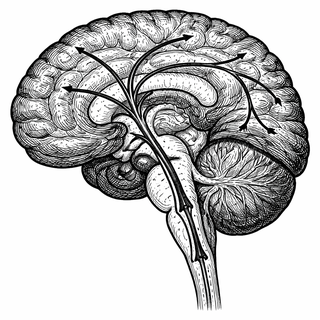
Disclaimer: The image accompanying this article is for illustrative purposes only and does not depict actual experimental results, data, or biological mechanisms.