
Your neurons are having conversations about you behind your back. Well, technically about themselves, but still. When an axon gets damaged, there's a whole internal debate happening about how to respond, and it turns out the uninjured parts of the neuron have a surprisingly loud voice in that discussion.
A study in eLife reveals a clever regulatory mechanism: when a neuron's axon has multiple branches and one branch gets injured, the intact branch can actually tell the cell body to calm down and suppress the injury response. It's like one sibling getting hurt on the playground and the other sibling telling mom, "Relax, it's just a scratch, we're fine."
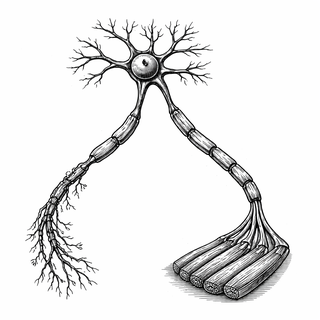
The Branching Problem: When One Limb Hurts, What Should the Body Do?
Picture a motor neuron in a fruit fly. These cells extend axons that branch out to connect with multiple muscle targets. It's an efficient design, one cell body serving multiple endpoints. But this creates an interesting problem when injury happens.
Let's say one branch gets damaged. The neuron now faces a decision. Should it go into full emergency mode, activating all the degeneration and regeneration programs? Should it start the cellular equivalent of tearing everything down to rebuild from scratch? Or is that maybe a bit of an overreaction?
The researchers behind this study wanted to figure out how the location of an injury affects these cellular decisions. Specifically, they were curious about whether having a healthy branch changes how a neuron responds to damage on another branch.
The "I'm Still Fine Over Here" Signal
Here's what they found: when one branch was injured but the other remained connected to its synaptic target, the injury response was suppressed. The intact "spared" branch was actively sending signals back to the cell body that essentially said, "Hey, don't panic. Part of the operation is still running smoothly over here."
This signaling involved a molecular pathway called DLK/JNK, which is a conserved injury response pathway. When we say "conserved," we mean it's been around for a really long time in evolutionary terms. Flies have it. Mice have it. Humans have it. This is the kind of ancient machinery that evolution kept around because it works, which means whatever's happening in fly neurons might be relevant to understanding human nerve injury too.
The spared branch wasn't just passively existing; it was actively communicating with the cell body and dampening the alarm signals coming from the injured branch. It's remarkably sophisticated coordination for a single cell.
This Actually Makes Sense If You Think About It
From the neuron's perspective, this is pretty reasonable logic. If part of your axon is still functional and still connected to the muscles it's supposed to control, why would you want to trigger an extreme response? Why tear down the whole house when only one room got damaged?
The neuron is essentially doing a cost-benefit analysis. A full injury response is metabolically expensive and disruptive. If you still have functional connections, activating emergency protocols might do more harm than good. You could lose working connections in the process of trying to rebuild damaged ones.
So the spared branch provides context. It tells the cell body, "Before you hit the panic button, here's some information about how the rest of me is doing." The cell body can then modulate its response based on the complete picture rather than just the damage report from one location.
This is a good reminder that even individual cells are processing complex information and making decisions that aren't purely reflexive. There's genuine cellular logic happening here.
Why This Complicates (But Might Also Help) Nerve Repair
Now, here's where things get interesting for anyone thinking about therapeutic applications. The current understanding of nerve regeneration has focused heavily on what happens at the injury site. How can we help damaged axons regrow? How can we encourage regeneration?
But this study suggests we need to zoom out. The injured axon isn't just responding to local signals at the damage site. It's receiving information from elsewhere in the cell, and that information can suppress regeneration.
If intact branches are normally putting the brakes on regeneration, then therapies aimed at promoting nerve repair might need to account for this. Maybe you need to overcome the restraining signals from spared branches. Maybe there's a way to temporarily block this communication to unleash the full regenerative response.
It's also possible that this restraint exists for good reasons and shouldn't always be overridden. Evolution gave neurons this mechanism presumably because it's adaptive in some contexts. Triggering aggressive regeneration when you still have functional connections might be counterproductive. Understanding when to release the brakes and when to leave them alone will be the tricky part.
The Connected View of Nerve Repair
The big takeaway here is that regeneration isn't just about what happens at the injury site. The entire neuron is involved in deciding how to respond. The context matters: what else is the cell doing? What other connections does it have? Is the damage partial or complete?
This is a more complicated picture than "injury happens, regeneration follows," but it's also a more complete picture. And complete pictures are usually what you need to develop treatments that actually work.
Your neurons are out there making decisions about their own repair, weighing information from different branches, running their own internal negotiations. They're more politically savvy than we gave them credit for.
Reference: Smithson LJ, et al. (2025). Axonal injury signaling is restrained by a spared synaptic branch. eLife. doi: 10.7554/eLife.104896 | PMID: 41159443
Disclaimer: The image accompanying this article is for illustrative purposes only and does not depict actual experimental results, data, or biological mechanisms.