
What if I told you that your brain's memory-making machinery could survive being turned into glass, stored in a freezer for a week, and then fired back up like nothing happened?
Because that's exactly what just went down in a German lab. Scientists at Friedrich-Alexander University in Erlangen didn't just freeze mouse brains - they froze them solid, waited a week, thawed them out, and watched those neurons pick up right where they left off. Chatting away like they'd just taken a really long nap.
The Ice Crystal Problem (And How They Dodged It)
Here's the thing about freezing biological tissue: water expands when it freezes. Those ice crystals that form? They're basically tiny knives slicing through cell membranes and shredding the delicate wiring between neurons. It's why you can't just stick a brain in your freezer and expect good results.
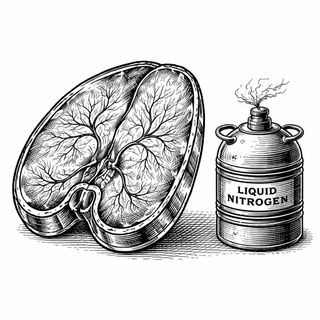
The research team, led by neurologist Alexander German, got around this by using a technique called vitrification. Instead of letting ice crystals form, they infused brain tissue with a cocktail of cryoprotective chemicals that turns water into something like glass when cooled rapidly. No crystals. No cellular carnage.
They dunked mouse hippocampus slices (that's the brain region that handles memory and spatial navigation) into liquid nitrogen at -196°C, stored them at -150°C for up to seven days, and then carefully rewarmed them. What happened next genuinely surprised everyone (German et al., 2026).
Wait, It Gets Better
The neurons didn't just survive - they started working again. Electrical signals began flowing. Synapses started chattering. But the real kicker? Long-term potentiation still worked.
LTP is the cellular mechanism behind how we learn and form memories. When certain neural pathways get used frequently, they get stronger - that's LTP doing its thing. It's basically your brain's way of saying "this connection matters, beef it up." And somehow, after being frozen into a molecular standstill for seven days, that process was still fully operational.
Think about what that means. Every piece of biological machinery required for memory formation - the receptors, the signaling cascades, the structural changes at synapses - all of it survived complete molecular shutdown and came back online.
From Sci-Fi Fantasy to Engineering Problem
"Our PNAS study is a proof of principle in neural cryobiology, not a demonstration of whole-organism cryostasis," German told Nature News. "What it shows is that adult mammalian brain tissue can recover near-physiological circuit function after complete arrest in an ice-free cryogenic glass."
The team has already started testing their method on human brain tissue, with preliminary results showing viability in human cortical samples. They're also looking at other organs - hearts, specifically.
But let's pump the brakes before we start planning our cryo-vacations to the 25th century. The researchers only worked with thin slices of tissue, about 350 micrometers thick. That's roughly the width of four human hairs. Getting cryoprotectants evenly distributed through an entire brain - let alone a whole body - is a completely different beast. The blood-brain barrier, that protective layer that keeps toxins out of your neural tissue, also keeps cryoprotectants from diffusing in properly.
Whole-brain attempts had only about a 33% success rate, and that was with some serious workarounds involving vascular perfusion techniques.
So What's Actually Useful Here?
Beyond the "whoa that's wild" factor, this research has some real-world applications right now. Surgical brain samples could be preserved for later drug testing. Neuroscience experiments could be distributed across different times and locations. And it pushes our understanding of what mammalian tissue can actually tolerate.
German dreams bigger though. He envisions artificial hibernation for space travel, or preserving patients with incurable diseases until future treatments become available. "The public takeaway should probably shift from 'pure science fiction' to 'a serious long-term scientific and engineering problem,'" he said.
Your brain, it turns out, is more resilient than anyone thought. The hardware that makes you you might be tougher than we ever imagined. We're not reviving frozen people anytime soon - but the fact that memory-making machinery can survive a week at -150°C and come back ready to learn? That's not nothing.
That's the first step toward something genuinely wild.
References
-
German, A., et al. (2026). Functional recovery of the adult murine hippocampus after cryopreservation by vitrification. Proceedings of the National Academy of Sciences, 123(10), e2516848123. https://doi.org/10.1073/pnas.2516848123 | PMC12974479
-
Thompson, T. (2026). Scientists revive activity in frozen mouse brains for the first time. Nature, 651(8106), 563-564. https://doi.org/10.1038/d41586-026-00756-w | PMID: 41813956
-
Fahy, G.M. & Rall, W.F. (2007). Vitrification in assisted reproduction: Current status and future considerations. Fertility and Sterility, 87(1), 1-3. https://doi.org/10.1016/j.fertnstert.2006.08.107
Disclaimer: The image accompanying this article is for illustrative purposes only and does not depict actual experimental results, data, or biological mechanisms.