You know that feeling when you're standing in front of a restaurant menu the size of a phone book, and suddenly ordering the same pad thai you always get sounds really, really appealing? Turns out your brain is doing something remarkably clever in that moment - and scientists have finally figured out what.
The Great Exploration Paradox
Here's the puzzle that's been bugging researchers for decades: humans are naturally curious creatures. We explore. We seek out the unknown. We voluntarily watch mystery movies and click on articles titled "You Won't Believe What Happened Next." Our brains are basically little information-hungry gremlins.
But here's the twist - we also sometimes do the exact opposite. We stick with the devil we know. We rewatch The Office for the fourteenth time instead of starting that critically acclaimed series everyone keeps recommending. We order the same coffee, take the same route to work, and actively avoid the uncertainty that our supposedly exploration-loving brains should crave.
So which is it? Are we explorers or creatures of habit? According to a new study published in eLife, the answer is: yes.
When "I Don't Know" Becomes "I Don't Wanna Know"
Researchers Yaniv Abir, Michael Shadlen, and Daphna Shohamy from Columbia University designed a clever experiment to crack this puzzle. They had participants explore a simulated environment where they had to learn about different options by sampling them - think of it like being a food critic who has to figure out which restaurants are good by actually eating there.
On each trial, participants chose between a better-known option (the place you've been to three times) and a lesser-known option (that new spot you keep walking past). The researchers tracked not just what people chose, but how quickly they made those decisions.
The findings? People generally do what you'd expect - they approach uncertainty. They pick the unknown option to learn more about it. Curiosity wins.
Except when overall uncertainty gets too high.
When participants were drowning in unknowns - when everything felt uncertain - they flipped their strategy entirely. They suddenly started choosing the familiar options, the things they already knew something about. And here's the kicker: they made these "retreat to safety" decisions faster than their exploratory ones.
Your Brain Is Running a Cost-Benefit Analysis (Poorly, But Efficiently)
The researchers explain this through something called "resource rationality" - which is a fancy way of saying your brain is constantly trying to get the most bang for its cognitive buck. Processing uncertainty is mentally expensive. It takes effort. Your neurons don't work for free.
When there's just a bit of uncertainty, your brain says, "Sure, let's investigate, we can handle this." But when uncertainty is everywhere - when you're already juggling a dozen unknowns - your brain essentially throws up its hands and says, "Nope, we're going with what we know. Cognitive resources are not unlimited, people."
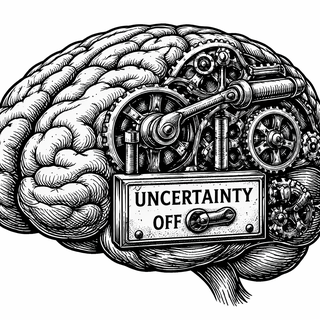
It's like your brain has a built-in circuit breaker. Push the uncertainty too high, and it trips, defaulting you back to familiar territory.
The Surprisingly Smart Strategy of Sometimes Being "Boring"
Here's what makes this finding genuinely cool: avoiding uncertainty when you're overwhelmed isn't a bug - it's a feature. The study found that participants who used this strategy didn't actually learn any worse than if they'd kept exploring. They just learned more efficiently, with less mental strain.
Think about it this way: if you're lost in a forest, randomly wandering everywhere might theoretically help you discover the exit faster. But if you're already exhausted and confused, sticking to paths you recognize might actually get you home - and you won't collapse from decision fatigue along the way.
This connects to broader research on how the brain handles uncertainty. Studies have shown there's actually an inverted U-shaped relationship between uncertainty and memory - some uncertainty boosts learning (keeps things interesting!), but too much tanks it. The brain knows this, apparently, and adjusts its exploration strategy accordingly.
What This Means for Your Netflix Queue
This research has implications beyond lab experiments. It helps explain why we sometimes make seemingly "irrational" choices - like sticking with a job we hate or eating at the same restaurant repeatedly. When life gets chaotic and uncertain, retreating to the familiar isn't intellectual laziness. It's your brain being strategic about where to spend its limited processing power.
So next time you find yourself ordering the same pad thai again while the world feels especially overwhelming, know this: you're not being boring. You're being resource-rational. Your brain is doing exactly what millions of years of evolution designed it to do - conserving energy for when it really matters.
And honestly? That's pretty smart.
References
-
Abir, Y., Shadlen, M. N., & Shohamy, D. (2026). Human exploration strategically balances approaching and avoiding uncertainty. eLife, 13:RP94231. https://doi.org/10.7554/eLife.94231 | PMID: 41894435
-
Lieder, F., & Griffiths, T. L. (2020). Resource-rational analysis. Behavioral and Brain Sciences, 43, e1. https://doi.org/10.1017/S0140525X1900061X
-
Attaallah, B., et al. (2024). The role of the human hippocampus in decision-making under uncertainty. Nature Human Behaviour. https://doi.org/10.1038/s41562-024-01855-2 | PMCID: PMC11272595
-
Mehlhorn, K., et al. (2015). Unpacking the exploration-exploitation tradeoff: A synthesis of human and animal literatures. Decision, 2(3), 191-215.
-
Decker, J. H., et al. (2016). Uncertainty alters the balance between incremental learning and episodic memory. eLife, 5:e81679. https://elifesciences.org/articles/81679
Disclaimer: The image accompanying this article is for illustrative purposes only and does not depict actual experimental results, data, or biological mechanisms.