
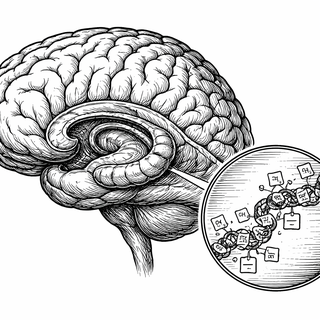
Somewhere in your hippocampus right now, tiny chemical tags are being slapped onto messenger RNA molecules like sticky notes on a refrigerator. "Remember this," they say. "This is important." And when you eventually forget where you parked your car? Those tags have already peeled off and floated away.
That's the gist of a new study from researchers at East China Normal University, who discovered that your brain uses a sneaky molecular trick called mRNA acetylation to flag which memories are worth keeping. It's like your neurons have their own internal filing system, and the label maker just got an upgrade.
The Molecular Memory Tag You've Never Heard Of
You've probably heard of DNA methylation - it's had its moment in the spotlight. But mRNA acetylation? It's been lurking in the background like that quiet coworker who turns out to be running half the company.
Here's how it works: an enzyme called NAT10 sticks an acetyl group (basically a tiny chemical decoration) onto cytosine molecules in your mRNA. This modification, called N4-acetylcytidine or ac4C, changes how that mRNA behaves - making it more stable and boosting its translation into proteins. NAT10 is the only enzyme in mammalian cells that can do this job, which makes it the sole gatekeeper of this entire process.
The research team put mice through the Morris water maze - a classic neuroscience test where rodents swim around looking for a hidden platform. (Yes, it's exactly as adorable and slightly mean as it sounds.) After the mice learned where the platform was located, the researchers examined their hippocampal neurons and found something striking: ac4C levels in synaptic regions shot up after learning. But here's the kicker - when the mice eventually forgot the maze over time, those acetylation levels dropped right back to baseline.
Memory formation literally leaves a chemical signature, and forgetting erases it.
Why Your Synapses Are Getting Special Treatment
The really interesting part is where these modifications happen. The team found that ac4C changes were concentrated in synaptosomes - the business ends of neurons where all the communication happens. We're talking about the precise locations where one neuron talks to another, where memories get encoded and stored.
This makes biological sense. If you're going to invest cellular resources in remembering something, you'd want those modifications happening exactly where memories are formed - not scattered randomly throughout the cell. Your brain, it turns out, is remarkably efficient about where it sticks its molecular Post-it notes.
The team identified specific mRNAs getting the acetylation treatment, including Arc, Camk2a, and Grin2b - all heavy hitters in the synaptic plasticity world. These genes encode proteins essential for strengthening connections between neurons, the cellular foundation of learning and memory.
Knocking Out the Memory Maker
To prove NAT10 actually matters for memory (and not just correlation), the researchers created mice lacking NAT10 specifically in hippocampal neurons. These mice weren't just missing a random enzyme - they had genuine memory problems.
Long-term potentiation, the process by which synaptic connections strengthen (basically the neural equivalent of "practice makes perfect"), was severely impaired in these animals. They struggled in spatial memory tests, unable to remember the location of that hidden platform in the water maze. Without NAT10, the whole memory consolidation process started falling apart.
This finding echoes related research showing NAT10's importance in the brain. A 2024 study in PNAS demonstrated that NAT10-mediated acetylation of GABABR1 mRNA in the hippocampus contributes to cognitive dysfunction during sepsis - suggesting this system can malfunction in pathological conditions too.
The Alzheimer's Connection
Perhaps most intriguing, the team found that ac4C modifications were significantly reduced in the hippocampus of 5xFAD mice, a commonly used model of Alzheimer's disease. The affected mRNAs included Arc, Grin1, and even Psen1 - genes directly implicated in Alzheimer's pathology.
This positions mRNA acetylation alongside better-studied modifications like m6A methylation, which has also been linked to memory formation and neurodegeneration. A 2018 study in Nature showed that m6A facilitates hippocampus-dependent learning through the reader protein YTHDF1, and subsequent research has found decreased m6A methylation in Alzheimer's patient brains.
The emerging picture suggests that RNA modifications broadly - the field called epitranscriptomics - might be central to how memories form and why they fail in disease. Your brain isn't just reading genetic instructions; it's actively editing and annotating them in real time.
What This Means Going Forward
We're still years away from NAT10-targeting therapies for memory disorders. But this research opens a door. If memory consolidation depends on specific, measurable chemical modifications at synapses, maybe we can eventually learn to boost that process - or prevent its decline.
The team has made their data publicly available at ac4catlas.com, creating a resource for other researchers to explore the brain's acetylation landscape. About 42% of the memory-associated acetylated mRNAs they found were modified independently of NAT10, hinting that additional regulatory systems remain to be discovered.
Your brain, it seems, has more tricks for remembering things than we realized. And somewhere in the chemistry of forgetting lies the key to understanding why we sometimes can't.
References
-
Zhou HQ, Zhu Z, Zhang JW, et al. Dynamic regulation of mRNA acetylation at synapses by spatial memory in mouse hippocampus. eLife. 2026;13:e108995. DOI: 10.7554/eLife.108995 | PMCID: PMC13008358
-
Wang Z, et al. N-acetyltransferase 10 mediates cognitive dysfunction through the acetylation of GABABR1 mRNA in sepsis-associated encephalopathy. PNAS. 2024. DOI: 10.1073/pnas.2410564121
-
Shi H, et al. m6A facilitates hippocampus-dependent learning and memory through YTHDF1. Nature. 2018;563:249-253. DOI: 10.1038/s41586-018-0666-1
-
Livneh I, et al. The m6A epitranscriptome: transcriptome plasticity in brain development and function. Nature Reviews Neuroscience. 2020;21:36-51. DOI: 10.1038/s41583-019-0244-z
-
Shafik AM, et al. Advances in brain epitranscriptomics research and translational opportunities. Molecular Psychiatry. 2024;29:1693-1705. DOI: 10.1038/s41380-023-02377-3
-
Xie L, et al. NAT10 and cytidine acetylation in mRNA: intersecting paths in development and disease. Cell Biochemistry and Biophysics. 2024. PMCID: PMC11317219
Disclaimer: The image accompanying this article is for illustrative purposes only and does not depict actual experimental results, data, or biological mechanisms.