You know how pediatricians have those charts showing whether your kid is growing normally? Well, scientists just made one for your brain's internal communication system - and it tracks you from birth all the way to your hundredth birthday. Turns out, your brain's organizational skills peak in your late teens and then... well, let's just say it gets more "relaxed" from there.
The Brain's Three-Lane Highway System
A team led by Hoyt Patrick Taylor IV at UNC Chapel Hill analyzed nearly 4,000 brain scans from 3,556 people, ranging from newborns to centenarians. What they mapped wasn't brain size or weight - it was something called "functional connectivity," which is basically how different brain regions coordinate their activity. Think of it as tracking which departments in a company actually talk to each other versus which ones just passive-aggressively CC each other on emails.
The researchers identified three main organizational patterns, or "axes," that govern how the brain sorts itself out:
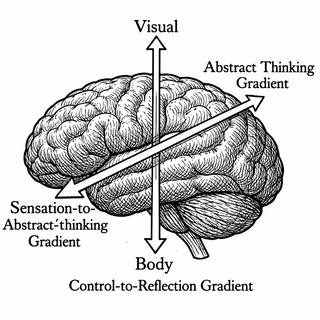
The Sensation-to-Abstract-Thinking Gradient: This one runs from the parts of your brain that handle raw sensory input (what you see, hear, and touch) to the fancy association regions that do things like daydream about your ex and contemplate your mortality.
The Visual-to-Body Gradient: Exactly what it sounds like - a spectrum from "I see things" to "I feel things with my body."
The Control-to-Reflection Gradient: This separates the brain regions that keep you focused and on task from those responsible for memory and internal reflection (the parts currently replaying that embarrassing thing you said in 2015).
The Dramatic First Four Years
Here's where it gets interesting: the most dramatic changes happen in the first four years of life. Your infant brain is basically a construction zone with neurons scrambling to figure out who talks to whom. The sensory systems - vision, hearing, touch - establish their territories first. This makes evolutionary sense: a baby needs to perceive the world before they can philosophize about it.
"These gradients are not just visual patterns. They capture fundamental aspects of brain organization," explains Pew-Thian Yap, the study's senior author. In other words, this isn't just pretty brain art - it's a map of how your thinking machinery is wired.
Peak Brain Organization: Age 19 (Sorry, Everyone Older)
Two of these gradients - the sensation-to-thinking axis and the control-to-reflection axis - strengthen throughout childhood and adolescence, reaching their peak around age 19. This timing aligns with what neuroscientists have long observed: higher-order cognitive abilities (executive function, complex reasoning, the ability to not say everything you think) are among the last to mature.
The visual-to-body axis, however, peaks much earlier - around age five - then gradually weakens. If you've ever watched a five-year-old's near-supernatural body awareness while they're climbing something they definitely shouldn't be climbing, this tracks.
After the late-teen peak, all three gradients slowly become less distinct, a process researchers call "dedifferentiation." Your brain's departmental boundaries get fuzzier with age. Before you panic: this isn't necessarily bad. It might reflect a shift toward more integrated, experience-based processing.
Why This Matters Beyond Cool Brain Pictures
The real payoff here is clinical. Many neurodevelopmental and psychiatric conditions - autism, ADHD, schizophrenia - involve disruptions across sensory, cognitive, and social domains that have been frustratingly hard to unify under a single explanatory model. A framework built around these hierarchical gradients could help researchers finally connect the dots.
"This gives us a reference map of how the brain is typically organized at different ages," says Taylor. When you know what "typical" looks like, spotting when something goes off-track becomes much easier.
The study also found that young adults whose brain organization closely matched the typical pattern performed better on memory and processing speed tests. Plus, early-life gene expression patterns aligned most strongly with these gradients, suggesting that the blueprint for your brain's organizational structure is laid down very early - possibly in the womb.
The Bottom Line
Your brain isn't a static lump of gray matter doing the same thing from cradle to grave. It's a dynamically reorganizing system that follows predictable (if complex) trajectories across your entire lifespan. And now, for the first time, scientists have a continuous map of that journey.
So the next time someone asks what your brain is doing, you can tell them: it's probably somewhere on its lifelong journey from "receiving sensory input" to "overthinking literally everything."
References
-
Taylor, H. P. IV et al. (2026). Functional hierarchy of the human neocortex across the lifespan. Nature. DOI: 10.1038/s41586-026-10219-x
-
Conroy, G. (2026). First atlas of brain organization shows development over a lifetime. Nature News. DOI: 10.1038/d41586-026-00975-1
-
Dong, H. M. et al. (2024). Functional connectivity development along the sensorimotor-association axis enhances the cortical hierarchy. Nature Communications. PMCID: PMC11045762
-
Sydnor, V. J. et al. (2023). Intrinsic activity development unfolds along a sensorimotor-association cortical axis in youth. Nature Neuroscience. DOI: 10.1038/s41593-023-01282-y
Disclaimer: The image accompanying this article is for illustrative purposes only and does not depict actual experimental results, data, or biological mechanisms.