
Ever made a bad decision for someone else and felt that special kind of awful that only comes from knowing you caused their misfortune? Turns out your brain has dedicated real estate for exactly this flavor of emotional torture.
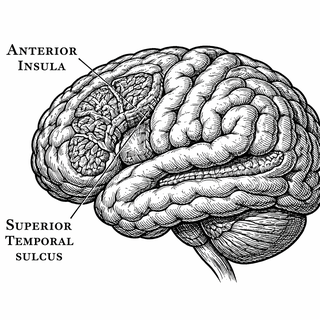
Researchers from Germany recently stuck people in fMRI machines and made them gamble with other people's money. Not to fund a neuroscience casino, but to figure out where guilt actually lives in your head. And they found it: nestled in a region called the anterior insula, your brain's resident drama queen for all things emotionally uncomfortable.
The Setup: Playing Dice with Someone Else's Wallet
Here's how the experiment worked. Participants repeatedly chose between safe and risky monetary outcomes - think of it as choosing between "definitely okay" and "maybe great, maybe terrible." The twist? Sometimes they were gambling for themselves, and sometimes they were making choices that affected a partner sitting nearby.
When things went badly for the partner after the participant chose the risky option, something interesting happened. Participants reported feeling significantly worse than when the partner had made their own unlucky choice. Same bad outcome, different emotional response. That gap? That's guilt, operationally defined and ready for its close-up.
The Insula: Your Brain's Emotional Switchboard
The anterior insula lit up during these guilt-heavy moments, particularly on the left side. This shouldn't surprise neuroscientists - the insula is basically the Grand Central Station of emotional processing. It's where your brain integrates what's happening inside your body (that sinking feeling in your stomach) with what's happening in the world (your friend just lost money because of you).
Think of the insula as that coworker who's somehow involved in every meeting. Pain perception? Insula. Disgust? Insula. Empathy? Insula. That cringe when you remember something embarrassing from 2007? You guessed it.
What makes this study neat is that it caught the insula doing something specific: processing not just that something bad happened, but that you were responsible for it. The region didn't activate the same way when outcomes were equally bad but someone else had rolled the dice.
The Superior Temporal Sulcus: Keeping Score
Meanwhile, another brain region was quietly doing its own thing. The left superior temporal sulcus (STS) - a strip of cortex typically busy helping you understand other people's minds and intentions - was tracking something called "partner reward prediction errors." In plain English: it was monitoring whether things went better or worse than expected for the other person, specifically when you were the one making choices.
The STS is part of what neuroscientists call the "social brain," the network that helps you figure out what other people are thinking, feeling, and might do next. It lights up when you're reading facial expressions, interpreting someone's gaze, or trying to understand why your friend is suddenly texting in all caps.
Here, it seemed to be calculating the social math of responsibility: tracking outcomes plus agency plus social context to determine exactly how guilty you should feel.
Why This Matters Beyond the Lab
Understanding the neural machinery of guilt isn't just academic navel-gazing. Guilt is one of the emotions that keeps society functioning - it motivates us to apologize, make amends, and maybe think twice before making risky decisions that affect others. When guilt processing goes awry, you get problems ranging from anxiety disorders (too much guilt) to antisocial behavior (not enough).
This research also adds nuance to our understanding of responsibility. Your brain doesn't just register bad outcomes - it cares deeply about whether you were the one who pulled the trigger. That distinction between "bad things happened" and "bad things happened because of me" gets its own neural signature.
The findings might eventually inform how we think about clinical conditions where guilt processing is disrupted, or how we design interventions for people who struggle with excessive or insufficient guilt. But perhaps more immediately, they give us a window into that universal human experience of lying awake at night, replaying decisions, and feeling terrible about outcomes we couldn't have predicted.
So the next time you feel guilty about something, know this: that uncomfortable sensation isn't just psychological theater. It's your insula and superior temporal sulcus doing their job, running the calculations on your social ledger. Your brain has evolved an elaborate system for feeling bad about affecting others negatively - which is weirdly comforting when you think about it.
References
-
Gädeke M, Willems TE, Ahmed OS, Weber B, Hurlemann R, Schultz J. Contributions of insula and superior temporal sulcus to interpersonal guilt and responsibility in social decisions. eLife. 2025;14:RP105391. DOI: 10.7554/eLife.105391
-
Deen B, Koldewyn K, Kanwisher N, Saxe R. Functional Organization of Social Perception and Cognition in the Superior Temporal Sulcus. Cerebral Cortex. 2015;25(11):4596-4609. DOI: 10.1093/cercor/bhv111. PMCID: PMC4816802
-
Zhang L, et al. The Insular Cortex: An Interface Between Sensation, Emotion and Cognition. Neuroscience Bulletin. 2024. DOI: 10.1007/s12264-024-01211-4. PMCID: PMC11607240
-
Xu Y, et al. Human neurocomputational mechanisms of guilt-driven and shame-driven altruistic behavior. Communications Biology. 2025. PMCID: PMC12688305
-
Basile B, et al. The Neural Signatures of Shame, Embarrassment, and Guilt: A Voxel-Based Meta-Analysis on Functional Neuroimaging Studies. Brain Sciences. 2023. PMCID: PMC10136704
Disclaimer: The image accompanying this article is for illustrative purposes only and does not depict actual experimental results, data, or biological mechanisms.