
Ever walk into a room and instantly know something's wrong - not from what you see, but from what you smell? Maybe it's the sulfurous whiff of a gas leak, or the unmistakable funk of food that's gone rogue in the fridge. Your brain didn't need to think about it. You just knew to back away.
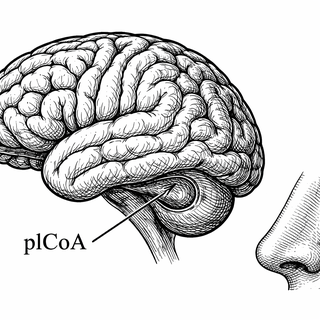
That gut-level "nope" (or conversely, that "ooh, yes please" when fresh cookies are involved) happens faster than you can consciously process. Scientists have long known the brain has built-in responses to certain smells, but the where and how remained fuzzy. Now, a team led by researchers at UC San Diego, the Salk Institute, and Columbia University has cracked open the smell-sorting machinery, and it turns out your brain is running a surprisingly tidy operation.
The Nose Knows, But Where Does It Go?
The star of this story is a brain region with a name that sounds like a rejected Harry Potter spell: the posterolateral cortical amygdala, or plCoA for short. This thumbnail-sized chunk of tissue sits at the crossroads of smell and emotion. It's part of your amygdala - yes, that amygdala, the one that gets blamed for everything from anxiety to why you ugly-cried during that dog food commercial.
What Howe and colleagues discovered is that the plCoA isn't just one homogeneous blob processing smells. It's geographically organized like a tiny strip mall where the stores at opposite ends sell completely different vibes. Stimulate the front of the plCoA? Mice run away like they've smelled a predator. Zap the back? They approach like they've caught a whiff of peanut butter - which, honestly, relatable.
A Tale of Two Projections
Here's where it gets elegant. The researchers didn't just map what happens when you artificially tickle different parts of the plCoA. They traced where the neurons in each zone actually send their signals. The anterior (front) neurons preferentially wire up to the medial amygdala, a region associated with defensive behaviors and avoidance. The posterior (back) neurons send their axons to the nucleus accumbens - the brain's reward center, the same area that lights up when you eat chocolate or win at a video game.
So the same brain region that receives smell information has pre-built highways leading to opposite behavioral destinations. It's like having one mail room that automatically routes love letters to one department and bills to another. No conscious sorting required.
Not About Individual Neurons Being "Good Smell" or "Bad Smell" Detectors
One of the more surprising findings: when the researchers recorded from individual neurons while mice sniffed various odors, they found the cells encoded what the smell was, not whether it was good or bad. In other words, your plCoA neurons aren't sitting around thinking "that's disgusting" or "that's delicious." They're more like neutral catalogers.
The valence - the goodness or badness - emerges from which population of catalogers gets activated and where their signals end up. It's a population code, not a labeled-line system. Think of it less like a switchboard operator saying "gross smell, connecting you to the rejection department" and more like a crowd of people simultaneously pointing in different directions, with the overall consensus determining where you go.
Why This Matters Beyond Mice and Smells
Sure, this was done in mice. But the olfactory amygdala is ancient, evolutionarily speaking. Smell is the only sense with a direct line to the amygdala and hippocampus - no pit stops at the thalamus required. That's why a whiff of your grandmother's perfume can teleport you back thirty years before you've even finished inhaling.
Understanding how innate smell responses are wired could eventually inform everything from anxiety disorders (which involve the amygdala going haywire) to understanding why certain smells trigger visceral, unlearned disgust - useful for everything from food safety to understanding phobias.
The research also hints at a broader principle: your brain may use similar geographic organization and divergent projection patterns for other types of automatic emotional responses. The plCoA might be a model system for understanding how the brain routes sensory information to appropriate behavioral outputs without needing conscious deliberation.
The Bottom Line
Your brain has a remarkably efficient system for turning "what is this smell" into "run away" or "get closer." The plCoA does this not by having special neurons for good or bad smells, but by organizing itself into zones with different downstream connections. It's less like a sophisticated AI making judgments and more like a well-designed highway system with clear exits for reward-seeking and danger-avoiding.
Next time you reflexively recoil from spoiled milk or lean into the scent of brewing coffee, you can thank your posterolateral cortical amygdala and its surprisingly orderly layout for keeping you safe and happy - one sniff at a time.
References
-
Howe JR, Chan CL, Lee D, et al. Control of innate olfactory valence by segregated cortical amygdala circuits. eLife. 2025;13:RP104677. DOI: 10.7554/eLife.104677 | PMID: 41870253
-
Root CM, Denny CA, Bhattarai JP, et al. The participation of cortical amygdala in innate, odor-driven behavior. Nature. 2014;515(7526):269-273. PMC4231015
-
Li Q, Bhattarai JP, et al. Aversion and attraction through olfaction. Curr Opin Neurobiol. 2015;34:120-127. DOI: 10.1016/j.conb.2015.02.007 | PMC4317791
-
Mori K, Sakano H. How is the olfactory map formed and interpreted in the mammalian brain? Annu Rev Neurosci. 2011;34:467-499.
Disclaimer: The image accompanying this article is for illustrative purposes only and does not depict actual experimental results, data, or biological mechanisms.