
For years, neuroscientists have been doing something slightly absurd: taking brain scans from a bunch of different people, smooshing all that data together, and declaring "this is how brains work." The result was something called the "average brain," which sounds scientific until you realize it's like averaging together everyone's faces and saying "here's what humans look like." Spoiler: nobody actually looks like that.
A new review in the Annual Review of Psychology describes how "precision fMRI" is changing the game. The basic idea is simple: stop pretending everyone's brain is organized the same way, because it really, really isn't. Your brain's network architecture is basically as individual as your fingerprint, except probably more so, and we've been accidentally ignoring this for decades.
The Great Averaging Swindle
Here's how traditional fMRI research typically works. You bring someone into a scanner, have them stare at things or do tasks for maybe 10 to 20 minutes, and collect your data. Then you do this with a bunch more people. Since no single person's data is reliable enough on its own (too much noise, not enough signal), you average everything together across dozens or hundreds of participants.
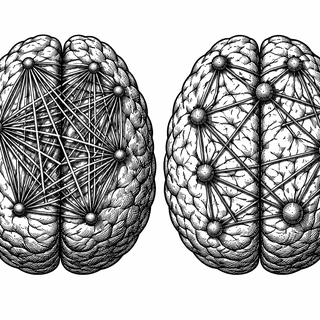
The logic seems sound. Average out the noise, and what's left should be the real signal, the common architecture that all human brains share. And to some extent, this works. We've learned a lot about which brain regions are generally involved in vision, movement, language, and so on.
But here's the catch: averaging emphasizes what's common and completely erases what's different. If your brain's visual network is organized slightly differently than the person next to you, that information vanishes into the statistical ether. Gone. Poof.
Why does this matter? Because those individual differences might be exactly what explains why some people are better at certain cognitive tasks, why some people develop depression and others don't, or why a treatment works for one patient and fails for another. We've been systematically throwing away the most interesting part of the data.
What If We Just... Scanned One Person a Lot?
The precision fMRI approach sounds almost too simple. Instead of scanning 100 people for 15 minutes each, what if you scanned one person for 100 sessions? Hours upon hours of data from a single individual, enough to map their specific brain's functional organization in exquisite detail.
When researchers actually did this, they discovered something that should have been embarrassing: brain networks look way more organized and detailed at the individual level than at the group level. The averaging wasn't revealing structure. It was hiding it. We had been accidentally blurring our own pictures.
Think of it like trying to understand how a city is organized by looking at a composite photo of 50 different cities stacked on top of each other. Sure, you might see that cities generally have streets and buildings, but you'd miss everything interesting about how any particular city actually works. That's essentially what group-averaged brain imaging was doing.
Your Wiring Diagram Is Not My Wiring Diagram
Perhaps the most striking finding from precision fMRI work is just how much the topography of major brain networks varies between individuals. The large-scale networks that neuroscientists have mapped over the years, things like the default mode network, the attention networks, the sensory networks, don't occupy exactly the same brain real estate in different people.
Sure, your motor cortex and my motor cortex are in roughly the same neighborhood. But the precise boundaries of functional regions, where one network ends and another begins, can be genuinely different between individuals. It's like two cities that both have a downtown area, but the streets are laid out differently in each.
This creates some real conceptual headaches for the field. If every brain is organized uniquely, what does it even mean to talk about "the" default mode network? How do we figure out which variations are meaningful and which are just noise? What's the difference between normal individual variation and something pathological?
The review digs into these questions and argues that we need new frameworks for thinking about brain organization. The old model, where we assumed one basic template that applies to everyone, is starting to look like an oversimplification that's been holding us back.
Why Your Doctor Should Care About This
Here's where things get practical. A lot of treatments for neurological and psychiatric conditions assume you can target specific brain networks. Transcranial magnetic stimulation for depression, for example, aims at particular regions that are supposed to be part of networks involved in mood regulation.
But if those networks are organized differently in every patient, then targeting the "standard" location might work great for some people and miss entirely for others. You'd be trying to hit a target that moves depending on whose brain you're looking at.
Precision imaging could enable genuinely personalized neurology. Map an individual patient's brain architecture first, then design treatments based on their specific organization rather than some fictional average. It's a shift from "here's how brains work" to "here's how your brain works."
The technology and methods are advancing rapidly. We're entering an era where "your brain is unique, and that actually matters for your medical care" isn't just a nice sentiment. It's becoming a practical reality. Turns out those individual differences we'd been averaging away were important after all. Who knew?
Reference: Gratton C, Braga RM. (2025). Dense Phenotyping of Human Brain Network Organization Using Precision fMRI. Annual Review of Psychology. doi: 10.1146/annurev-psych-032825-032920 | PMID: 41061168
Disclaimer: The image accompanying this article is for illustrative purposes only and does not depict actual experimental results, data, or biological mechanisms.