
When you search for something, like spotting your friend in a crowded bar, your brain creates a mental template of what you're looking for. But here's a question that has been bugging neuroscientists for years: what does that template actually look like inside your head? Is it like you're already sort of seeing your friend's face? Or is it something more abstract, like a checklist of features?
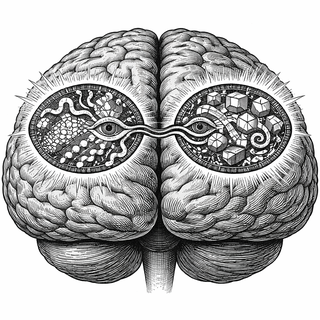
A study in eLife discovered something nobody expected: your brain keeps both versions. And you can wake up the sensory one with a well-timed visual flash.
Your brain keeps backup copies of search templates. Who knew?
The Format Wars That Weren't Really Wars
For years, researchers have argued about what format attentional templates take in the brain. Some experiments found templates that looked a lot like actual perception, as if imagining the target was almost like seeing it. Other experiments found abstract representations that didn't resemble sensory processing at all.
Both camps had solid data. Neither could fully explain what the other was finding. It was the kind of scientific stalemate that usually means everyone is partially right and the full story is more complicated than anyone realized.
The researchers in this study decided to settle things using fMRI, focusing specifically on isolating preparatory brain activity (what happens before you actually see the target) from stimulus-evoked activity (what happens when the target appears). They used an orientation cueing task, where people knew to look for lines tilted at a particular angle.
The Brain Is Playing It Cool
During preparation, before any target appeared, the team found decodable information about the to-be-attended orientation in visual cortex. The brain definitely had a template. But here's the twist: the pattern of activity during preparation was different from the pattern evoked when people actually perceived those orientations.
In other words, the preparatory template wasn't sensory-like. It was abstract. The brain knew what to look for, but it wasn't actively simulating seeing it. It's like having a description of your friend ("tall, red jacket, curly hair") rather than a mental photograph.
This makes a certain kind of sense. Holding a full sensory simulation constantly active would be metabolically expensive. An abstract representation might be cheaper to maintain while still being useful for guiding attention.
Then They Pinged the Brain
Here's where the study gets clever. The researchers introduced a visual "ping," a brief flash during the preparation period. Nothing special about the flash itself; it wasn't informative about the target.
But when they looked at brain activity after the ping, something remarkable happened. The activity patterns transformed. Suddenly, they looked much more like the patterns associated with actually perceiving the target orientations.
The sensory-like template was there all along. It just wasn't active. The perturbation woke it up.
It's like your brain keeps a dormant sensory simulation in the back pocket, ready to activate when something prompts it. The ping essentially said "get ready for real processing" and the abstract template shifted into sensory mode.
Why Would the Brain Bother With Two Templates?
Having both abstract and sensory representations during preparation might seem redundant, but it's actually pretty smart engineering.
The abstract template can support initial guidance, helping broadly select relevant information when it appears. It's lightweight, easy to maintain, and good enough for coarse filtering.
The sensory-like template can be engaged when finer processing is needed, when you really need to match incoming visual information against a detailed expectation. It's more powerful but also more expensive to run.
By keeping both available and switching between them strategically, the brain gets flexibility. It can cruise on autopilot with the abstract version, then shift into high gear with the sensory version when the situation demands.
This Predicted Actual Performance
This isn't just an interesting academic finding. The emergence of the sensory-like template after the ping coincided with enhanced connectivity between primary visual cortex (V1) and frontoparietal attention areas. The brain regions responsible for attention were more strongly linked to the earliest stages of visual processing.
And this connectivity pattern predicted better behavioral performance. People found targets faster and more accurately when the sensory template was active.
Two templates, used strategically, work better than one. The brain's dual-format approach isn't just elegant. It's functional.
What This Means for Understanding Visual Search
The finding helps explain why previous research produced such conflicting results. Depending on exactly when and how you measure, you might catch the brain in abstract mode or sensory mode. Different experimental designs biased toward different formats.
It also suggests that attention isn't a single thing that gets deployed uniformly. It's a flexible system with multiple modes of operation. Understanding these modes could have implications for everything from designing better visual interfaces to understanding attention disorders.
When someone has difficulty finding things visually, is the problem with the abstract template, the sensory template, or the switching between them? This framework gives researchers new questions to ask.
The Dormancy Question
One of the most intriguing aspects of this study is the dormancy of the sensory template. It was there, encodable, but not active until provoked. This raises questions about how much of what the brain knows is held in these latent states, ready to activate under the right conditions.
Memory researchers have found similar phenomena. Sometimes information is present in the brain but not accessible until the right retrieval cue comes along. The visual system might be doing something analogous: maintaining latent representations that aren't consuming resources until they're needed.
Your brain is more sophisticated than it lets on. It's not just running one search program. It's running a lightweight version continuously while keeping a heavyweight version on standby, ready to boot up when the stakes get real.
That's the kind of optimization that makes evolutionary sense. It's also the kind of thing that makes studying the brain endlessly surprising.
Reference: Chen Y, et al. (2025). Dual-format attentional template during preparation in human visual cortex. eLife. doi: 10.7554/eLife.103425 | PMID: 41160433
Disclaimer: The image accompanying this article is for illustrative purposes only and does not depict actual experimental results, data, or biological mechanisms.