
The brain is a notoriously secretive organ. It runs the entire show - your memories, your movements, that inexplicable craving for cheese at 2 AM - yet refuses to give up its secrets easily. Scientists have been trying to eavesdrop on neural conversations for decades, and the fundamental problem remains stubbornly consistent: the harder you look, the less you can see at once, and vice versa.
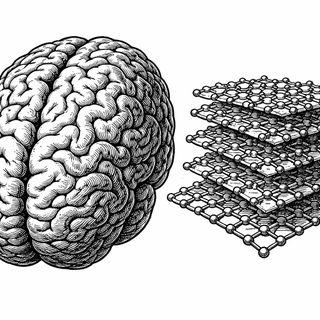
Enter a team of researchers from Yonsei University, Seoul National University, and several other institutions, who've essentially built a really, really fancy listening device out of something called molybdenum disulfide. If that sounds like the name of a spacecraft fuel, you're not far off - it's actually a material that forms layers just three atoms thick.
The Eavesdropping Problem
Traditional electrocorticography (ECoG) - the technique of placing electrodes directly on the brain's surface to record its electrical chatter - has always faced an annoying trade-off. You can either record from a large area and miss the fine details, or zoom in on tiny patches and lose the bigger picture. It's rather like being forced to choose between a satellite photo of your city or a detailed blueprint of your kitchen. Both are useful; neither is complete.
The issue comes down to wires. Each electrode needs its own connection back to the recording equipment, which means that cramming more electrodes onto a device creates an unwieldy mess of cables. The human cortex contains roughly 16 billion neurons in its thin outer layer alone. Trying to monitor all of them with current technology would require a cable bundle roughly the diameter of your head - rather defeating the purpose of minimally invasive recording.
Semiconductors to the Rescue
This is where molybdenum disulfide (MoS₂) becomes interesting. Unlike graphite's better-known cousin graphene, MoS₂ has a tuneable bandgap - a property that lets it switch between conducting and insulating states. This makes it ideal for building transistors, and transistors are the secret to solving the wiring problem.
The research team grew wafer-scale trilayer MoS₂ directly onto flexible polyimide substrates, creating 50 × 50 arrays of active transistors that can multiplex signals at about 20 nanoseconds per switch. In practical terms, this means 2,500 recording sites can share a dramatically reduced number of output wires, compressing what would otherwise be an impossible tangle into something manageable.
The result? A resolution of 51 pixels per square millimetre - roughly equivalent to having a 51-megapixel camera focused on a patch of brain the size of a postage stamp. Previous flexible arrays rarely exceeded 10 pixels per square millimetre. This is a substantial leap.
The Mouse Trials
Testing this on living mice (as one does in neuroscience), the team demonstrated their array could pick up auditory-evoked potentials - the brain's electrical response when the animal hears a sound. More impressively, they mapped tonotopic organisation, showing how different frequencies activate spatially distinct regions of the auditory cortex. They even captured localised multiunit activity, the rapid-fire signals from small clusters of neurons, at frequencies that standard ECoG arrays simply cannot resolve.
The megahertz-range bandwidth of the system means it can capture signals that flicker in and out faster than you can blink. Most neural processes worth studying occur at these timescales, which is precisely why conventional slow-sampling approaches miss so much.
Why This Matters Beyond the Lab
The brain-computer interface field has been making headlines with devices like the BISC chip, which packs 65,536 electrodes onto a single flexible substrate (ScienceDaily, 2025). These technologies aim to restore movement, speech, and even vision to people with paralysis or sensory loss. But all such efforts face the same bottleneck: how do you record enough neural information without turning the patient's head into a cable management nightmare?
The MoS₂ approach offers a compelling answer. By using active transistor arrays rather than passive electrodes, the device handles signal processing locally, reducing noise and the need for external wiring. The flexible substrate conforms to the brain's curved surface, reducing mechanical mismatch - a major cause of chronic inflammation and device failure in long-term implants (Nature, 2025).
Whether these arrays eventually find their way into clinical devices remains to be seen. The gap between mouse experiments and human applications is substantial, littered with regulatory hurdles and the general unpredictability of biology. But as a proof of concept, the work demonstrates that two-dimensional semiconductors aren't just laboratory curiosities. They might be precisely what neuroscience needs to finally get a clear signal from the brain's 86 billion neurons.
And the brain, for its part, will presumably continue doing whatever it likes - cheese cravings and all.
References
-
Xu D, Hong J, Zhao H, et al. Two-dimensional semiconductor-based active array for high-fidelity spatiotemporal monitoring of neural activities. Nature Materials. 2026;25(3):511-522. doi:10.1038/s41563-025-02430-4
-
Londoño-Ramírez H, et al. Multiplexed Surface Electrode Arrays Based on Metal Oxide Thin-Film Electronics for High-Resolution Cortical Mapping. Advanced Science. 2024. doi:10.1002/advs.202308507
-
Materials and devices for high-density, high-throughput micro-electrocorticography arrays. Device. 2024. Available at: ScienceDirect
-
Flexible high-density microelectrode arrays for closed-loop brain-machine interfaces: a review. Frontiers in Neuroscience. 2024. PMCID: PMC11057246
-
A wireless subdural-contained brain-computer interface with 65,536 electrodes and 1,024 channels. Nature Electronics. 2025. Available at: Nature
Disclaimer: The image accompanying this article is for illustrative purposes only and does not depict actual experimental results, data, or biological mechanisms.