
You know that feeling when you're standing in front of an open refrigerator at midnight, scanning the shelves like you're trying to solve a puzzle? Congratulations - you're foraging. And your brain is doing some seriously impressive math that you never asked it to do.
The Ancient Art of Not Starving
Here's the thing about foraging: every animal on Earth does it. From the tiniest nematode wriggling through soil to your neighbor Bob wandering the grocery store aisles, we're all just creatures trying to maximize calories while minimizing effort. It's basically economics, except the currency is "not dying," which really puts your stock portfolio into perspective.
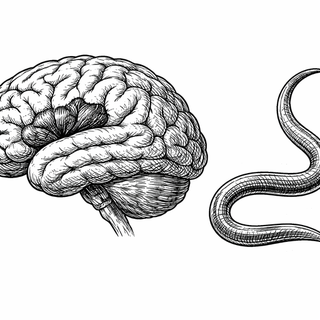
Emily Jane Dennis from the Janelia Research Campus and Ahmed El Hady from the Max Planck Institute have just published a comprehensive review that pulls together decades of foraging research into something neuroscientists can actually use (Dennis & El Hady, 2026). Their argument? Foraging isn't just about finding food - it's a window into how brains make decisions, period.
Your Brain Has a "Should I Stay or Should I Go" Calculator
The real star of foraging neuroscience is a brain region called the anterior cingulate cortex (ACC). Think of it as your brain's overly analytical friend who can't just enjoy a meal without calculating whether they should have ordered something else.
When you're at an all-you-can-eat buffet and the shrimp cocktail is running low, your ACC is doing rapid-fire calculations: "Is it worth walking back to the seafood station, or should I pivot to the pasta?" Research shows that neurons in this region literally fire more as resources deplete, building up to a threshold that screams "time to move on" (Strait et al., 2022).
This follows something called the marginal value theorem, which sounds like something an economist made up to ruin picnics. The idea is simple: animals should leave a depleting food patch when the rate of return drops to match the average reward rate of the entire environment. Your brain does this calculation automatically, probably while you're also wondering if you left the oven on.
The Great Debate: Learning vs. Counting
Here's where things get spicy (like the food you're theoretically foraging for). Scientists are currently duking it out over exactly how the brain tracks all this information.
One camp, led by researchers at NYU and the Allen Institute, argues that your brain learns action values through synaptic plasticity - basically rewiring itself based on what worked before (Pereira-Obilinovic et al., 2024). The other camp thinks neurons are doing continuous integration, adding up rewards and costs in real-time like some kind of biological spreadsheet.
The twist? Both models can explain the same behaviors. It's like two chefs using completely different recipes to make identical-tasting cookies. The neuroscience community is currently trying to figure out which grandmother's cookbook the brain is actually using.
Even Worms Have Food Opinions
If you think foraging is only interesting in creatures with actual faces, allow me to introduce you to C. elegans - a microscopic worm with exactly 302 neurons and surprisingly strong opinions about where to find bacteria to eat.
Researchers at the Salk Institute have been using these tiny creatures to understand how neural circuits handle foraging decisions (Haley & Chalasani, 2024). With so few neurons to study, scientists can actually trace every single connection, which is way easier than trying to map the 86 billion neurons in your skull that are currently deciding whether to keep reading this article.
Why Any of This Matters (Besides Being Cool)
The implications here extend well beyond where squirrels bury their acorns. Foraging decisions engage the same neural machinery we use for all kinds of choices: job hunting, apartment searching, or deciding when to swipe away from a disappointing dating app profile.
Recent work highlighted in Trends in Neurosciences argues that foraging provides an "ethological framework" for understanding decision-making in naturalistic settings (Grima et al., 2025). Translation: instead of studying brains in artificial lab tasks, we can learn more by watching how they evolved to solve actual survival problems.
There's even clinical relevance here. Disorders like depression and anxiety mess with effort-based decision-making - the calculations underlying whether it's worth getting off the couch to find food. Understanding the foraging brain might help us understand why lethargy feels so paralyzing in mood disorders.
The Buffet Table of Future Research
Dennis and El Hady are betting that foraging research will keep delivering insights by integrating across scales - from molecules to ecosystems, from worms to macaques to humans. New wireless recording technology means we can finally watch brains forage in the wild instead of just in boring lab chambers.
So the next time you find yourself wandering a farmer's market or excavating the back of your pantry for that one good snack, give your anterior cingulate cortex a little nod of appreciation. It's doing millions of years of evolutionary math so you don't have to think about it.
Though honestly, it could be faster about deciding what's for dinner.
References
-
Dennis, E. J., & El Hady, A. (2026). Neurobiology of Foraging: An Integrative Approach. Annual Review of Neuroscience. https://doi.org/10.1146/annurev-neuro-091724-040841
-
Grima, L. L., Haberkern, H., Mohanta, R., Morimoto, M. M., Rajagopalan, A. E., & Scholey, E. V. (2025). Foraging as an ethological framework for neuroscience. Trends in Neurosciences, 48(11), 877-890. https://doi.org/10.1016/j.tins.2025.08.006 | PMID: 41058420
-
Pereira-Obilinovic, U., Hou, H., Svoboda, K., & Wang, X. J. (2024). Brain mechanism of foraging: Reward-dependent synaptic plasticity versus neural integration of values. Proceedings of the National Academy of Sciences, 121(14). https://doi.org/10.1073/pnas.2318521121 | PMCID: PMC10998608
-
Haley, J. A., & Chalasani, S. H. (2024). C. elegans foraging as a model for understanding the neuronal basis of decision-making. Cellular and Molecular Life Sciences, 81(1), 252. https://doi.org/10.1007/s00018-024-05223-1 | PMCID: PMC11335288
-
Strait, C. E., Sleezer, B. J., & Hayden, B. Y. (2022). Rat Anterior Cingulate Cortex Continuously Signals Decision Variables in a Patch Foraging Task. Journal of Neuroscience, 42(29), 5730-5743. https://doi.org/10.1523/JNEUROSCI.0587-21.2022 | PMCID: PMC9302469
Disclaimer: The image accompanying this article is for illustrative purposes only and does not depict actual experimental results, data, or biological mechanisms.