
Turns out, your neurons really enjoy a good trip. Not in a "whoa, look at the colors" kind of way, but in a "let's grow some new branches and make friends" kind of way. Researchers in Germany just gave lab-grown human brain cells a dose of psilocin - the stuff your liver makes when you eat magic mushrooms - and what happened next has some pretty wild implications for treating depression.
Mini-Brains in a Dish (Yes, Really)
Here's the thing: we've known for a while that psychedelics do something to the brain. Mouse studies have shown increased neural connections, clinical trials are showing depression lifting like morning fog, and people keep reporting that their brains feel "reset." But actually watching what happens inside human neurons? That's been tricky, because (shockingly) people aren't keen on donating brain samples mid-trip.
Enter induced pluripotent stem cells, or iPSCs - basically a scientific cheat code. Researchers at the German Cancer Research Center took skin cells, rewound them to a stem cell state, then coaxed them into becoming actual human cortical neurons. Same genetic makeup as a human brain, no skulls required.
The Neurons Got Busy
When the team exposed these lab-grown neurons to psilocin, things got interesting fast. The cells cranked up production of BDNF - brain-derived neurotrophic factor - which is essentially Miracle-Gro for your nervous system. BDNF is a big deal: it helps neurons survive, encourages new connections, and is basically the VIP pass for learning and memory.
But here's what makes this study stand out from the pile: they showed the whole cascade in human neurons. Psilocin binds to the 5-HT2A serotonin receptor (the main molecular target of psychedelics), which kicks off a chain reaction involving protein kinase C and some receptor recycling. The result? More BDNF, more synaptic proteins, and neurons that looked like they'd been hitting the gym.
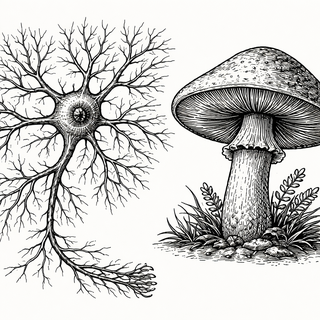
The cells literally grew more complex. More dendritic branches. More connection points. And when the researchers measured electrical activity, these treated neurons were chattier - firing more and talking to each other with increased enthusiasm.
Why This Actually Matters
Depression isn't just "feeling sad." At the cellular level, there's evidence that synaptic connections wither - neurons pull back from their neighbors like introverts at a loud party. The prefrontal cortex, which handles emotional regulation and decision-making, shows reduced connectivity in people with depression.
Psychedelics appear to reverse this. A single dose of psilocybin has been shown to increase dendritic spine density in mice that lasts for weeks. Clinical trials are showing depression remission persisting for years after just one or two sessions. And just this year, COMPASS Pathways announced their Phase 3 trial for treatment-resistant depression hit its primary endpoint.
This German study adds a crucial piece to the puzzle: proof that the same neuroplastic effects seen in rodents actually happen in human neurons too.
The Fine Print
Before you start foraging, some caveats. Neurons in a dish aren't the same as neurons in a skull. They lack the full orchestra of supporting cells, blood supply, and the complex circuitry of an actual brain. And the "optimal" dose and timing for humans is still very much under investigation.
But the direction is clear. Psilocin doesn't just temporarily scramble perception - it appears to prime human neurons for rewiring. It creates what the researchers call "a state of enhanced neuronal plasticity." Think of it as opening a window that's usually stuck shut, giving the brain a chance to rearrange its furniture.
For the millions of people with treatment-resistant depression, that window can't open soon enough.
References
-
Schmidt M, et al. Psilocin fosters neuroplasticity in iPSC-derived human cortical neurons. eLife. 2025. DOI: 10.7554/eLife.104006 | PMID: 41891829
-
Vargas MV, et al. Psychedelics promote neuroplasticity through the activation of intracellular 5-HT2A receptors. Science. 2023. DOI: 10.1126/science.adf0435
-
Cao D, et al. Identification of 5-HT2A receptor signaling pathways associated with psychedelic potential. Nature Communications. 2023. DOI: 10.1038/s41467-023-44016-1
-
Shao LX, et al. Psilocybin promotes neuroplasticity and induces rapid and sustained antidepressant-like effects in mice. Neuropsychopharmacology. 2024. PMID: 38680011
-
Miranda M, et al. Brain-Derived Neurotrophic Factor: A Key Molecule for Memory in the Healthy and the Pathological Brain. Frontiers in Cellular Neuroscience. 2019. DOI: 10.3389/fncel.2019.00363
Disclaimer: The image accompanying this article is for illustrative purposes only and does not depict actual experimental results, data, or biological mechanisms.