
Everyone knows sleep is important. Pull an all-nighter and you feel like garbage. Sleep well and you're a functioning human again. But what's actually happening in there? Turns out your brain is running an elaborate cleaning operation, and according to a study in PNAS, the deep sleep crew uses completely different equipment than the light sleep crew. Same building, totally different janitorial strategies.
The Brain's Plumbing Problem
Your brain produces waste constantly. All that thinking and remembering and trying to figure out what to have for dinner generates molecular garbage. Unlike the rest of your body, your brain doesn't have a traditional lymphatic system to haul away the trash. Instead, it uses cerebrospinal fluid (CSF), the clear liquid that surrounds your brain and spinal cord.
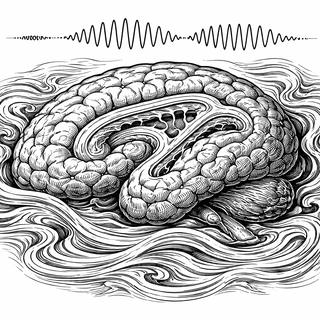
During sleep, this fluid flows through your brain tissue, picking up waste products and carrying them away. It's like a slow-motion power wash for your neurons. The system even has a catchy name: the glymphatic system (a mashup of "glial cells" and "lymphatic").
But here's what nobody had really pinned down: does this cleaning happen the same way all night, or does it change depending on how deeply you're sleeping?
Watching Brain Juice Slosh Around While People Snooze
The researchers used a clever combination of techniques: sparse-functional MRI to track cerebrospinal fluid movement, plus polysomnography (the whole sleep-monitoring setup with electrodes all over your head) to monitor brain waves simultaneously. This let them ask: when the brain does this particular electrical thing, what's happening with the fluid?
What they found was that different sleep stages have completely different plumbing dynamics.
Deep Sleep: The Power Wash Cycle
During slow-wave sleep (the really deep stuff), the brain waves called slow waves and sleep spindles were associated with short-cycle, frequent, and moderate CSF fluctuations. Picture a rhythmic pulsing, like a pressure washer that fires in quick, regular bursts. The fluid moves in and out in a steady, rapid rhythm.
The frequency of these CSF signals was significantly faster during deep sleep compared to lighter sleep stages. It's not just more cleaning during deep sleep; it's a fundamentally different cleaning pattern.
Light Sleep: Different Plumbing Entirely
Light sleep told a different story. The CSF movements were slow, infrequent, and steep. Instead of quick rhythmic pulses, you get occasional large waves. And during REM sleep (when you're dreaming), the fluid dynamics changed again, now linked to the rapid eye movements and distinctive "sawtooth" brain waves that characterize that stage.
Each sleep stage isn't just a deeper or lighter version of the same thing. They're qualitatively different modes of operation, complete with their own fluid dynamics.
Why "Eight Hours" Might Not Be Enough
Here's where this gets personally relevant. If deep sleep has its own special cleaning mode, then sleep quality matters as much as quantity. Six hours of solid deep sleep might do more cleaning than eight hours of fragmented, shallow sleep.
This could explain why some nights you sleep "enough" hours but still wake up feeling foggy. If you spent the night skimming along in light sleep without much deep sleep, your brain never got to run its intensive cleaning cycle. The night shift showed up but couldn't access the heavy equipment.
The Memory Connection
The brain regions recruited during deep sleep CSF dynamics weren't random. They overlapped with memory circuits and homeostatic systems, which fits with what we know about deep sleep's role in memory consolidation and restoration.
So deep sleep might be doing double duty: consolidating your memories while also clearing out metabolic waste. It's like reorganizing your files while also taking out the recycling. Efficient, but both need to happen.
Why This Matters for More Than Sleep Tips
Understanding how the brain cleans itself could have implications for neurodegenerative diseases. Alzheimer's disease, for instance, involves accumulation of proteins that the brain normally clears. If we understand how the cleaning system works, we might eventually figure out how to keep it working better for longer.
For now, the practical takeaway is what your grandmother probably already told you: get good sleep, and not just "enough" sleep. Your brain's deep cleaning cycle is waiting, and it apparently has very specific ideas about how to do its job.
Reference: Uji M, et al. (2025). Human deep sleep facilitates cerebrospinal fluid dynamics linked to spontaneous brain oscillations and neural events. PNAS. doi: 10.1073/pnas.2509626122 | PMID: 41055981
Disclaimer: The image accompanying this article is for illustrative purposes only and does not depict actual experimental results, data, or biological mechanisms.