
Somewhere in a neuroscience lab, a researcher is staring at a monkey and thinking: "I really need to read your brain right now, but I am absolutely not shaving your head."
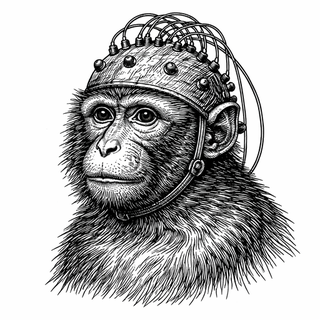
This, believe it or not, is a genuine scientific problem. Non-invasive brain monitoring - the kind where you stick electrodes on a scalp and listen to neurons chat - has a mortal enemy, and it's not funding cuts or broken equipment. It's hair. Dense, unyielding, signal-blocking hair. And until now, the solution has been about as elegant as you'd expect: break out the razor.
The Hairy Situation
Here's the deal. Electroencephalography (EEG) works by detecting the tiny electrical whispers that your neurons produce when they fire. We're talking microvolts here - signals so faint that a bad electrode connection turns your data into meaningless static. Traditional setups require conductive gel smooshed between an electrode and the scalp, and ideally, that scalp should be as smooth as a bowling ball.
For humans in clinical settings, a quick shave is annoying but manageable. For lab animals? Not so much. Shaving stresses the animal, alters skin physiology, and in many scenarios (like long-term behavioral studies where you need the same monkey to show up chill and cooperative for months), it's simply not an option. It's like asking someone to get a fresh buzzcut every time they want to check their email.
The field has tried workarounds - dry electrodes with tiny pins, semi-dry sponge systems, even paintable biogels that solidify on the scalp. Each gets closer to the dream of "just stick it on and go," but none have quite nailed the trifecta: penetrate the hair, stick to the skin, and actually pick up clean signals.
Enter the HAAT Gel (Yes, That's Its Real Name)
A team led by Nan Liu has built what might be the most cleverly engineered hair gel since the 1980s - except this one reads minds. They call it the HAAT interface, which stands for Hair-Adaptable and Adhesion-Tunable. (Scientists: terrible at naming things, but great at acronyms that technically work.)
The secret sauce is a copolymer with a name only a chemist could love: poly(sodium thioctate-co-sulfobetaine methacrylate). Let's break that down into human language. The "sodium thioctate" part provides dynamic covalent bonds - chemical connections that can form, break, and reform on demand. Think of them as molecular Velcro. When the gel is heated, these bonds loosen up, letting the material flow like honey through even the densest fur. Once it cools down and settles against skin, the bonds tighten, locking the gel into a conformal coating that hugs every microscopic contour of the scalp.
The "sulfobetaine methacrylate" half handles the electrical side. These zwitterionic molecules (carrying both positive and negative charges, because apparently commitment issues exist at the molecular level) create ionic highways that shuttle brain signals from skin to electrode with remarkably low impedance.
The result? A gel that can worm through thick animal fur, glue itself to the scalp beneath, conduct neural signals cleanly, and then - here's the party trick - detach painlessly on demand when you add a mild reducing agent. No ripping, no residue, no traumatized research subjects.
So Does It Actually Work?
The team tested their creation across the full spectrum of scalp furriness: mice (dense and fine), monkeys (coarse and thick), and humans (variable, as any barber will confirm). In all cases, the HAAT electrodes matched or outperformed commercial alternatives in signal quality, even at the low frequencies where EEG data lives.
The real showstopper was the monkey experiment. The researchers recorded event-related potentials - those sharp electrical blips that appear when the brain notices something interesting - while monkeys performed vision-attention tasks. These ERPs, including the classic P300 component that fires around 300 milliseconds after a surprising stimulus, came through crisp and clean. No shaving required. The monkeys presumably had no complaints.
Why Should You Care?
This isn't just about keeping lab animals well-groomed. Non-invasive brain-computer interfaces are one of the hottest areas in neuroscience, with applications ranging from controlling prosthetic limbs to diagnosing neurological disorders. But all that potential hinges on being able to record brain signals reliably, comfortably, and for extended periods. Every advance in electrode-skin interfaces - from adhesive wearable sensors to this new HAAT system - brings us closer to a future where monitoring your brain is as casual as checking your heart rate on a smartwatch.
For animal cognition research specifically, removing the shaving requirement is a game-changer. It means less stress on subjects, faster experimental setups, and the ability to study species that were previously off-limits because nobody wanted to (or could) shave them. Imagine EEG studies on cats. (Actually, maybe don't imagine that. Nobody is shaving a cat and living to publish the results.)
The gap between brain and machine just got a little smaller - and this time, nobody lost any hair over it.
References
-
Yang, L., Chen, M., Qi, J., Hu, W., Wang, S., Wu, Y., Song, D., Xing, D., & Liu, N. (2026). Conformal and adhesive gel for stable electrophysiology on hairy animals without shaving. Nature Communications. DOI: 10.1038/s41467-026-70093-z
-
Wang, C., Wang, H., Wang, B., Miyata, H., Wang, Y., Nayeem, M.O.G., Kim, J.J., Lee, S., Yokota, T., Onodera, H., & Someya, T. (2022). On-skin paintable biogel for long-term high-fidelity electroencephalogram recording. Science Advances, 8(20). DOI: 10.1126/sciadv.abo1396 | PMCID: PMC9122322
-
Zhang, A., Shyam, A.B., Cunningham, A.M., Williams, C., Brissenden, A., Bartley, A., Amsden, B., Docoslis, A., Kontopoulou, M., & Kabiri Ameri, S. (2023). Adhesive wearable sensors for electroencephalography from hairy scalp. Advanced Healthcare Materials, 12(23). DOI: 10.1002/adhm.202300142
-
Wang, S., Song, X., Song, X., Gu, Y., Cong, Z., Shen, Y., & Yu, L. (2026). Non-invasive brain-computer interfaces: Converging frontiers in neural signal decoding and flexible bioelectronics integration. Nano-Micro Letters. DOI: 10.1007/s40820-025-02042-2 | PMCID: PMC12791105
Disclaimer: The image accompanying this article is for illustrative purposes only and does not depict actual experimental results, data, or biological mechanisms.