
Picture this: tiny cells in your brain are constantly patrolling the neighborhood, hunting down dead neurons, cleaning up debris, and occasionally reshaping your neural connections. Now imagine scientists can steer these cells around like microscopic RC cars using nothing but light. That's not science fiction - that's what researchers just pulled off in zebrafish brains.
Meet Your Brain's Janitorial Staff
Microglia are the immune cells of your central nervous system, and they're absolute workaholics. In their "surveillance mode," they extend and retract branch-like processes continuously, sampling the brain environment like overeager quality control inspectors who can't sit still. When they detect something wrong - say, a dying neuron or an injury - they switch gears, morph into a more mobile shape, and race to the scene to gobble up the problem.
The thing is, we've known microglia do all this for years. What we haven't fully understood is how they switch between these different behaviors. Are they getting conflicting memos? Running on autopilot? Taking suggestions from middle management?
The Molecular Motor Behind the Magic
A team led by researchers at the University of Zurich decided to crack this code using zebrafish - whose transparent brains make them the perfect subjects for watching cellular drama unfold in real time. What they found was elegantly simple: myosin II, a molecular motor protein that generates cellular contractility, acts as the master switch controlling whether microglia survey, migrate, or eat.
Think of myosin II as the cell's internal tension cable system. When it contracts, it can squeeze and pull different parts of the cell, changing its shape and behavior. The researchers discovered that this single mechanism governs the transitions between all of microglia's major jobs - from calmly extending branches to scope out the territory, to packing up and relocating, to engulfing dead cells.
Hijacking the System with Light
Here's where it gets wild. Armed with this knowledge, the team engineered an optogenetic tool they call "opto-ArhGEF25." Optogenetics - the technique that won headlines as "method of the year" in 2010 - involves inserting light-sensitive proteins into cells so researchers can control them with precision using targeted illumination.
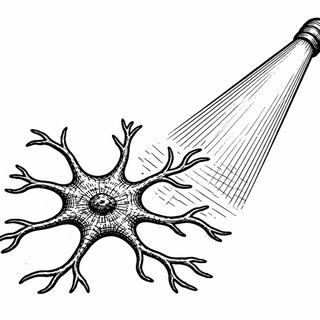
Their new tool activates RhoA, a signaling protein that cranks up myosin II activity. Shine light on one side of a microglial cell, and that side contracts. The result? The cell gets squeezed and pushed in the opposite direction - away from the light source. It's like cellular crowd control with a flashlight.
The researchers could literally override a microglial cell's natural instincts. When they created an injury in the zebrafish brain (the normal "come hither" signal for microglia), they could shine their light and force the cells to ignore the injury entirely, sending them scurrying the other way instead. It's the cellular equivalent of a security guard being told to leave a break-in because someone turned on a really compelling lamp elsewhere.
Why This Matters Beyond Cool Party Tricks
This isn't just about making cells do the locomotion on command. Microglia are increasingly recognized as key players in neurodegenerative diseases like Alzheimer's, Parkinson's, and ALS. When microglia malfunction - either becoming overactive and attacking healthy tissue, or becoming sluggish and failing to clear toxic debris - bad things happen to brains.
Current therapeutic approaches are somewhat blunt instruments. What if you could precisely dial microglial activity up or down in specific brain regions? What if you could redirect rogue microglia away from healthy synapses they're mistakenly pruning? What if you could summon the cleanup crew more efficiently to clear amyloid plaques?
This research provides the first demonstration that you can reversibly puppet microglial behavior with spatial and temporal precision in a living brain. The tool works in both directions - the same system that repels cells from light could potentially be engineered to attract them toward it.
The Road from Fish to Human
Zebrafish and humans share more neurobiology than you might expect, but there's obviously a long way between these proof-of-concept experiments and clinical applications. Still, the fundamental mechanisms - myosin II, RhoA signaling, microglial surveillance behaviors - are conserved across vertebrates.
The more immediate applications might be in research itself. Having a tool that can precisely manipulate microglial behavior in living tissue means scientists can finally test decades of hypotheses about what these cells actually do during development, injury, and disease - with the ability to hit "undo" and try again.
For now, we've learned that the brain's cleanup crew runs on a surprisingly simple operating system. And someone just figured out the admin password.
References
-
Biermeier, C.M., Albert, M., Pal, A.A., et al. (2026). Optogenetic mediated contractility enables reversible control of microglial morphology and migration in vivo. Cell Reports. DOI: 10.1016/j.celrep.2026.117150
-
Vicente-Manzanares, M., Ma, X., Adelstein, R.S., & Horwitz, A.R. (2009). Non-muscle myosin II takes centre stage in cell adhesion and migration. Nature Reviews Molecular Cell Biology. https://www.nature.com/articles/nrm2786
-
De Dios, L., et al. (2024). The ins and outs of microglial cells in brain health and disease. Frontiers in Immunology. https://www.frontiersin.org/journals/immunology/articles/10.3389/fimmu.2024.1305087/full
-
Gao, Y., et al. (2025). Biomarkers and therapeutic strategies targeting microglia in neurodegenerative diseases: current status and future directions. Molecular Neurodegeneration. https://link.springer.com/article/10.1186/s13024-025-00867-4
-
Deisseroth, K. (2011). Optogenetics: Controlling the Brain with Light. Scientific American. https://www.scientificamerican.com/article/optogenetics-controlling/
Disclaimer: The image accompanying this article is for illustrative purposes only and does not depict actual experimental results, data, or biological mechanisms.