
Here's something nobody warns you about getting old: your nose will eventually betray you. More than 75% of people over 80 have significant smell loss, and it turns out the reason might be microscopic drama happening inside your neurons. A new study in fruit flies just caught the culprit red-handed - and honestly, the plot twist is pretty wild.
The Setup: Mitochondria Having a Midlife Crisis
Your neurons are full of mitochondria - those "powerhouse of the cell" organelles you memorized in high school and promptly forgot. But here's what they didn't teach you: mitochondria are divas. They accumulate damage over time, their proteins get misfolded, and they start producing nasty reactive oxygen species like tiny cellular arsonists.
Normally, your cells have a cleanup system called the mitochondrial unfolded protein response (UPRmt). Think of it as an emergency repair crew that springs into action when mitochondria go haywire. The UPRmt activates a whole army of molecular chaperones and antioxidant enzymes to fix the mess.
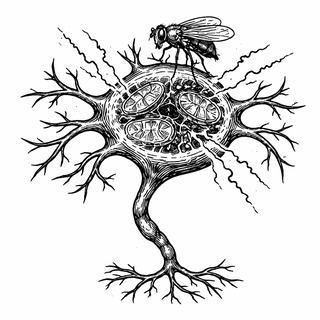
The problem? As you age, this repair crew gets progressively more incompetent. And researchers from Chile just figured out why.
The Villain: An Overzealous Epigenetic Editor
The study, published in eLife, found that a protein called dSetdb1 is basically vandalizing your DNA's instruction manual with age. Specifically, it's adding chemical tags called methyl groups to a histone protein (H3K9 trimethylation, for the nerds in the room), which effectively locks down access to the genes your cells need to mount that emergency repair response.
Imagine your mitochondria are sending out distress signals, but someone keeps changing the locks on the emergency exits. That's what H3K9 trimethylation does to your neurons - it compacts the chromatin so tightly that the rescue transcription factors literally can't get to the genes they need to activate.
Francisco Muñoz-Carvajal and colleagues at Universidad Mayor showed this happening in real-time in Drosophila (fruit flies, the unsung heroes of neuroscience). Their olfactory neurons progressively lost the ability to smell as they aged, and when the team looked inside those neurons, they found mitochondria that were morphologically abnormal and spewing reactive oxygen species everywhere.
The Plot Twist: Reversing the Damage
Here's where it gets genuinely exciting. When the researchers knocked down dSetdb1 specifically in the olfactory neurons of aged flies, something remarkable happened: the UPRmt snapped back to attention. The mitochondria started looking healthy again. The neurons stopped dying.
And the flies could smell again.
Let that sink in. By removing this one epigenetic modifier, they essentially reversed age-related neurodegeneration. The aged flies' olfactory function was restored to something approaching youthful levels.
Why This Matters Beyond Bug Noses
This isn't just about flies forgetting what rotting fruit smells like. Research at Johns Hopkins has shown that smell loss in humans is a predictive marker for frailty and unhealthy aging. Even more concerning, about 90% of people with early-stage Parkinson's disease and over 80% of those with Alzheimer's show olfactory dysfunction - often years before other symptoms appear.
The connection between epigenetics, mitochondrial function, and neurodegeneration appears to be deeply conserved across species. A separate 2024 mouse study (DOI: 10.1101/2024.07.24.604929) showed that complete loss of H3K9me3 leads to accelerated aging across multiple organs, with median lifespan cut dramatically short. So the balance has to be just right - too much methylation locks down protective responses, too little and everything falls apart.
The human equivalent of dSetdb1 is SETDB1, which is highly expressed in developing brains and already implicated in several neuropsychiatric conditions. Targeting it therapeutically won't be straightforward - you'd need to reduce its activity specifically in aging neurons without disrupting its essential roles elsewhere.
The Bigger Picture
What this study elegantly demonstrates is that aging isn't just passive wear and tear. It's an active process where specific molecular players are progressively sabotaging your cellular defenses. The UPRmt is sitting there, ready to help, but epigenetic changes are literally locking it out.
The good news? Active processes can potentially be intervened upon. If we can find ways to modulate H3K9 methylation status in aging neurons - without throwing everything else out of whack - we might be able to help cells maintain their stress responses well into old age.
For now, though, maybe be a little more patient with Grandpa when he can't smell the cookies burning. His neurons are dealing with some seriously complicated molecular politics.
References:
-
Muñoz-Carvajal F, Sanhueza N, Sanhueza M, Court FA. Age-dependent H3K9 trimethylation by dSetdb1 impairs mitochondrial UPR leading to degeneration of olfactory neurons and loss of olfactory function in Drosophila. eLife. 2025. DOI: 10.7554/eLife.103118. PMID: 41885373.
-
Muñoz-Carvajal F, Sanhueza M. The Mitochondrial Unfolded Protein Response: A Hinge Between Healthy and Pathological Aging. Front Aging Neurosci. 2020;12:581849. DOI: 10.3389/fnagi.2020.581849. PMCID: PMC7518384.
-
Griñán-Ferré C, et al. Loss of H3K9 trimethylation leads to premature aging. bioRxiv. 2024. DOI: 10.1101/2024.07.24.604929. PMCID: PMC11291141.
-
Sun Q, et al. Epigenetic mechanism of SETDB1 in brain: implications for neuropsychiatric disorders. Transl Psychiatry. 2020;10:115. DOI: 10.1038/s41398-020-0797-7.
Disclaimer: The image accompanying this article is for illustrative purposes only and does not depict actual experimental results, data, or biological mechanisms.