
Your brain is lying to you. Not about the big stuff - your memories of that embarrassing thing you said in 2009 are probably accurate enough. No, it's been lying about what scientists call "neural noise" - all that random fizzing and popping happening in your neurons right now. For decades, neuroscientists treated this variability like static on an old TV set: annoying interference that obscures the "real" signal. Turns out, your brain might actually be running on that static.
The Beautiful Mess Inside Your Head
Here's what we used to think: neurons fire in predictable patterns, and anything that deviates from those patterns is basically biological garbage. Random fluctuations? Noise. Unpredictable responses to identical stimuli? More noise. Scientists built elegant models that smoothed over all this messiness, treating it as a nuisance to be mathematically eliminated.
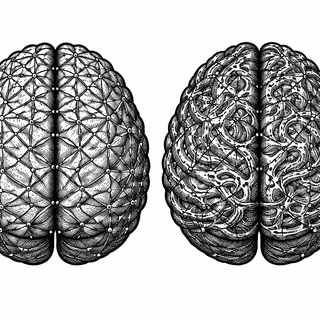
But a new review by Rentzeperis and colleagues argues we've been thinking about this all wrong. That "noise" isn't your brain malfunctioning - it's your brain being clever. Evolution didn't accidentally leave random variability in neural systems like some cosmic manufacturing defect. It built it in, and for good reasons.
Think of it this way: if your brain operated like a precisely engineered Swiss watch, every identical input would produce an identical output. Sounds efficient, right? Except the world isn't a laboratory. It's messy, unpredictable, and constantly throwing curveballs. A rigid, noise-free brain would be like a GPS that can only handle one route - great until there's construction.
When Randomness Actually Helps
This is where things get wonderfully weird. There's a phenomenon called stochastic resonance that sounds like something a philosophy major made up at 3 AM, but it's real and your neurons might be using it right now. Here's the gist: sometimes adding more noise to a system actually helps detect weaker signals (McDonnell & Abbott, 2009).
Imagine you're trying to hear someone whisper across a crowded room. Logic says less background chatter would help. But in certain conditions, a moderate amount of ambient noise can actually push those whisper-level signals over your detection threshold. It's counterintuitive enough to make your head hurt - which is fitting, since it's happening inside your head.
Research from the Max Planck Institute found that people who could better regulate their neural variability performed better on cognitive tasks. When asked to detect visual targets, their neural "noise" actually increased. When they needed to avoid mistakes, it decreased. The brain isn't just tolerating randomness; it's dialing it up and down like a volume knob depending on what the situation demands (Garrett et al., 2021).
Building Brains Without a Blueprint
The review also tackles a mind-bending implication: variability might be how brains develop in the first place. Think about the genetic instructions needed to wire up 86 billion neurons. That's a lot of data. But what if you didn't need to specify every single connection? What if you could let controlled randomness do some of the heavy lifting?
This is exactly what happens during brain development. Instead of following a rigid blueprint, neurons grow and form connections through processes that embrace variability. Self-organization - where complex patterns emerge from simple rules plus randomness - reduces the genetic information required to build a working brain. It's like the difference between writing a novel word by word versus setting up conditions where a compelling story naturally unfolds.
A recent review on harnessing neural variability for brain stimulation (Miniussi & Bortoletto, 2025) argues this same principle applies to brain therapies. Instead of trying to suppress variability in patients, maybe we should work with it, tailoring treatments to individual neural patterns rather than forcing everyone into the same box.
What This Means for Brain Science
The authors aren't just saying "noise is fine, actually." They're making a more radical argument: we need to stop modeling variability as random garbage and start treating it as mechanistically meaningful. Current computational models basically vacuum up all the unpredictable stuff into a "noise" category. The proposal here is to replace that catch-all term with actual mechanisms - understanding why variability happens and what it accomplishes.
This shift is already happening in sensory neuroscience, where "noisy, unreliable neurons" have been reconceptualized as sophisticated statistical processors. Similar advances are underway in understanding brain development and plasticity. Generative models - which focus on the principles producing variability rather than just averaging it away - could accelerate this trend (PMC on Generative Models).
The Takeaway
Your brain isn't a computer that occasionally glitches. It's a system that evolved to exploit randomness for flexibility, robustness, and efficiency. That mental fuzziness when you're tired? Might be your brain adjusting its variability levels. That moment of sudden clarity? Possibly stochastic resonance giving a weak signal a boost.
The next time someone accuses you of being scatterbrained, you can explain that you're not unreliable - you're adaptively variable. Whether they'll buy it is another matter, but at least you'll have neuroscience on your side.
References
-
Rentzeperis I, Li J, Bauer R, van Leeuwen C. Opening the black box of neural variability: from noise to mechanisms. Neuroscience and Biobehavioral Reviews. 2026. DOI: 10.1016/j.neubiorev.2026.106661. PMID: 41881182
-
Miniussi C, Bortoletto M. Harnessing neural variability: Implications for brain research and non-invasive brain stimulation. Neuroscience & Biobehavioral Reviews. 2025;176:106312. DOI: 10.1016/j.neubiorev.2025.106312. PMID: 40752783
-
McDonnell MD, Abbott D. What is stochastic resonance? Definitions, misconceptions, debates, and its relevance to biology. PLoS Computational Biology. 2009;5(5):e1000348. PMCID: PMC2660436
-
Garrett DD, et al. How the "noise" in our brain influences our behavior. Max Planck Institute for Human Development. 2021. Available from: ScienceDaily
-
Breakspear M. Dynamic models of large-scale brain activity. Nature Neuroscience. 2017;20(3):340-352. Related overview: Generative Models of Brain Dynamics
Disclaimer: The image accompanying this article is for illustrative purposes only and does not depict actual experimental results, data, or biological mechanisms.