
You know that feeling when you order your favorite pizza and... nothing? No excitement, no anticipation, just a hollow "I guess I'll eat" vibe? That's anhedonia knocking at your door, and it turns out this party-crasher is way more complicated than scientists originally thought.
What the Heck Is Anhedonia, Anyway?
Back in 1896, a French psychologist named Théodule-Armand Ribot coined the term "anhedonia" to describe the inability to experience pleasure. Simple enough, right? Except the brain, being the overcomplicating drama queen it is, said "hold my neurotransmitters."
Modern researchers now recognize that anhedonia isn't just about failing to enjoy things - it's a triple threat. There's consummatory anhedonia (not enjoying the pizza while eating it), anticipatory anhedonia (not getting excited about the pizza coming), and deficits in reward learning (forgetting that pizza has ever made you happy in the first place). Your brain basically has three different ways to ruin pizza night, which feels unnecessarily cruel.
Enter the Math Nerds: Computational Models to the Rescue
A new scoping review by Singh and colleagues just dropped a comprehensive analysis of 37 studies trying to crack the anhedonia code using computational models. Their weapon of choice? Reinforcement learning - basically the same math that teaches robots to play video games, except here it's modeling how your brain learns what feels good.
Here's the thing: reinforcement learning has been the golden child of computational psychiatry for years. The idea is elegant. Your brain is constantly making predictions about rewards, and when reality differs from expectation, dopamine neurons fire off what's called a "reward prediction error." It's your neural system going "Oh! That was better/worse than expected!" and updating accordingly.
But the review reveals an awkward truth: RL models, while great at capturing some aspects of anhedonia, completely whiff on anticipation and motivation. It's like trying to understand why someone doesn't want to go to a party using only data from how they behaved once they got there. You're missing half the story.
The Brain's Reward Circuit: A Dysfunctional Family
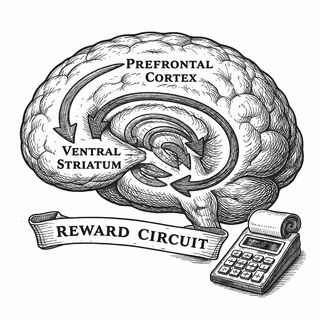
The ventral striatum, prefrontal cortex, and their dopamine-soaked connections form what neuroscientists call the reward circuit. In people with anhedonia, neuroimaging studies show this system running on low power. The striatum underperforms during reward anticipation, while the prefrontal cortex acts wonky during actual pleasure experiences. It's like having a car where the engine sputters when you're excited about driving but also when you're actually on the road.
What makes Singh's review particularly valuable is its honesty about the field's limitations. Most computational models of anhedonia demonstrate what's called "face validity" - they look reasonable on paper. But predictive validity? Knowing whether someone will actually experience anhedonia based on their model parameters? That's still largely a pipe dream.
Why Should You Care About Robot Math Applied to Sad Brains?
Because anhedonia predicts bad outcomes. People with this symptom have more severe depression, higher suicide risk, and don't respond as well to standard antidepressants. SSRIs, the go-to pills for depression, are particularly lousy at treating anhedonia - probably because they target serotonin while anhedonia seems more tied to dopamine and the reward system.
The good news? Understanding the computational architecture of anhedonia opens doors to better treatments. Newer medications like ketamine, bupropion, and even psychedelics show promise specifically for anhedonic symptoms. The math models help explain why: they target different parts of the reward-learning machinery than traditional antidepressants.
The Road Ahead
Singh and colleagues propose something ambitious - a systems neuroscience approach that doesn't just look at reward processing but integrates executive function, sensory processing, and self-referential thinking. Because if anhedonia teaches us anything, it's that the brain's pleasure system doesn't operate in isolation. It's connected to memory, attention, motivation, and how you think about yourself.
The computational models aren't perfect yet. They're better at capturing behavior than biology, and they can't tell us much about individual patients' trajectories. But they're giving researchers a common language to describe what's breaking down when pleasure goes missing.
And honestly? There's something weirdly hopeful about reducing existential emptiness to equations. If anhedonia is a math problem, then maybe - just maybe - we can solve for joy.
References
-
Singh, S., Cunningham, J.E.A., Uher, R., Becker, S., & Nunes, A. (2026). The conceptualization, measurement, and critical appraisal of computational models of anhedonia in depression. Neuroscience and Biobehavioral Reviews. DOI: 10.1016/j.neubiorev.2026.106652
-
Rizvi, S.J., Pizzagalli, D.A., Sproule, B.A., & Kennedy, S.H. (2016). Characterizing anhedonia: A systematic review of neuroimaging across the subtypes of reward processing deficits in depression. Cognitive, Affective, & Behavioral Neuroscience. PMCID: PMC7395022
-
Serretti, A. (2025). Anhedonia: Current and future treatments. Psychiatry and Clinical Neurosciences Reports. PMCID: PMC11930767
-
Liang, L., et al. (2025). The characteristics of anhedonia in depression: a review from a clinically oriented perspective. Translational Psychiatry. DOI: 10.1038/s41398-025-03310-w
-
Huys, Q.J.M., Maia, T.V., & Frank, M.J. (2016). Computational psychiatry as a bridge from neuroscience to clinical applications. Nature Neuroscience. PMCID: PMC3253139
Disclaimer: The image accompanying this article is for illustrative purposes only and does not depict actual experimental results, data, or biological mechanisms.