
Here's something that'll mess with your head (literally): what if the physical shape of your brain - its curves, folds, and contours - is actually more important for how it works than all those billions of neural connections we've been obsessing over for decades?
A new study from researchers in Melbourne has just taken this wild idea and applied it to one of neuroscience's trickiest puzzles: figuring out where seizures come from in the brains of people with epilepsy.
The Problem: EEG Is Like Listening Through a Wall
When neurologists stick electrodes on your scalp to record brain activity (that's an EEG), they're essentially trying to eavesdrop on a conversation happening inside a thick-walled room. They can tell something is going on in there, but pinpointing exactly where? That's the inverse problem, and it's been giving researchers headaches since the 1950s.
The math behind it is genuinely unfair. There are infinite possible combinations of brain activity that could produce the same squiggly lines on an EEG readout. It's like trying to figure out what instruments are in an orchestra just by listening to the music through a pillow. You need some kind of cheat sheet - some constraint that narrows down the possibilities.
Traditionally, that constraint has been the connectome: a detailed map of which brain regions are connected to which. Think of it as the brain's subway map. The assumption was that activity spreads along these established routes.
Plot Twist: Maybe Just Look at the Shape
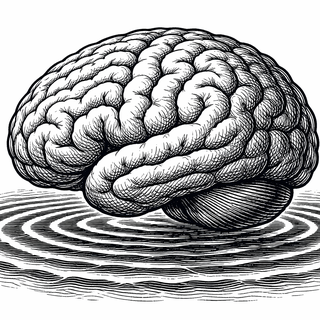
But in 2023, a landmark study in Nature dropped a bombshell. Researchers found that the brain's physical geometry - just its shape, nothing fancy - actually predicts brain activity better than all that complex connectivity data. The analogy they used: brain activity moves more like ripples in a pond than signals in a telecommunications network. And what determines how ripples move? The shape of the pond.
Enter "eigenmodes" - and yes, that word sounds like something from a sci-fi movie. They're basically the natural resonance patterns that any shape can produce. Strike a bell, and it rings at certain frequencies determined by its geometry. Same deal with your brain, except instead of sound, we're talking about waves of neural activity.
Tracking Seizures with Brain Geometry
The new study, published in Advanced Science, asked a practical question: can we use these geometric eigenmodes to better locate seizures in epilepsy patients?
For the roughly 30% of epilepsy patients whose medications don't work, surgery to remove the seizure-generating region can be life-changing. But surgeons need to know exactly where to cut. Getting it wrong means either leaving the problematic tissue behind or removing healthy brain. Neither is great.
The researchers tested their geometric eigenmode approach against the traditional connectome-based method and several other standard techniques. The results? Geometric eigenmodes reconstructed seizure spread slightly better than connectome eigenmodes, and both types significantly outperformed the commonly used approaches.
Why This Matters
This isn't just academic navel-gazing. EEG source localization for epilepsy surgery currently requires either invasive electrode implantation (they literally drill into your skull) or expensive imaging like PET and SPECT scans. A method that works better with regular scalp EEG could make accurate seizure localization accessible to way more patients worldwide.
Plus, there's something philosophically satisfying here. Neuroscientists have spent decades building increasingly detailed maps of brain connectivity, and it turns out that for some purposes, you can get comparable or better results from something as simple as brain shape. It's like discovering you don't need Google Maps when you can just look out the window.
The Bigger Picture
This research is part of a growing realization that the brain's physical architecture - the geometry we can see on an MRI scan - deserves more attention. Brain shape changes with age, disease, and development. If shape constrains function as strongly as this research suggests, we might have been overlooking an important piece of the puzzle.
The eigenmodes approach has already found applications beyond epilepsy, from studying meditation's effects on the brain to tracking how the brain changes across a lifespan. Not bad for a concept that essentially says: sometimes, the simplest explanation really is the best one.
Your brain, it turns out, might be less like a computer network and more like a very complicated musical instrument. And we're just starting to learn its frequencies.
References
-
Siu PH, Karoly PJ, Mansour L S, et al. Structural Eigenmodes of the Brain to Improve the Source Localization of EEG: Application to Epileptiform Activity. Advanced Science. 2025. DOI: 10.1002/advs.202516802
-
Pang JC, Aquino KM, Oldehinkel M, et al. Geometric constraints on human brain function. Nature. 2023;618:566-574. DOI: 10.1038/s41586-023-06098-1 | PMC10266981
-
Grech R, Cassar T, Muscat J, et al. Review on solving the inverse problem in EEG source analysis. J Neuroeng Rehabil. 2008;5:25. PMC2605581
-
Khoshkhahtinat A, et al. A Review of EEG-based Localization of Epileptic Seizure Foci. J Med Signals Sens. 2024. PMC11373807
Disclaimer: The image accompanying this article is for illustrative purposes only and does not depict actual experimental results, data, or biological mechanisms.