
Remember when your parents said video games would rot your brain? Turns out they had it backwards. If you spent your childhood hunched over a Game Boy, obsessively catching 'em all, congratulations: you've contributed to one of neuroscience's most delightful natural experiments. Your brain now has a dedicated region for recognizing Pikachu, and researchers couldn't be happier about it.
The Accidental Neuroscience Lab
Here's the thing about studying how brains develop specialized regions for visual recognition: it's really hard to do ethically. You can't exactly lock a bunch of kids in a room for years and force them to stare at the same images over and over while you measure their brains. Enter Pokémon, which accomplished basically the same thing while parents happily paid for the privilege.
In 2019, Jesse Gomez and colleagues at Stanford did something wonderfully nerdy. They rounded up adults who'd been serious Pokémon players as kids (ages 5-8, the golden age of "I NEED that Charizard") and compared their brains to people who'd somehow escaped the Pokémon craze. Using fMRI, they showed both groups images of faces, places, animals, and - crucially - the original 151 Pokémon characters (Gomez et al., 2019).
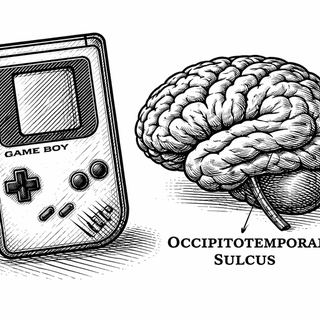
The results were wild. In the childhood Pokémon masters, a specific brain region called the occipitotemporal sulcus - a little fold tucked behind your ears - lit up like a Christmas tree whenever they saw Bulbasaur or Jigglypuff. Non-players? Crickets. That same region in their brains responded to animals, cartoons, and words, but showed no special love for pocket monsters.
Why Your Retina Called Dibs on That Brain Real Estate
The really clever part of this study wasn't just finding the "Pokémon region" - it was explaining why it developed where it did. The researchers tested something called eccentricity bias theory, which sounds like a fancy way of describing that one cousin everyone avoids at family reunions, but is actually about how the size and position of things on your retina determines which part of your visual cortex gets trained to recognize them.
Think about it: every kid played Pokémon on the same tiny Game Boy screen, held at roughly the same distance from their face. Those pixelated creatures occupied a very specific, very small portion of central (foveal) vision. According to eccentricity bias theory, this should activate a predictable region in the visual cortex - and that's exactly what happened. The brain, ever the efficient machine, essentially said "Oh, we're going to see these weird animal-things constantly? Better build a specialized recognition system."
This finding helps explain a long-standing mystery about the fusiform face area and other category-selective regions in the brain. Why do we have dedicated neural real estate for faces but not, say, coffee mugs? Partly because we experience faces under consistent visual conditions during critical developmental windows. Pokémon provided the same conditions - just for fictional creatures instead of grandma.
Thirty Years of Pocket Monsters Shaping Science
With Pokémon celebrating its 30th anniversary in 2026, scientists are taking stock of how this franchise has quietly shaped multiple research fields. Beyond neuroscience, Pokémon has influenced everything from ecology education to species naming conventions. The Natural History Museum in London even launched a "Pokécology" exhibit exploring how the games' mechanics mirror real evolutionary and ecological principles.
But the neuroscience contribution might be the most lasting. Recent work published in Nature Reviews Psychology notes that the original 2019 study serves as "a reminder of why foundational research matters, how much can be learned from careful design (even with small samples), and why communicating differences in brain science needs care, humility and nuance" (Weiner et al., 2025).
The study has also informed broader questions about visual cortex development. Research now shows that category-selective regions emerge quite early in infancy - face responses appear around 4-6 months - and that both genetic factors and experience shape their final form. Your childhood Pokémon habit was basically running an uncontrolled experiment on the plasticity side of that equation.
What This Means (Besides Validating Your Misspent Youth)
The implications extend well beyond nostalgia trips. Understanding how consistent visual experience during childhood shapes brain organization could help researchers investigate developmental conditions like prosopagnosia (face blindness), dyslexia, and certain aspects of autism. If we know that retinal size and viewing patterns during critical periods determine where specialized recognition systems develop, we might eventually understand why these systems sometimes develop differently.
So the next time someone gives you grief about your continued emotional attachment to imaginary creatures, just tell them you're a participant in ongoing neuroscience research. Your brain has been permanently altered by hours of dedicated training, and science is genuinely grateful. Not many hobbies can claim that kind of academic validation.
Gotta scan 'em all, indeed.
References
-
Gomez, J., Barnett, M. A., & Grill-Spector, K. (2019). Extensive childhood experience with Pokémon suggests eccentricity drives organization of visual cortex. Nature Human Behaviour, 3(6), 611-624. https://doi.org/10.1038/s41562-019-0592-8 | PMCID: PMC7055538
-
Weiner, K. S., Torres, M., & Willbrand, E. H. (2026). How the Pokémon franchise has helped to shape neuroscience. Nature. https://doi.org/10.1038/d41586-026-00861-w
-
Naddaf, M. (2026). Pokémon turns 30 — how the fictional pocket monsters shaped science. Nature. https://doi.org/10.1038/d41586-026-00441-y
-
How Pokémon helped to explain brain differences. (2025). Nature Reviews Psychology, 4, 621. https://doi.org/10.1038/s44159-025-00485-3
-
Kanwisher, N., McDermott, J., & Chun, M. M. (1997). The fusiform face area: a module in human extrastriate cortex specialized for face perception. Journal of Neuroscience, 17(11), 4302-4311. https://doi.org/10.1523/JNEUROSCI.17-11-04302.1997
Disclaimer: The image accompanying this article is for illustrative purposes only and does not depict actual experimental results, data, or biological mechanisms.