
You're standing in your kitchen. If you're hungry, you head toward the fridge. If you're doing dishes, you head toward the sink. The physical space is identical in both cases, but you do completely different things based on what you're trying to accomplish. How does your brain pull off this trick of using context to guide behavior in familiar places?
A study in Cell Reports digs into this question and identifies a circuit that lets the hippocampus know which rules apply right now. Turns out, a brain region called the medial septum is sending the contextual memo.
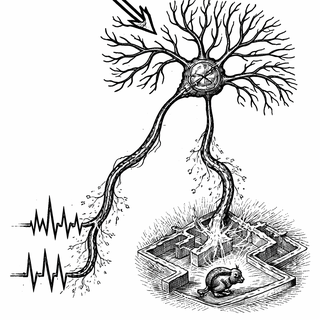
Same Place, Different Meaning
The hippocampus is famous for its place cells, neurons that fire when an animal is in a particular location. These cells help create your internal map of space. But here's where it gets interesting: some hippocampal cells don't just care about where you are. They also care about what you're doing there.
These are called "splitter cells," and they fire differently in the exact same location depending on the behavioral context. Same spot on the maze, but the cell's activity pattern changes based on which rule the animal is following. It's like the cell is encoding "I'm here AND I'm doing this task" rather than just "I'm here."
This makes intuitive sense when you think about it. A pure spatial map wouldn't be enough for flexible behavior. You need to overlay context onto location to know what to do. Standing at a crossroads means nothing until you know whether you're supposed to turn left or right.
Beyond Left and Right
Most previous studies of splitter cells focused on spatial contexts, like whether an animal was about to make a left turn versus a right turn. That's useful, but it doesn't fully capture the range of contexts that matter for behavior. Sometimes the difference isn't about spatial choices at all.
The researchers pushed further. They designed a task where mice had to follow different stimulus-response rules. The rules weren't about which direction to go, but about which type of stimulus demanded which type of response. It's a non-spatial kind of context.
Using calcium imaging, which lets you watch neurons firing in real time, they tracked hippocampal cells while mice performed this task. The result: splitter cells were robustly encoding which rule was active. They weren't just representing location. They were representing the current behavioral rules that should govern action.
This is a more abstract kind of information than "turn left." It's more like "in this situation, respond to stimulus A but ignore stimulus B." The hippocampus is doing more sophisticated work than just mapping space.
Where Does the Context Signal Come From?
Once you know that splitter cells encode context, the obvious next question is: where does that contextual information come from? The hippocampus doesn't exist in isolation. It receives input from many other brain regions, and one of those inputs must be carrying the "here's what you're supposed to be doing" signal.
The researchers focused on the medial septum, a brain structure that sends major projections to the hippocampus. The septum was already known to be important for hippocampal function, particularly for the rhythmic activity patterns that characterize hippocampal processing. But its role in contextual coding wasn't clear.
The test was straightforward in concept: silence the medial septum and see what happens to splitter cell activity. If the septum is delivering the contextual signal, silencing it should disrupt contextual coding.
That's exactly what happened. When the medial septum was inactivated, splitter cells lost their ability to distinguish between behavioral contexts. They still encoded spatial information just fine. They knew where the animal was. But they no longer knew which rules were in play.
This dissociation is really informative. It means the septum isn't just providing generic input to the hippocampus. It's specifically carrying the contextual information that gets layered onto spatial representations. Turn off that input and you have a map without meaning.
A Circuit for Flexible Behavior
What emerges from this study is a picture of how the brain enables flexible behavior in familiar environments. The hippocampus builds spatial maps. The medial septum tells the hippocampus which behavioral rules apply in the current situation. Splitter cells integrate these two streams of information, creating representations that combine "where I am" with "what I should do."
This circuit architecture makes sense for an animal, or a person, that needs to behave appropriately across different contexts. You don't want a rigid mapping of locations to actions. You want a flexible system that can adjust based on goals, rules, and circumstances.
Think about all the places in your life where the same location demands different behaviors depending on context. Your office desk when you're working versus when you're about to leave for the day. Your car when you're driving to work versus driving to pick up groceries. Your kitchen when you're cooking dinner versus when you're grabbing a quick snack. Same places, different behavioral demands.
Why This Matters
Understanding these circuit mechanisms has implications beyond basic science. Hippocampal dysfunction is central to several neurological conditions, including Alzheimer's disease. But "hippocampal dysfunction" isn't one thing. The hippocampus does multiple things using different circuits and inputs.
If contextual coding depends specifically on septal input, then damage to the septum or to the septal-hippocampal connection could produce very specific deficits. You might be able to recognize familiar places but not know what to do in them. You might get confused about which rules apply in which situations.
These kinds of subtle deficits might not show up on a simple "do you know where you are" test, but they could massively disrupt daily functioning. Understanding the circuit details helps explain what can go wrong and maybe points toward more targeted interventions.
The Bottom Line
Your hippocampus isn't just a GPS. It's a GPS with context awareness, and that awareness comes from its conversation with the medial septum. Splitter cells are the neurons that hold both pieces of information together, representing where you are and what you're supposed to be doing.
Next time you're in a familiar place and seamlessly switch to the appropriate behavior for your current goal, give a quiet thanks to your splitter cells. They're working hard so you don't have to consciously figure out the rules every time you walk into a room.
Reference: Bhattacharyya S, et al. (2025). Medial septum-dependent encoding of contextual inputs by hippocampal splitter cells. Cell Reports. doi: 10.1016/j.celrep.2025.116338 | PMID: 40991931
Disclaimer: The image accompanying this article is for illustrative purposes only and does not depict actual experimental results, data, or biological mechanisms.