
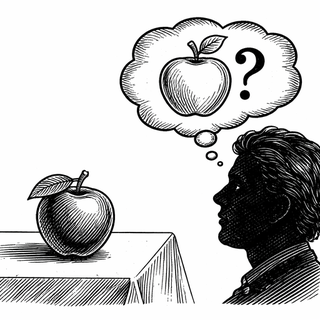
Close your eyes. Picture a red apple on a white table. See it? The gentle curve, the waxy sheen, maybe a tiny leaf curling off the stem?
Now imagine someone telling you they see... absolutely nothing. Just darkness. Maybe the idea of an apple, floating somewhere in the void of conceptual space, but no image at all. Not blurry. Not faint. Just gone.
Welcome to aphantasia - the condition where roughly 4% of the population walks around with a mind's eye that's permanently out of office.
The Blind Spot Hiding in Plain Sight
The term "aphantasia" is relatively new - coined in 2015 by neurologist Adam Zeman at the University of Exeter - but the phenomenon has been quietly existing since, well, forever. Francis Galton first stumbled on it back in 1880, when he noticed many of the scientists he surveyed were genuinely baffled by the concept of mental imagery. Which, if you think about it, is a bit like finding out some people don't hear music in their heads when they recall a song. You don't know what you're missing until someone tells you it exists.
After Zeman published his initial findings, roughly 20,000 people contacted him to say, essentially, "Wait, other people actually see things when they imagine?" That's 20,000 small identity crises, delivered by science.
The Brain Is Baking a Cake You Can't Eat
Here's where it gets genuinely strange.
You'd expect people with aphantasia to show quiet visual cortices - the brain's projection room simply dark and empty. But when researchers stuck people with aphantasia into an fMRI scanner and asked them to imagine colored patterns, their visual cortex lit up anyway (Chang et al., 2025).
The brain was generating something that looked, neurologically speaking, like an image. But the person experienced nothing. As Professor Joel Pearson from UNSW put it: "Their brain is doing the math but skipping the final step."
It's like watching rain fall into a river that flows underground. The water is there. The current is moving. But the surface stays perfectly dry.
The Switchboard of Imagination
Researchers at the Paris Brain Institute used ultra-high-field 7-Tesla fMRI - the kind that makes regular brain scanners look like toy walkie-talkies - to peer deeper into the problem. What they found is that people with aphantasia show reduced connectivity between visual processing areas and frontoparietal networks, the regions handling attention, awareness, and working memory (Liu et al., 2025).
Think of it like a forest ecosystem where all the individual organisms are thriving, but the corridors between habitats have grown over. The trees are fine. The rivers are flowing. But nothing can migrate from one patch to the next.
And then came the discovery that tied it all together: the "fusiform imagery node." Researchers examining people who lost their ability to visualize after brain injuries found that 100% of cases were connected to this single neural hub in the left fusiform gyrus (Kutsche et al., 2026). It's the air traffic controller of your imagination, and when it loses its flight paths, the planes just... don't arrive.
Not Broken, Just a Different Season
Here's where I step back and feel a kind of quiet awe at the sheer variety of human experience.
Aphantasia isn't a disorder. People with it perform perfectly well on memory tests and mental rotation tasks. They hold jobs, raise families, write novels. Glen Keane - the animator who drew Ariel in The Little Mermaid - has aphantasia. The person who created one of the most visually iconic characters in film history can't picture her in his head.
What does shift is autobiographical memory. People with aphantasia remember their past more as facts than films - they recall that the beach was beautiful, not what it looked like. It's the difference between reading about a thunderstorm and feeling the rain on your skin.
There's a genetic thread here, too: having a sibling with aphantasia increases your own odds roughly tenfold. And in a twist that almost feels like nature balancing its books, people with aphantasia may be somewhat shielded from PTSD, because intrusive visual flashbacks have a harder time taking root when the mind's eye is quiet (Zeman, 2024).
The Weather Inside Your Head
What aphantasia ultimately reveals is something humbling about consciousness itself. We walk around assuming everyone's inner world looks roughly like ours - same mental movies, same daydreams, same visual replay of last night's dinner. But the truth is that the way reality shows up inside your head might be profoundly different from the person sitting next to you on the bus.
And neither version is wrong. They're just different weather systems passing through the same sky.
References
-
Chang, S., Zhang, X., Cao, Y., Pearson, J., & Meng, M. (2025). Imageless imagery in aphantasia revealed by early visual cortex decoding. Current Biology, 35(3), 591-599.e4. DOI: 10.1016/j.cub.2024.12.012
-
Liu, J., Zhan, M., Hajhajate, D., Spagna, A., Dehaene, S., Cohen, L., & Bartolomeo, P. (2025). Visual mental imagery in typical imagers and in aphantasia: A millimeter-scale 7-T fMRI study. Cortex. DOI: 10.1016/j.cortex.2025.01.013
-
Kutsche, J., Kletenik, I., et al. (2026). Fusiform imagery node in acquired aphantasia. Cortex. DOI: 10.1016/j.cortex.2026.01.009
-
Zeman, A. (2024). Aphantasia and hyperphantasia: exploring imagery vividness extremes. Trends in Cognitive Sciences. DOI: 10.1016/j.tics.2024.02.007
-
Quill, E. (2026). Many people have no mental imagery. What's going on in their brains? Nature, 650(8100), 20-23. DOI: 10.1038/d41586-026-00311-7
Disclaimer: The image accompanying this article is for illustrative purposes only and does not depict actual experimental results, data, or biological mechanisms.