
Here's something that might blow your mind a little: your muscles aren't just dumb tissue that contracts when told. They're packed with sensors that tell your brain where your limbs are and how fast they're moving. Standard biology class stuff, right? But here's where it gets weird. According to a study in Cell Reports, those sensors aren't passive measuring devices. They're actively adjusting their own sensitivity settings based on what you're doing. Your body is running an auto-tune system you didn't know existed.
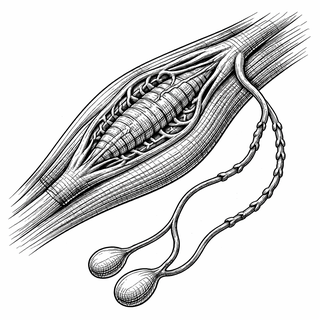
Muscle Spindles: More Than Tiny Rulers
Muscle spindles are these specialized structures buried in your muscles that detect stretch. Every textbook describes them the same way: they measure how much your muscle is stretched and how fast, then report that information to the brain. Simple input, simple output. Like a thermometer, but for muscle length.
Except, as it turns out, thermometers don't get phone calls from headquarters telling them to change their readings based on what room they're in. Muscle spindles apparently do.
The researchers recorded from muscle spindle afferents (the nerve fibers that carry spindle signals) in mice doing a directed licking task. Why mouse jaws? Because jaw muscle spindles have a peculiar property: their cell bodies sit inside the central nervous system rather than out in the peripheral ganglia like normal sensory neurons. This means they can receive direct input from the brain. They're not just sensors; they're sensors with a hotline to management.
The "Same Movement, Different Signal" Discovery
Here's the finding that made everyone sit up straighter. When the researchers analyzed what the spindle signals were actually encoding, straightforward movement information (how far, how fast) only explained about half of the variability. What explained the rest?
Context. Where the animal was in the behavioral sequence.
The spindle signals changed depending on whether the mouse was at the beginning of a lick sequence, in the middle, at the end, or consuming a reward. Same physical movement, different sensory signal. It's like your speedometer reporting different speeds depending on whether you're starting your commute, stuck in traffic, or finally pulling into your driveway.
This isn't noise or error. This is the nervous system actively recalibrating its sensors based on behavioral context.
Your Brain Is Talking to Your Sensors (And They're Listening)
How does this work? Through something called fusimotor neurons, which control the sensitivity of muscle spindles. Think of them as the volume knob for your proprioceptive sensors. When the brain wants more sensitive feedback, it cranks up the fusimotor activity. When it wants less, it dials it down.
For jaw spindles, there's an additional trick: those direct central inputs we mentioned. The brain can literally whisper to these sensors, adjusting their responses in real-time based on what's happening behaviorally.
It's like having a microphone that automatically adjusts its gain based on whether you're at a whisper, normal conversation, or shouting, but also knows whether you're in a lecture hall, a library, or a rock concert, and adjusts accordingly.
Why This Matters for Understanding Movement
For decades, motor control models have treated proprioception as a fixed sensory input. The brain sends motor commands out, gets sensory feedback back, compares them, adjusts. Clean, simple, and apparently incomplete.
If your sensors are actively reconfiguring based on context, they're not just providing input to the control system. They're part of the control system itself. The feedback loop isn't just a loop; it's a dynamically adjusting system where even the sensors are actively participating in the computation.
This has implications for everything from understanding how we learn new movements to why certain movement disorders are so hard to treat. If the sensors themselves are part of the problem, just fixing the motor output won't be enough.
Your Body Is Smarter Than Its Textbook Description
The bigger takeaway here is one that keeps coming up in neuroscience: biological systems are almost always more sophisticated than our initial models suggest. We describe things simply because simple descriptions are useful, but the actual machinery is often doing something much cleverer.
Your muscle spindles aren't just measuring stretch. They're sophisticated sensors that adjust their properties on the fly, taking orders from the brain and tuning their sensitivity to match behavioral demands. They're not passive thermometers; they're smart sensors with adjustable settings.
Next time you reach for your coffee cup without looking, remember: there's a whole symphony of dynamically tuned sensors making that possible, and they're way more sophisticated than anyone gave them credit for until pretty recently.
Reference: Olson WP, et al. (2025). Muscle spindles provide flexible sensory feedback for movement sequences. Cell Reports. doi: 10.1016/j.celrep.2025.116452 | PMID: 41129318
Disclaimer: The image accompanying this article is for illustrative purposes only and does not depict actual experimental results, data, or biological mechanisms.