
Everyone knows stress is bad for your bones. People with nerve damage often develop bone problems too. But the actual mechanism connecting nerves to bone health has been murky until now. A study in the Journal of Clinical Investigation found something pretty direct: your sympathetic nerves live right in the same neighborhood as your bone stem cells, and when the boundaries between them break down, your bones pay the price.
Stem Cells Have Roommates
Skeletal stem cells (SSCs) are the progenitors that eventually become bone, cartilage, and fat cells. They don't just float around randomly in your body. They live in specialized microenvironments called "niches," which you can think of as tiny apartment complexes where the neighbors have a lot of influence over what happens.
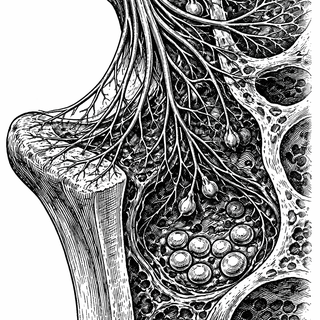
It turns out sympathetic nerve fibers are key residents of these stem cell neighborhoods. They're not just passing through. They're actively living there, and the signals they send affect what the stem cells do.
There's a molecule called SLIT2 that's classically known as an axon guidance cue. Its job is basically to tell growing nerve fibers "not here, go somewhere else." In the bone stem cell niche, SLIT2 acts like a bouncer keeping the nerve population from getting too crowded.
When researchers knocked out SLIT2 specifically in sympathetic neurons, the mice developed osteopenia, which means weak, thinning bones. No SLIT2, no bouncer, and apparently that's a problem.
Turns Out You Can Have Too Much Innervation
Here's where the finding gets counterintuitive. Without SLIT2 to repel them, sympathetic nerve fibers went into overdrive and overgrew into the bone tissue. You might think more nerves means more signals means better communication means healthier tissue, right?
Nope. The increased sympathetic innervation actually decreased the number of skeletal stem cells. The neighborhood got too crowded with nerves, and the stem cells suffered.
The researchers tested this by transplanting SSCs from hyperinnervated bones into new locations. These stem cells performed terribly at forming new bone compared to normal SSCs. The nerve signals had essentially ruined the stem cells' ability to do their job.
It's like having a helpful neighbor who keeps coming over to check on you. Nice in moderation. Oppressive when they're there every five minutes. The stem cells were getting overwhelmed by sympathetic input.
The Actual Troublemaker Revealed
The researchers dug deeper to find the specific molecule causing problems. They identified FSTL1 (Follistatin-like 1) as the culprit.
Normally, SLIT2 keeps FSTL1 levels in check. When you remove SLIT2, FSTL1 goes wild, running around the neighborhood suppressing SSC self-renewal and bone-forming capacity. The stem cells can't maintain themselves or produce healthy bone because they're being constantly harassed by this overabundant molecule.
To prove this was really the mechanism, the researchers deleted FSTL1 from sympathetic neurons. Result: the bone problems were rescued. Even without SLIT2, removing FSTL1 prevented the bone loss. That's about as clean a mechanistic confirmation as you can get.
Your Bones Are More Complicated Than Calcium
This finding adds a whole new layer to how we think about bone health. The standard advice for bones is pretty simple: calcium, vitamin D, weight-bearing exercise, maybe some hormones. The skeleton is often treated as a mechanical structure that needs the right building materials and forces.
But this study shows that local nerve activity directly influences whether your bone stem cells can do their job. It's not just about having enough calcium or the right hormones. The neural environment of the stem cell niche matters.
For people with nerve damage, chronic stress, or other conditions affecting sympathetic nerve activity, this provides a potential explanation for why their bones might suffer even when calcium and hormones seem fine. The conversation between nerves and stem cells has gone wrong.
New Angles for Osteoporosis
The obvious question is whether this could lead to new treatments. Current osteoporosis drugs mostly target osteoclasts (cells that break down bone) or try to boost osteoblasts (cells that build bone). This research suggests a different approach: modulating the nerve-stem cell interaction at the source.
If too much sympathetic innervation suppresses bone stem cells, could you partially block that signaling? Could you boost SLIT2 to keep nerve growth in check? Could you target FSTL1 directly to prevent it from harassing the stem cells?
These are speculative possibilities, but the point is that understanding this mechanism opens doors that weren't visible before. Your skeleton isn't just responding to mechanical forces and hormones. It's having an ongoing conversation with your nervous system, and that conversation affects whether your bones stay strong or start to thin. Bones have feelings too, apparently.
Reference: Wu Z, et al. (2025). Axon guidance cue SLIT2 regulates the murine skeletal stem cell niche through sympathetic innervation. Journal of Clinical Investigation. doi: 10.1172/JCI193014 | PMID: 41090361
Disclaimer: The image accompanying this article is for illustrative purposes only and does not depict actual experimental results, data, or biological mechanisms.