
Here's a thought that will make your next doctor's visit slightly more awkward: what if the drugs we use to manage cancer pain are secretly moonlighting as tumor bodyguards? Before you dismiss this as late-night WebMD paranoia, hear me out. A review in Cancer Cell by Davis and colleagues lays out some pretty compelling evidence that your pain-sensing neurons aren't just passive messengers running to tell your brain "hey, something hurts." They're active participants in your tumor's survival strategy. It's like finding out your fire alarm has been texting the arsonist.
Pain Neurons: The Tumor's Unlikely Henchmen
Let's talk about nociceptors, which is the fancy term for your pain-sensing nerve fibers. You probably think of them as simple alarm systems, right? Stubbed toe, neuron fires, brain goes "ow." End of story. Except it's not.
Turns out these neurons have a side hustle. When cancer shows up, nociceptors start releasing chemical signals like CGRP (calcitonin gene-related peptide, if you want to impress someone at a party). And what does CGRP do? It actively suppresses your immune system's ability to go after tumors.
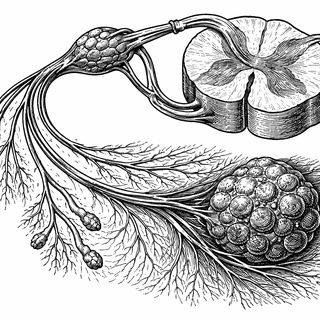
Think of it this way: your tumor throws an evil lair party, and your pain neurons accidentally become the bouncers who keep the immune police standing outside in the cold. "Sorry, your name's not on the list, T cells."
Research shows that when you block these pain-signaling pathways, immune cells suddenly flood into the tumor like they've been waiting outside for this exact moment. Scientists (as scientists do) decided to ablate TRPV1+ sensory neurons in mouse models, essentially firing the bouncers. Result? More effector T cells showed up ready to fight, while fewer regulatory cells tried to play peacemaker. The immune party got started for real.
The Painkiller Paradox Nobody Warned You About
So here's where things get uncomfortable. Current cancer pain management looks something like this:
- Opioids that work on your brain and spinal cord
- Peripheral nerve blocks like lidocaine
- NSAIDs that reduce inflammation
Notice what's missing from that list? Any consideration whatsoever of what these drugs do to your immune function. We've been prescribing painkillers like we're ordering off a menu where the only category is "does it make the pain stop?" Nobody's been asking "but wait, does it also tell my immune system to take a coffee break?"
Some of these drugs might inadvertently suppress anti-tumor immunity. Others might not. The honest answer is: we don't actually have great data yet. We've been flying blind in a way that feels pretty uncomfortable once you think about it for more than thirty seconds.
The authors of this review suggest something that sounds obvious in hindsight: maybe we should pick analgesics not just based on how well they kill pain, but also based on whether they help or hurt the body's ability to fight cancer. Revolutionary, right? Pain management meets immunotherapy in a crossover episode nobody saw coming.
Plot Twist: Your Migraine Medicine Might Fight Cancer
Here's where this gets genuinely exciting. Remember CGRP, that molecule your pain neurons release to give tumors VIP protection? Well, we already have FDA-approved drugs that block it. They're called CGRP inhibitors, and right now doctors prescribe them for migraines. Drugs like rimegepant are sitting on pharmacy shelves, approved and ready.
Could migraine drugs become cancer drugs? Early studies suggest this isn't as wild as it sounds. Research in thyroid cancer (doi: 10.1038/s41467-024-49824-7) and oral cancers has shown that blocking CGRP can restore immune function and actually shrink tumors. We're talking about repurposing existing, approved medications for an entirely different disease. The drug development timeline gods are smiling.
Why This Changes Everything (And Why We're Just Figuring It Out)
For years, cancer treatment and pain management existed in separate silos. Oncologists worried about killing cancer cells. Palliative care teams worried about comfort. Nobody was asking whether those two goals might occasionally be working at cross-purposes.
But now the emerging field of cancer neuroscience is connecting dots we didn't even know were on the same page. The nervous system isn't just along for the ride during cancer. It's driving some of the getaway car.
The Bottom Line
Cancer pain isn't just miserable (though it certainly is that). When left unaddressed, it actually impacts survival rates. But the solution isn't simply "more painkillers." We need smarter painkillers. Ones that don't accidentally hand tumors a get-out-of-jail-free card from immune surveillance.
The future of cancer pain management might look completely different. Imagine choosing an analgesic partly based on whether it helps your immune system do its job. That's not science fiction anymore. That's where this research is headed, and it could change how we treat both cancer and the pain it causes.
Reference: Davis BM, McIlvried LA, Saloman JL, Nilsen ML, Scheff NN. (2025). Rethinking relief: Targeting sensory neurons to combat cancer and pain. Cancer Cell, 43(10):1777-1782. doi: 10.1016/j.ccell.2025.07.019 | PMID: 40780214
Disclaimer: The image accompanying this article is for illustrative purposes only and does not depict actual experimental results, data, or biological mechanisms.