
For decades, psychologists have insisted you're a cocktail of five ingredients: Openness, Conscientiousness, Extraversion, Agreeableness, and Neuroticism. The Big Five. It's been the gold standard for understanding why your coworker never returns emails while you respond within minutes, or why some people thrive at parties while others are mentally calculating their exit strategy.
But here's the thing: what if we've been overcomplicating this?
When Machines Play Personality Detective
A team of researchers recently fed data from over 1.3 million people into a machine learning algorithm. That's not a typo. More than a million personalities, crunched through an AI that doesn't care about psychological traditions or what the textbooks say should happen. And what popped out wasn't the familiar five-factor arrangement.
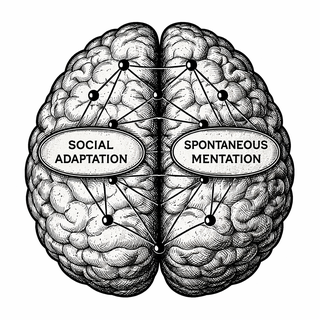
Instead, the algorithm identified what the researchers call the "Big Two": Social Adaptation and Spontaneous Mentation.
Before you assume those are rejected Harry Potter spells, let me explain.
Social Adaptation bundles together the outward-facing stuff: how well you play with others, whether you're the person organizing the group project or pretending the email never arrived, and your general capacity for being a functional member of society. It's basically Extraversion, Agreeableness, and Conscientiousness holding hands.
Spontaneous Mentation is where things get interesting. It combines Neuroticism with the more introspective bits of Openness, capturing that inner world of daydreaming, emotional processing, and the kind of deep thinking that happens when you're supposed to be paying attention in a meeting but instead you're pondering the nature of existence. It's your brain's tendency to wander inward rather than outward.
Your Brain Already Knew This
Here's where the neuroscience gets genuinely wild. When the researchers looked at how these two dimensions mapped onto actual brain connectivity patterns using functional MRI data, the Big Two outperformed the Big Five. The simplified two-factor model did a better job predicting how different brain regions communicate with each other.
This makes a certain intuitive sense. Previous research has established that personality traits reflect what scientists call "conceptual nervous systems," or functionally integrated brain networks rather than isolated brain regions. The Big Two might simply be a cleaner match for how the brain actually organizes itself: one system oriented outward toward the social world, another oriented inward toward reflection and emotional processing.
Think of it this way. Your brain isn't sitting there running five separate programs for each personality trait. It's more likely running two major operating modes: "dealing with other humans" and "processing internal experience." The Big Two might be a more honest description of what's actually happening under the hood.
Why This Matters Beyond Academic Bickering
You might be wondering why anyone should care about whether personality has two factors or five. Fair question.
For starters, simpler models are easier to work with clinically. If mental health outcomes and cognitive functioning correlate better with a two-factor model, that's potentially useful for therapists, researchers studying psychiatric conditions, and anyone trying to understand the link between personality and psychological wellbeing.
The study found that this Big Two framework preserved associations with cognition and mental health while offering improved prediction of brain connectivity patterns. Translation: we're not losing important information by simplifying. We might actually be gaining clarity.
There's also the cross-cultural angle. Recent research suggests that a Big Two structure shows stronger consistency across different cultures than more complex models. When you strip away some of the finer distinctions, you might be left with something more universally human.
The Fine Print
This doesn't mean the Big Five is wrong or useless. The researchers are careful to position the Big Two as a complement rather than a replacement. Different levels of analysis are useful for different purposes, like how you might describe someone as "tall" for everyday conversation but need their exact height in centimeters for a medical chart.
But there's something satisfying about the possibility that beneath all our individual quirks, humans might organize along two fundamental axes: how we engage with the external social world, and how we engage with our own internal landscape.
Your brain, it turns out, might have been keeping things simpler than psychology assumed all along.
References
Zhuang, K., Chen, J., Han, J., Cheng, W., Qiu, J., Feng, J., Eickhoff, S., & Vatansever, D. (2025). Machine-Learning Decomposition Identifies a Big Two Structure in Human Personality with Distinct Neurocognitive Profiles. Advanced Science. DOI: 10.1002/advs.202509009 | PubMed
Nostro, A. D., Müller, V. I., Varikuti, D. P., Pläschke, R. N., Hoffstaedter, F., Langner, R., Patil, K. R., & Eickhoff, S. B. (2018). Predicting personality from network-based resting-state functional connectivity. Brain Structure and Function, 223(6), 2699-2719. PMC7219685
Witzlack-Makarevich, A., Bächlin, L., & Condon, D. M. (2024). The cross-cultural big two: A culturally decentered theoretical and measurement model for personality traits. Journal of Personality and Social Psychology.
Disclaimer: The image accompanying this article is for illustrative purposes only and does not depict actual experimental results, data, or biological mechanisms.