
3.7 millimeters. That's the margin of error in a new tracking system that can tell exactly where a marmoset is looking in three-dimensional space while it freely wanders around, socializes, and (presumably) judges its companions. To put that in perspective, that's roughly the width of two grains of rice. Scientists can now reconstruct the gaze direction of a tiny monkey's face with the kind of precision most of us can't achieve when parallel parking.
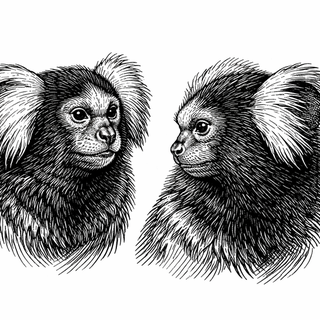
The Staring Problem Nobody Talks About
Here's a thing about primates: we're obsessed with where everyone else is looking. Humans do it. Monkeys do it. Your cat does it too, but that's a different paper. Gaze direction is one of the most fundamental channels of social communication in the primate world, a sort of silent broadcast system that says "I see you," "I'm watching you," or "please stop eating my food" without a single vocalization.
The problem? For decades, studying gaze in lab primates meant bolting their heads in place. Imagine trying to understand someone's social life by strapping them to a chair and flashing pictures at them. You'd learn something, sure, but you'd miss the good stuff: the stolen glances, the mutual stares, the elaborate dance of who-looks-at-whom-and-when that makes primate social life so ridiculously complex (Deen et al., 2023).
Enter the Marmosets (and a Lot of GoPros)
Researchers at Yale built a system using four synchronized cameras, deep learning, and some seriously clever math to track six facial landmarks on multiple common marmosets (Callithrix jacchus) as they roamed freely in pairs. The system, based on a modified DeepLabCut pipeline, reconstructs a 3D "face frame" for each animal and projects a virtual 10-degree cone from its head to determine gaze direction (Xing et al., 2025).
Why marmosets? These pint-sized New World monkeys (about 350 grams, roughly the weight of a can of soda) are one of the few primate species that pair bond and cooperatively raise their young, behaviors that are eerily human. They're also wildly social, living in family groups of up to 15, sharing food with strangers, and generally being the extroverts of the primate world (Miller et al., 2016).
Boys Will Be Boys (Statistically Speaking)
The team paired marmosets up, male-female, some familiar (cagemates) and some strangers, and let them interact. What they found won't shock anyone who's ever been to a bar, but it's the first time it's been rigorously quantified in freely moving primates.
Males stared at females' faces significantly more than females stared back. This held true regardless of whether the pair knew each other (p < 0.0001, for those keeping score at home). Male marmosets, it turns out, are the primates equivalent of the person who keeps making eye contact across the room while their companion politely looks elsewhere.
Strangers vs. Old Flames
Familiarity changed everything about how pairs used gaze, though. Unfamiliar pairs were hypervigilant: sustained monitoring across distances, more stereotyped movement patterns, essentially circling each other with their eyes like two people on a deeply awkward first date. Their joint gaze (looking at the same spot simultaneously) only happened when they were physically close together.
Familiar pairs? They'd already figured each other out. They showed higher levels of joint gaze overall and could coordinate their attention even from across the arena. Think of it as the difference between two strangers nervously checking each other out versus an old couple who can communicate an entire dinner order with a single look. Males in familiar pairs were also more likely to reciprocate their partner's gaze, suggesting that familiarity builds a kind of visual rapport.
Why This Actually Matters
This isn't just a cute story about monkey staring contests. Social gaze dysfunction is a hallmark of conditions like autism spectrum disorder and social anxiety, and understanding the neural circuits behind these behaviors requires watching them happen naturally. Previous work has identified neurons throughout the prefrontal cortex and amygdala that fire specifically during social gaze exchanges (Dal Monte et al., 2022), but linking those neural signals to natural, unconstrained behavior has been nearly impossible until now.
By giving marmosets the freedom to be themselves (while quietly tracking every glance with millimeter precision), this framework opens the door to studying social cognition the way it actually works: messy, dynamic, and full of awkward eye contact.
References
-
Xing, F., Sheffield, A. G., Jadi, M. P., Chang, S. W. C., & Nandy, A. S. (2025). Dynamic modulation of social gaze by sex and familiarity in marmoset dyads. eLife, 14, RP105034. DOI: 10.7554/eLife.105034 | PubMed
-
Miller, C. T., Freiwald, W. A., Leopold, D. A., Mitchell, J. F., Silva, A. C., & Wang, X. (2016). Marmosets: A neuroscientific model of human social behavior. Neuron, 90(2), 219-233. DOI: 10.1016/j.neuron.2016.03.018 | PMID: 27100195
-
Dal Monte, O., Fan, S., Fagan, N. A., Chu, C. J., Zhou, M. B., Putnam, P. T., Nair, A. R., & Chang, S. W. C. (2022). Widespread implementations of interactive social gaze neurons in the primate prefrontal-amygdala networks. Neuron, 110(13), 2183-2197.e7. DOI: 10.1016/j.neuron.2022.04.013 | PMID: 35545090
-
Deen, B., Schwiedrzik, C. M., Sliwa, J., & Freiwald, W. A. (2023). Specialized networks for social cognition in the primate brain. Annual Review of Neuroscience, 46, 381-401. DOI: 10.1146/annurev-neuro-102522-121410 | PMID: 37428602
Disclaimer: The image accompanying this article is for illustrative purposes only and does not depict actual experimental results, data, or biological mechanisms.