
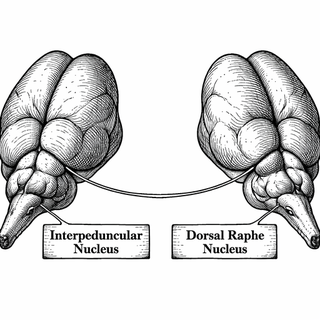
Chronic pain and depression love to travel as a matched set. Not always, not for everyone, and not because your brain is "weak" or doing performance art. But often enough that doctors have been stuck dealing with the world's worst buy-one-get-one-free deal. A new mouse study in Cell Reports points to one possible wiring diagram behind that overlap: a set of inhibitory neurotensin-expressing neurons in the interpeduncular nucleus, sending signals to the dorsal raphe nucleus - two brain regions with names that sound made up by a sleep-deprived anatomist and, unfortunately, are very real.
The brain's miserable group chat
Here's the basic setup. Chronic pain is not just a sore knee that refuses to stop whining. Over time, pain can drag mood, motivation, and sleep down with it. That part has been obvious to patients forever. Neuroscience has been slower, mostly because the brain is less like a neat circuit board and more like a basement full of old wiring, mystery leaks, and one breaker that trips if you look at it funny.
In this paper, researchers used male mice with inflammatory pain induced by complete Freund's adjuvant, a standard lab method for creating persistent pain. They found increased activity in neurotensin-positive neurons in the interpeduncular nucleus, or IPN. These neurons project to the dorsal raphe nucleus, or DRN, which is a major serotonin-related hub involved in mood, stress, and affect. If the DRN is one of the brain's mood regulators, this IPN input may be the coworker barging into its office and slapping a "everything is terrible" memo on the desk.
The key claim is that this IPN-to-DRN inhibitory circuit helps drive both pain behaviors and depression-like behaviors in these mice.
Tiny brake lines with big consequences
A few pieces make this especially interesting. First, the neurons in question express neurotensin, a neuropeptide with a weirdly broad resume in pain, reward, and mood regulation. Second, the pathway is inhibitory, meaning these cells are effectively pressing a neural brake on targets in the DRN. Third, the authors used modern circuit tools - including tracing, activity mapping, and optogenetic or chemogenetic manipulations - to test whether this pathway actually matters rather than just lighting up like a Christmas tree after injury.
And apparently it does matter.
When the researchers activated this pathway, pain sensitivity and depression-like behaviors got worse. When they suppressed it, the mice improved. That's the kind of result neuroscientists like because it moves beyond "this area seems involved" into "if we poke the plumbing here, the leak changes."
Now, before anyone starts promising a miracle cure, this is still a mouse study. Mice are useful, but they are not tiny bearded philosophers who can report sadness over coffee. "Depression-like behavior" in mice usually means changes in validated behavioral tests, not a rodent writing bleak poetry in the corner. Still, these models are one of the main ways researchers map the circuitry that may later matter in humans.
Why this matters outside the mouse hotel
Pain and depression are both common. Together, they are brutal. Each can amplify the other. Pain can grind down sleep, motivation, movement, and social life. Depression can make pain feel more inescapable and treatment less effective. Clinically, this overlap is a massive headache - for patients, families, and healthcare systems.
So a circuit that links pain and mood in a mechanistic way is a big deal. If findings like this hold up and expand into other models, sexes, and eventually humans, they could help explain why some people do not just hurt more - they also feel emotionally flattened, exhausted, and trapped by the pain. It suggests that in some cases, the same neural wiring may be helping to carry both loads.
That matters for treatment. Right now, pain and depression often get treated like neighbors in separate apartments when they may be sharing a busted water main.
The catch, because there is always a catch
A few caveats matter. This study used male mice, so we do not know if the same circuit works the same way in females. That is not a small footnote - pain and depression biology can differ by sex in meaningful ways. Also, inflammatory pain is one form of chronic pain, not the whole circus. Neuropathic pain, fibromyalgia-like states, migraine, and other conditions may involve overlapping but distinct circuitry.
And then there is the DRN itself. The dorsal raphe is not one thing. It contains several neuron types and projection patterns, and serotonin systems are famously not simple. Anyone who says "we found the depression center" should lose lab pipette privileges for a week.
The bigger picture
Recent work has increasingly framed chronic pain as a whole-brain problem, not just a signal coming up from the body. Emotional circuits, stress circuits, and reward circuits all get dragged into the mess. Reviews in the last few years have emphasized exactly that point: persistent pain reshapes networks involved in affect and motivation, while mood-related pathways can feed back and worsen pain perception itself (Bushnell et al., 2013; updated conceptual reviews below).
This paper adds one more suspicious pipe to the blueprint. Not the whole house. But a pipe worth labeling.
If future studies confirm this IPN-DRN pathway in broader settings, it could become a useful target for drugs or neuromodulation strategies aimed at treating pain and mood symptoms together instead of playing clinical whack-a-mole with each one separately. And honestly, that would be nice. The current arrangement is terrible.
References
-
Song L, Ge T, Cui M, Zhang M, Wu M, Li Q, Zhou X, Sha S, Yang X, Yang JX, Hu A, Cao JL, Zhang H. An NTS-expressing inhibitory circuit from interpeduncular nucleus to dorsal raphe nucleus controls pain and comorbid depression in male mice. Cell Rep. 2025;44(3):116719. doi:10.1016/j.celrep.2025.116719
-
Sheng J, Liu S, Wang Y, Cui R, Zhang X. The link between depression and chronic pain: neural mechanisms in the brain. Neural Plast. 2017;2017:9724371. doi:10.1155/2017/9724371 PMCID: PMC5619517
-
Zhou W, Jin Y, Meng Q, Zhu X, Bai T, Tian Y, Mao Y, Wang L, Xie W, Zhong H, Mao Q. A neural circuit for comorbid depressive symptoms in chronic pain. Nat Neurosci. 2019;22(10):1649-1658. doi:10.1038/s41593-019-0468-2
-
Yang S, Chang MC. Chronic pain: structural and functional changes in brain structures and associated negative affective states. Int J Mol Sci. 2019;20(13):3130. doi:10.3390/ijms20133130 PMCID: PMC6651703
-
Yoon EJ, Kim YK. Pain-related brain networks in neuropathic pain. Int J Mol Sci. 2021;22(10):4902. doi:10.3390/ijms22104902 PMCID: PMC8156642
-
Navratilova E, Porreca F. Brain circuits encoding reward from pain relief. Trends Neurosci. 2014;37(11):741-750. doi:10.1016/j.tins.2014.09.003 PMCID: PMC4216585
Disclaimer: The image accompanying this article is for illustrative purposes only and does not depict actual experimental results, data, or biological mechanisms.