Your body runs on a schedule more precise than any Swiss railway, and at the heart of this temporal machinery sits cortisol - the hormone that gets you out of bed in the morning and (mostly) lets you sleep at night. Cortisol surges at dawn, tapers through the afternoon, and hits its lowest point around midnight. Every single day. Like clockwork. Literally.
Now imagine a tumor, sitting quietly in breast tissue, somehow reaching into the brain and smashing that clock within three days. Before you can even feel the lump.
That's precisely what a team at Cold Spring Harbor Laboratory has demonstrated in a study published in Neuron, and the implications are, to put it mildly, rather extraordinary (Gomez et al., 2026).
The Brain's Stress Hormone Factory Has a Night Shift Problem
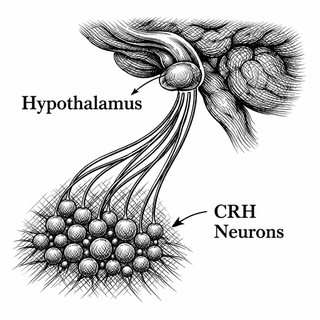
Let's back up. Your hypothalamus - a brain region roughly the size of an almond that punches vastly above its weight - contains a cluster of neurons called the paraventricular nucleus (PVN). Among these are cells that produce corticotropin-releasing hormone (CRH), the chemical that kicks off the entire stress hormone cascade known as the HPA axis. The hypothalamus tells the pituitary, which tells the adrenal glands, which pump out cortisol. It's a three-part relay race your body runs thousands of times.
This system is supposed to oscillate - high during waking hours, low at night - with the rhythm set by signals from the brain's master clock. In breast cancer patients, this rhythm flattens. Cortisol levels stop rising and falling and instead hover at a sort of hormonal purgatory. This flattening has been linked to fatigue, insomnia, depression, and - rather grimly - worse survival outcomes (Amidi & Wu, 2022).
The question nobody had properly answered: why does this happen?
Turns Out, the Brakes Are Off
Gomez and colleagues found their answer in mice bearing breast tumors. Within three days of tumor implantation - before tumors were even palpable - the daily rhythm of PVN CRH neuron activity had already collapsed. These neurons, normally kept in check by inhibitory GABAergic neurons acting as a kind of neurological handbrake, were suddenly running unsupervised. The GABAergic inputs had weakened, and without that restraint, CRH neurons became hyperactive yet paradoxically less effective at delivering a clear signal. Think of it as an office where everyone's shouting so loudly that nobody can hear the actual instructions.
The result? Blunted glucocorticoid rhythms. The adrenal glands received garbled timing signals, and the elegant daily cortisol wave became a flat line. Previous work from the same group had proposed that the hypothalamus detects cancer as a homeostatic threat - essentially your brain's way of sensing that something is very wrong in the body, then failing spectacularly at fixing it (Francis & Borniger, 2021).
The Fix - But Only If You Get the Timing Right
Here's where the story takes its most satisfying turn. Using chemogenetics - a technique that lets researchers switch specific neurons on or off with a designer drug - the team stimulated PVN CRH neurons at different times of day.
When they activated these neurons just before the dark period (the mouse equivalent of dawn, since mice are nocturnal creatures who run their cortisol schedule in reverse), the hormone rhythm snapped back into place. More remarkably, tumors shrank and became flooded with CD8+ T cells - the immune system's most effective assassins. No chemotherapy. No immunotherapy drugs. Just restoring the brain's timing signal.
The same stimulation at the wrong time of day? Absolutely nothing. The immune system didn't budge. The tumors carried on unbothered.
As lead researcher Jeremy Borniger noted: "The brain is an exquisite sensor of what's going on in your body. But it requires balance."
One might call that British understatement, except he's at Cold Spring Harbor.
Why Your Oncologist Should Care About Clocks
This work sits at the expanding frontier of cancer neuroscience, a field revealing that peripheral tumors don't just grow in isolation - they conduct an ongoing, generally unhelpful dialogue with the brain. Glucocorticoids themselves are a double-edged sword in cancer: protective during early inflammation, yet capable of suppressing the very immune responses needed to fight established tumors (Khadka et al., 2023).
The practical implication is tantalizing. If the timing of hormonal rhythms matters this much for anti-tumor immunity, then chronotherapy - delivering treatments at biologically optimal times - isn't merely a nice idea. It might be essential. And the notion that strengthening a patient's own physiology could boost existing cancer treatments, without adding more toxic drugs to the mix, is the kind of elegant solution that makes you wonder why we weren't looking at this sooner.
Of course, these are mouse studies. The leap to human brains is never straightforward, and anyone who tells you otherwise is selling something. But the fundamental biology - the HPA axis, the circadian system, the immune-cancer relationship - is conserved across mammals.
The clock is ticking. And now, at least, we know who's been tampering with it.
References
-
Gomez AM, Wu Y, Zhang C, et al. Aberrant hypothalamic neuronal activity blunts glucocorticoid diurnal rhythms in murine breast cancer. Neuron. 2026;114(5):820-835.e6. DOI: 10.1016/j.neuron.2025.11.019 | PubMed: 41401811
-
Francis N, Borniger JC. Cancer as a homeostatic challenge: the role of the hypothalamus. Trends in Neurosciences. 2021;44(3):182-196. DOI: 10.1016/j.tins.2021.08.008 | PMCID: PMC9901368
-
Amidi A, Wu LM. Circadian disruption and cancer- and treatment-related symptoms. Frontiers in Oncology. 2022;12:1009064. DOI: 10.3389/fonc.2022.1009064 | PMCID: PMC9650229
-
Khadka S, Druffner SR, Duncan BC, Busada JT. Glucocorticoid regulation of cancer development and progression. Frontiers in Endocrinology. 2023;14:1161768. DOI: 10.3389/fendo.2023.1161768 | PMCID: PMC10151568
Disclaimer: The image accompanying this article is for illustrative purposes only and does not depict actual experimental results, data, or biological mechanisms.