
Take your grandma's signature soup recipe. You know the one - handed down through generations, supposedly foolproof, always turns out a little different depending on who's cooking. Someone adds too much salt, someone else forgets the bay leaf, and your cousin microwaves it (we don't talk about your cousin). Same recipe, wildly different results. That's depression in a nutshell: one label, millions of individual variations, and for decades, scientists have been trying to cook up a single treatment for all of them.
A new review paper from Jiao Li, Huafu Chen, and Wei Liao, published in Biological Psychiatry, argues it's time to throw out the one-size-fits-all approach and start reading each brain's individual recipe card (Li et al., 2025).
Your Brain on Depression: It's Complicated (No, Really)
Here's the thing. Depression affects roughly 280 million people worldwide, but no two depressed brains look exactly the same under a scanner. Traditional neuroimaging research has been doing the equivalent of averaging everyone's soup together and declaring "yep, it's soup." Group-level studies compare depressed people to healthy controls, find some differences in brain regions, and call it a day.
The problem? Those average differences explain less than 2% of what's actually going on (Winter et al., 2022). Two percent. That's like predicting the weather by checking if there are clouds somewhere on Earth.
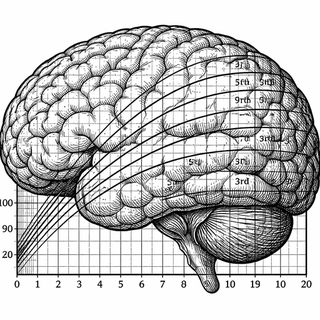
Enter Normative Modeling: Growth Charts, but for Your Brain
So what's the fix? The review spotlights a technique called normative modeling, and it's honestly kind of elegant. Remember those growth charts your pediatrician used when you were a kid? The ones that showed whether your height was in the 50th percentile or whether you were rocketing toward NBA territory? Normative modeling does the same thing for brains (Rutherford et al., 2022).
Scientists build a reference model from large datasets of healthy brains, mapping how brain structure and function vary across age, sex, and other factors. Then they check where each individual patient falls on those charts. Instead of asking "are depressed brains different from healthy ones?" (spoiler: on average, barely), they ask "how is THIS specific brain different from what we'd expect?"
The results are wild. When researchers applied this approach to over a thousand people, they found that individual patterns of brain abnormalities barely overlapped - less than 11% for any given brain region (Li et al., 2024). Your depression literally looks different from your neighbor's depression at the biological level.
Six Flavors of Sad (At Least)
This isn't just academic hand-wringing. A landmark 2024 study from Stanford used brain circuit analysis to identify six distinct biological subtypes - or "biotypes" - of depression and anxiety (Williams et al., 2024). Each one involves different patterns of activity across brain networks controlling things like attention, emotion processing, and problem-solving.
The kicker: different biotypes respond to different treatments. One subtype with overactive cognitive regions did well on venlafaxine. Another with heightened resting activity in problem-solving circuits responded better to talk therapy. A third, with sluggish attention circuits, barely budged with therapy alone but improved when medication addressed the underlying circuit issue first.
Using brain imaging to match patients to biotypes predicted treatment success 63% of the time, compared to 36% without it. Not perfect, but nearly double the accuracy of throwing darts blindfolded, which is roughly what standard treatment selection has been.
Why This Matters for Your Actual Life
Look. About one-third of people with depression don't respond adequately to their first treatment. Or their second. Some cycle through medications for years, each attempt a months-long experiment with side effects and disappointment. The review makes a case that normative modeling could change this by identifying each person's unique neural fingerprint of depression before treatment even starts.
The paper also highlights how researchers are connecting these individual brain deviations to genetic data, neurotransmitter maps, and even cellular-level information from existing brain atlases. It's like going from "your car is broken" to "the alternator is shot, the left headlight is out, and someone put diesel in the gas tank." Specific problems get specific fixes.
The Catch (There's Always a Catch)
The authors are refreshingly honest about limitations. We need bigger, more diverse brain datasets. The fancy models need to work across different scanners and populations. And translating these findings from research papers to your doctor's office is a whole separate adventure in logistics.
But the trajectory is clear. Depression isn't one thing. Your brain isn't average. And the future of treatment might finally start acting like it knows that.
References:
-
Li, J., Chen, H., & Liao, W. (2025). Biologically annotated heterogeneity of depression through neuroimaging normative modeling. Biological Psychiatry. https://doi.org/10.1016/j.biopsych.2025.07.002 | PubMed
-
Williams, L. M., et al. (2024). Personalized brain circuit scores identify clinically distinct biotypes in depression and anxiety. Nature Medicine, 30, 2076-2087. https://doi.org/10.1038/s41591-024-03057-9 | PMID: 38886626
-
Rutherford, S., et al. (2022). The normative modeling framework for computational psychiatry. Nature Protocols, 17(7), 1711-1734. https://doi.org/10.1038/s41596-022-00696-5 | PMID: 35650452
-
Li, J., et al. (2024). Capturing the individual deviations from normative models of brain structure for depression diagnosis and treatment. Biological Psychiatry, 95(5), 403-413. https://doi.org/10.1016/j.biopsych.2023.08.005 | PMID: 37579934
-
Winter, N. R., et al. (2022). Quantifying deviations of brain structure and function in major depressive disorder across neuroimaging modalities. JAMA Psychiatry, 79(9), 879-888. https://doi.org/10.1001/jamapsychiatry.2022.1780 | PMID: 35895072
Disclaimer: The image accompanying this article is for illustrative purposes only and does not depict actual experimental results, data, or biological mechanisms.