
Good news - scientists keep finding elegant little rules for how nervous systems work. Bad news - every time they do, the nervous system immediately says, "Cute theory, but I also do three side quests and a part-time job." That is basically the vibe of a new eLife paper on Caenorhabditis elegans, the microscopic worm that has become neuroscience's favorite oddly transparent overachiever.
The headline is delightfully weird: a neuron best known for sensing temperature appears to help the worm adjust how it moves after touch. In other words, a cell that was supposed to be handling the thermostat may also be moonlighting in traffic control.
The worm with the multitasking neuron
The paper by Rosero and Bai focuses on a neuron called AFD, which in C. elegans is famous for thermosensation - detecting temperature changes and helping the animal navigate its environment. If neurons had résumés, AFD would have "temperature specialist" in bold font at the top.
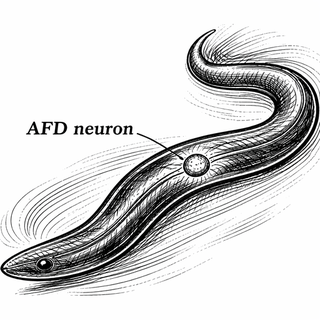
But this study suggests AFD is not just sitting around waiting for weather updates. It also helps link tactile experience - basically, mechanical stimulation or touch - to changes in locomotion. That means when the worm gets bumped, AFD helps determine how its movement gets adjusted afterward.
This matters because brains, even tiny ones, do not usually keep sensory information in neat little labeled folders. Real nervous systems are messy, efficient, and a bit nosy. A neuron that detects one kind of signal may also influence responses to something else entirely. Scientists call that multimodal integration. Normal people call it "apparently nothing in biology can just do one job."
So what did they find?
From the abstract and paper summary, the researchers show that AFD thermosensory neurons mediate tactile-dependent modulation of locomotion. They also point to molecular machinery involving cGMP signaling, guanylyl cyclases, cyclic nucleotide-gated channels, and likely interactions through electrical synapses.
That sounds like a lot, but the basic idea is manageable:
- A worm experiences touch.
- Its movement pattern changes.
- AFD neurons help shape that change.
- They do this using signaling pathways already known to be important in sensory transduction.
So the paper adds a new twist: a neuron famous for one sensory modality can influence behavior in another context. It is less "one neuron, one job" and more "small nervous system, everyone cross-trains."
Why should anyone care about a tiny worm's commute?
Because this is how neuroscience often works. You start with a worm doing something strange, and a few years later you realize the same basic logic shows up in bigger, fancier brains - including the one currently deciding whether to keep reading or check the fridge again.
C. elegans is especially useful because its nervous system is mapped in exquisite detail, with only 302 neurons in the hermaphrodite. That lets researchers ask very precise questions about how sensation becomes action. If one sensory neuron can modulate behavior outside its supposed specialty, that tells us something broad and important: neural circuits are flexible.
That flexibility is a big deal. Animals constantly combine signals from touch, temperature, internal state, and past experience to decide what to do next. You do it when you pull your hand from a hot mug, shuffle on icy pavement, or walk differently after stepping on one Lego and losing all trust in the floor.
AFD: thermometer, yes. Also maybe a behavior manager nobody asked for
AFD has already been studied as a key thermosensory neuron in worms, and work over the years has shown that cGMP signaling is central to how it functions. This paper pushes that story further by suggesting AFD helps couple experience to behavioral output, not just detect a temperature cue in isolation.
That is interesting because it hints that sensory neurons may act less like passive detectors and more like context-sensitive editors. They do not simply report what happened. They help decide what that event means for future movement.
Which, honestly, is a very brain thing to do. The nervous system rarely just forwards the message. It adds commentary, edits for tone, and CCs half the circuit.
The bigger neuroscience plot twist
Recent work across neuroscience supports the idea that sensory circuits are deeply intertwined, not modular in the tidy textbook way. Reviews on multisensory processing and state-dependent behavior keep landing on the same point: perception and action depend on context, internal state, and cross-circuit communication. Even in simple animals, behavior is not a straight line from stimulus to response. It is more like a committee meeting, except somehow useful.
That makes studies like this one valuable. They show how a specific cell, a known signaling pathway, and a measurable behavior can be linked together. If those findings hold up and extend to other systems, they help explain how nervous systems tune movement based on experience rather than reflex alone.
The catch, because there is always a catch
This is one study in one model organism. Worms are amazing, but they are not tiny people with excellent grant support. We should not pretend a thermosensory worm neuron instantly explains human sensory processing.
Still, the principle is powerful. A nervous system can reuse the same components for multiple behavioral jobs. That is efficient, adaptable, and slightly rude to anyone hoping biology would be simple.
And maybe that is the charm here. Even a creature with a brain you could lose in a dust speck refuses to behave like a wiring diagram.
References
Rosero M, Bai J. AFD thermosensory neurons mediate tactile-dependent locomotion modulation in Caenorhabditis elegans. eLife. 2025;14:RP106496. doi:10.7554/eLife.106496
Goodman MB. Mechanosensation. WormBook. 2006:1-14. PMCID:PMC4781360
Bargmann CI. Beyond the connectome: how neuromodulators shape neural circuits. Bioessays. 2012;34(6):458-465. doi:10.1002/bies.201100185
Yemini E, Jucikas T, Grundy LJ, Brown AEX, Schafer WR. A database of Caenorhabditis elegans behavioral phenotypes. Nat Methods. 2013;10(9):877-879. doi:10.1038/nmeth.2560
Steinmetz NA, Zatka-Haas P, Carandini M, Harris KD. Distributed coding of choice, action and engagement across the mouse brain. Nature. 2019;576(7786):266-273. doi:10.1038/s41586-019-1787-x
Disclaimer: The image accompanying this article is for illustrative purposes only and does not depict actual experimental results, data, or biological mechanisms.