Dear cortex, we need to talk about what the hypothalamus has been doing.
Specifically, we need to discuss a molecule called vasopressin (AVP) and its main receptor AVPR1a - and why your brain might be running a completely different version of this system depending on whether you're male or female. A team from Mount Sinai just published the most detailed atlas we've ever had of where these molecules hang out in the mouse brain, and spoiler alert: the two sexes are basically running different operating systems.
The Molecule That Does Everything
Vasopressin is one of those overachieving neuropeptides that refuses to stay in its lane. Originally famous for regulating blood pressure and keeping you from peeing yourself dry, it turns out AVP also moonlights as your brain's social behavior coordinator. Pair bonding? AVP's involved. Recognizing your friends versus strangers? AVP again. Aggression, anxiety, parental care? You guessed it.
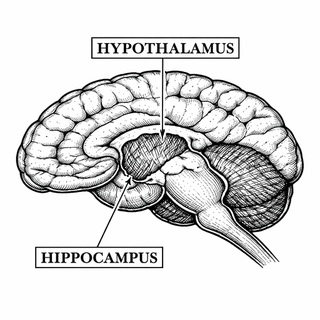
Here's where it gets interesting: these social effects aren't one-size-fits-all. Males and females respond differently to vasopressin, and until now, we didn't have a great map of why. The receptor (AVPR1a) is the lock to vasopressin's key, but nobody had systematically catalogued where all these locks are installed throughout the brain - or whether male and female brains put them in different places.
Mapping the Unmapped
The researchers used a technique called RNAscope that can detect individual mRNA transcripts - essentially counting each molecular "instruction manual" for making AVP or AVPR1a one by one across the entire brain. It's like going from a blurry satellite photo to Google Street View.
What they found flips some assumptions on their head. Female mice showed more AVP-producing cells in the hypothalamus (607 vs 471 in males) and were the only sex expressing AVP in the third ventricular region and thalamus. Meanwhile, male mice had more AVP action in the hippocampus (118 vs 58) and forebrain structures.
The receptor distribution was equally uneven. This isn't just academic bean-counting - it potentially explains decades of research showing that vasopressin affects male and female behavior differently.
Why Prairie Voles Care (And You Should Too)
The vasopressin system shot to fame in studies of prairie voles - those adorable rodents that mate for life. Researchers discovered that males with more AVPR1a receptors in their ventral pallidum form stronger pair bonds. Block the receptor, and suddenly that devoted partner becomes... less devoted. Even more wild: take a promiscuous meadow vole, artificially boost AVPR1a in the right brain region, and congratulations - you've created monogamy in a species that doesn't do monogamy.
This new atlas helps explain why similar manipulations might produce different effects in males versus females. The hardware is literally installed differently.
The Autism Connection
Here's where the clinical implications start stacking up. Autism spectrum disorder shows a stark sex bias (3-5 times more common in males), and researchers have been circling vasopressin as a potential player for years. Children with autism show lower vasopressin levels, and clinical trials are testing whether boosting vasopressin improves social abilities.
But here's the catch: those effects appear to be sex-specific too. Recent work in mouse models of autism found that activating AVPR1a in the lateral septum could rescue social deficits - but the underlying wiring differs between sexes. Without a detailed map of who expresses what and where, you're essentially doing brain surgery with a blindfold.
What Comes Next
This atlas is a resource, not an answer. It's the equivalent of finally having a complete parts list when you're trying to repair a machine. The Mount Sinai team identified brain regions expressing AVP and AVPR1a that previous techniques missed entirely - nodes in the network that might turn out to be critical for specific behaviors.
The sex differences they documented also raise uncomfortable questions about how much neuroscience has been done assuming male and female brains are interchangeable. (Hint: a lot.) For any research targeting the vasopressin system therapeutically, this atlas provides the baseline map that makes precision possible.
Your brain's social chemistry isn't just complex - it's customized.
References
-
Gumerova AA, et al. (2026). Sex-specific single transcript level atlas of vasopressin and its receptor (AVPR1a) in the mouse brain. eLife, 14:RP105355. DOI: 10.7554/eLife.105355. PMCID: PMC12991652
-
Rigney N, et al. (2024). A vasopressin circuit that modulates mouse social investigation and anxiety-like behavior in a sex-specific manner. PNAS, 121(20). DOI: 10.1073/pnas.2319641121. PMCID: PMC11098102
-
Kingsbury L, et al. (2025). Amygdala AVPR1A mediates susceptibility to chronic social isolation in female mice. Nature Communications. DOI: 10.1038/s41467-025-64742-y
-
Mossa A, et al. (2025). Impaired vasopressin neuromodulation of the lateral septum leads to social behavior deficits in Shank3B+/- male mice. Nature Communications. DOI: 10.1038/s41467-025-61994-6
-
Baribeau DA, et al. (2023). Vasopressin as Possible Treatment Option in Autism Spectrum Disorder. Biomedicines, 11(10):2603. DOI: 10.3390/biomedicines11102603. PMCID: PMC10603886
Disclaimer: The image accompanying this article is for illustrative purposes only and does not depict actual experimental results, data, or biological mechanisms.