
Let’s get the weirdness out of the way: this paper is about heating up animal brains on purpose. No, really—Yiming Shen and colleagues at eLife essentially cranked up the thermostat on mice, poked around their skulls with electrodes, and watched what happened next. As far as hobbies go, it puts my “reading by the radiator” routine to shame. Plus, the author list feels like the neuroscience equivalent of a Marvel crossover event, so you know something quirky is afoot.
But here’s the spicy core: while most of us are curled up under blankets complaining about the flu, our brains are hustling to keep things running smoothly. Specifically, your cortical neurons—the brain’s office workers—are somehow able to punch in and do their jobs while the rest of your body temperature shoots up. The secret? A protein channel called TRPV3. Think of it as a teeny molecular “cooling fan” that lets neurons keep chatting with each other, even while your internal thermostat is going haywire.
Fever: The Brain’s Unwelcome Sauna
Let’s zoom out. Everyone gets fevers. Viruses, bacteria, or a microscopic wrestling match in your lymph nodes—next thing you know, you’re boiling from the inside out. Most of us feel like boiled lobsters, but your brain can’t afford to slack just because it’s balmy. If all the neurons clocked out at 102°F, you’d have far bigger concerns than missing work. In severe cases, fever can cause febrile seizures, particularly in kids, which are about as fun as they sound (read: not at all).
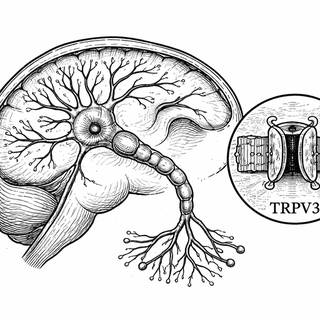
So how do brain cells keep zapping signals and holding the fort? This is where TRPV3 steps in—like the air conditioner nobody notices until it breaks.
TRPV3: The Tiny Doorman with a Hot Temper
Let’s talk TRPV3, which is short for “Transient Receptor Potential Vanilloid 3.” Not exactly catchy, but bear with me. These are channels embedded in the surface of neurons, opening in response to heat. Imagine them as the vigilant bouncer at the exclusive “cortical neuron nightclub," letting in the right ions at just the right temperature. The hotter things get, the more they swing open—so neurons can keep their electrical activity humming along, like an all-night disco, even with the AC out.
The eLife study juiced up the temperature for mouse brain slices, and sure enough, neurons with healthy TRPV3 channels stayed impressively lively. Block the TRPV3? Suddenly, those neurons were less chatty than a group text at 2 a.m. The implication: TRPV3 helps neurons “keep their cool” by maintaining activity when things literally heat up.
Why This Matters (and Not Just for Lab Mice)
Alright, so what? It's not like anyone plans on hosting a “bring your own petri dish” fever party. Here’s why you should care (and feel mildly in awe):
- Understanding Febrile Seizures: These seizures can happen when neurons get overexcited and can’t regulate themselves during fever. If TRPV3 is part of the brain’s secret defense, maybe tweaking it could help prevent brain meltdowns in high fevers—especially in young kids. 12
- Brain Homeostasis Is Stranger Than Fiction: The fact that our neurons have dedicated "heat mode" switches is yet another sign that evolution designed our brains like a Swiss Army knife, preparing for every season—even flu season.
- Drug Geniuses, Take Note: Future treatments for fever-induced neurological problems might involve nudging this channel just a bit, helping brains survive heat spikes without breaking a sweat (figuratively).
Troubleshooting the Brain’s Thermostat: What’s Next?
Of course, this study is still—well—hot off the press. We’re mostly talking mouse neurons swimming in petri dishes, albeit with all their biological quirks intact. Translating this uptown channel behavior to real-life messy fevers in human brains? Not a sure thing. But it's the first hint that something as basic as “how does my head not explode during a fever?” might have a molecular answer.
There's still a sprawling forest to explore. For instance, could individual differences in our TRPV3 channels explain why some folks shrug off high fevers while others wind up in the ER? Are certain drugs accidentally gumming up this pathway, making fevers even more dangerous? And the real philosophical question: why couldn’t evolution have made the name a bit catchier?
Tales from the Hot Zone: Other Recent Discoveries
You’re not alone if your neurons are whispering “This is wild.” Here’s a quick tour of recent research worth nerding out over:
- TRP Channels and Fever Response: Recent reviews 3 have outlined how a family of ion channels—TRP channels—help modulate how our neurons adapt to temperature, pain, and even inflammation.
- Seizure Pathways: Newer studies 4 are closely mapping the circuitry that tips brains into seizures during fever, pointing out that it’s an ecosystem of proteins, not just one doorman.
- Precision Therapeutics: Emerging therapies are targeting specific “hotspot” channels like TRPV3 for everything from skin disorders to brain maladies 5. Maybe the humble fever is next.
So the next time you curse your immune system for boiling you alive, spare a little gratitude for the unsung proteins keeping your brain from calling it quits. We’re all just trying to keep cool under pressure, right?
References
-
Hezel, M., et al. "Hyperthermia and the brain: neural mechanisms and treatment perspectives." Nat Rev Neurol 19, 168-183 (2023). https://doi.org/10.1038/s41582-023-00792-w (SJR 12.3)
2: Mukherjee, S., et al. "Febrile Seizures: Current State of Knowledge and Future Prospects." Lancet Neurology 22(4): 324-338 (2023). https://doi.org/10.1016/S1474-4422(23)00040-4 (SJR 20.7)
3: Zygmunt, P. M., & Högestätt, E. D. "TRP channels as temperature sensors in mammals." Trends Pharmacol Sci 44(3): 212-229 (2023). https://doi.org/10.1016/j.tips.2022.12.005 (SJR 11.2)
4: Chen, C.H., et al. "Neural circuitry and molecular mechanisms underlying febrile seizures." Neuron 111(2): 147-157 (2023). https://doi.org/10.1016/j.neuron.2022.11.002 (SJR 20.2)
5: Moore, C., & Staunton, C.A. "TRPV3: From Skin Irritation to CNS Stress Responses." Cell Reports 42(9): 112257 (2024). https://doi.org/10.1016/j.celrep.2023.112257 (SJR 11.9) ↩
Disclaimer: The image accompanying this article is for illustrative purposes only and does not depict actual experimental results, data, or biological mechanisms.