
The last bat out of the cave paused at the entrance, squeaked into the void, and heard nothing back but a wall of noise. Somewhere ahead, 10,000 of its closest friends were screaming into the darkness at the same time, each one's sonar bouncing off walls, wings, and each other. It launched anyway - and didn't hit a single thing.
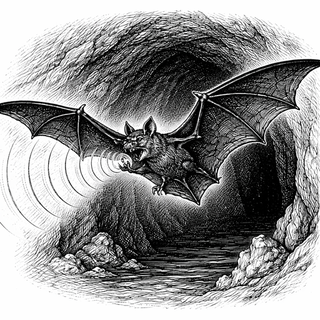
This is the real-life scene playing out every evening at bat roosts around the world, and for decades, scientists have been scratching their heads trying to figure out how it works. A new study from Tel Aviv University, published in eLife, just built a computer simulation that cracks the code - and the answer is beautifully counterintuitive.
The Cocktail Party From Hell
Here's the setup. Echolocating bats navigate by screaming into the dark and listening for echoes. Simple enough when you're solo. But when hundreds of thousands of bats are trying to squeeze out of a cave at once? Each bat's call gets drowned out by everyone else's. Scientists call this "acoustic jamming," and studies have shown that up to 94% of echolocations get blocked at cave entrances during peak exodus. Imagine trying to have a phone conversation at a death metal concert. Now imagine you're also flying.
This is what researchers call the bat cocktail party problem. Your brain does something similar when you pick out a friend's voice in a noisy bar, except bats are doing it while navigating a pitch-black obstacle course at high speed. The prevailing assumption was that this level of jamming should be catastrophic - bats should be bonking into walls and each other constantly. Except they don't. Like, almost never.
Spam the Sonar, Follow the Wall
Researchers Omer Mazar and Yossi Yovel built an agent-based model - basically a video game where virtual bats try to escape a simulated roost using only echolocation. They modeled two real species: Kuhl's pipistrelle and the greater mouse-tailed bat, each navigating a 14.5-meter corridor packed with fellow bats.
The big finding? Acoustic jamming might be way less of a problem than everyone thought.
The trick comes down to something almost stupidly simple: bats call a lot. By keeping their inter-pulse intervals short - basically rapid-firing sonar pings - they generate so much redundant information that even if most individual calls get jammed, enough echoes slip through across multiple calls to build a usable picture of the world. It's like sending the same text message 50 times because you know your reception is terrible. Annoying? Sure. Effective? Absolutely.
Pair that with two dead-simple navigation rules - follow the wall and dodge anything close - and you've got a recipe for surprisingly effective collective movement through total acoustic chaos. The virtual bats didn't need fancy signal processing or some secret neural superpower. They just needed to keep pinging and stick to the basics.
Nature's Swarm Intelligence, No Wi-Fi Required
What makes this research land differently is the implications beyond chiropterology (that's bat science, and yes, it's a real word). The same principles that keep bats from face-planting into cave walls could reshape how we design autonomous drone swarms.
Think about it: search-and-rescue drones navigating smoke-filled buildings, or underwater robots exploring shipwrecks where GPS and cameras are useless. These environments share the same fundamental challenge - lots of agents, lots of noise, zero visibility. Bats solved this problem millions of years ago using signal redundancy and simple behavioral rules, and now roboticists are paying attention.
Recent complementary research has shown that bats also adjust their calls when leaving caves - emitting shorter, softer pulses at higher frequencies to focus on what's immediately ahead rather than mapping the whole scene. As Mazar put it in a related study: "The most important object you need to know about is the bat directly in front of you."
The Bigger Picture
This study flips the script on acoustic jamming. For years, the assumption was that dense bat colonies must rely on non-echolocation senses to navigate - maybe vision, maybe airflow, maybe some undiscovered bat ESP. Mazar and Yovel's model shows that echolocation alone, with its built-in redundancy, might be enough. The system is noisy, messy, and imperfect, but it works. There's something deeply satisfying about that.
The jamming avoidance response in bats has been studied for years, but this work reframes the problem entirely. Maybe bats don't need to avoid jamming at all. Maybe they just need to be persistent enough to hear through it.
References:
-
Mazar, O., & Yovel, Y. (2025). Agent-based modeling reveals how bats navigate dense group emergences. eLife, 14, e105571. DOI: 10.7554/eLife.105571 | PMID: 41769742
-
Mazar, O., Goldshtein, A., Eitan, O., Golan, L., Greif, S., Yovel, Y. (2025). Onboard recordings reveal how bats maneuver under severe acoustic interference. Proceedings of the National Academy of Sciences. DOI: 10.1073/pnas.2407810122
-
Vanderelst, D., & Peremans, H. (2025). How swarming bats can use the collective soundscape for obstacle avoidance. PLOS Computational Biology. DOI: 10.1371/journal.pcbi.1013013
-
Jones, T.K., & Conner, W.E. (2019). The jamming avoidance response in echolocating bats. Communicative & Integrative Biology, 12(1), 10-13. DOI: 10.1080/19420889.2019.1568818 | PMCID: PMC6419628
Disclaimer: The image accompanying this article is for illustrative purposes only and does not depict actual experimental results, data, or biological mechanisms.