
Ever freeze in front of the fridge at midnight, torn between the leftover pizza calling your name and the memory of promising yourself you'd eat better? Congratulations - your dorsomedial prefrontal cortex was having a tiny existential crisis.
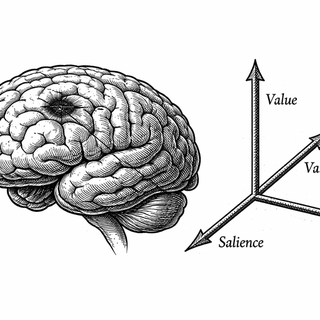
A new study published in Nature by Nanci Winke and colleagues just pulled back the curtain on how a small patch of brain real estate sorts the entire world into "go get it" and "get away from it" - and the answer turns out to be surprisingly geometric.
Your Brain Runs a Three-Channel Sorting Hat
Here's the thing about staying alive: you need to constantly evaluate whether stuff in your environment is worth approaching or avoiding. A ripe berry? Approach. A rustling bush that might hide a predator? Maybe not. Your brain handles this by processing three separate channels of information simultaneously, like a nature documentary running three storylines at once.
Value - how much reward or punishment you expect. Valence - whether something is positive or negative. Salience - how much it grabs your attention regardless of whether it's good or bad.
What Winke's team discovered is that the dorsomedial prefrontal cortex (dmPFC) doesn't just mush these three signals together into some vague "gut feeling." Instead, neurons in this region encode them along completely independent axes - like the x, y, and z coordinates on a map. The technical term is "orthogonal," which is a fancy way of saying these information channels don't interfere with each other (Winke et al., 2026).
Think of it like a weather station that separately tracks temperature, humidity, and wind speed. Each sensor does its own thing, but together they tell you whether to grab a jacket or stay inside.
Watching Neurons Learn in Real Time
The team used calcium imaging to watch individual neurons light up in freely-moving mice as the animals learned to associate specific sounds with different outcomes - some leading to sweet rewards, others to mild punishments. As the mice got better at telling the cues apart, something remarkable happened: the neural representations got sharper and more organized, like a garden gradually separating its flower beds from its vegetable patches.
Early on, dmPFC activity was messy and overlapping. But as learning progressed, distinct subpopulations of neurons carved out their own territories - some specializing in valence (is this good or bad?), others in salience (should I pay attention?). The geometry of these neural maps didn't just reflect what the mice had learned. It actively predicted their behavioral choices - whether they'd approach a reward or freeze to avoid a threat.
Why Geometry Matters When You're Trying to Stay Alive
This isn't just an elegant mathematical observation. The orthogonal organization solves a real engineering problem. If your brain encoded "this is scary" and "this is attention-grabbing" along the same neural dimension, you'd constantly confuse a loud birthday party with an approaching bear. Both are high-salience events, but they call for very different responses. Previous work has shown that the brain uses distinct circuit motifs - labeled lines, divergent paths, opposing components - to keep valence signals from getting tangled (Tye, 2018).
By keeping these channels geometrically separated, the dmPFC acts like an ecosystem maintaining clear boundaries between its microhabitats - each one supporting different species of behavior without cross-contamination. Earlier research demonstrated that the prefrontal cortex and hippocampus use geometric arrangements to organize abstract information (Bernardi et al., 2020), but nobody had shown how this geometry actively steers an animal's moment-to-moment motivated behavior until now.
The Part Where This Gets Personal
Here's where it gets uncomfortably relevant to your life. Daniel Jercog, one of the study's authors, pointed out that many mental health conditions might boil down to warped versions of exactly this geometry. Anxiety? Your brain overestimates threats - the "bad stuff" axis is stretched too far. Addiction? The "good stuff" axis is cranked up to eleven. Depression? The reward channel barely registers anymore, like a radio turned down so low you forget music exists. Research into how the prefrontal cortex controls anxiety-related approach-avoidance behavior is already revealing that distinct cell types and neural pathways modulate these decisions in opposing ways (Mack et al., 2022).
If the dmPFC is essentially running a coordinate system for motivation, then psychiatric conditions might represent distortions of that inner map - not broken circuits, but bent geometry. That reframes the question from "what's wrong with this brain?" to "how did this brain's map get warped, and can we straighten it out?"
We're a long way from geometry-correcting brain treatments, but understanding the blueprint is how every repair job starts. And right now, thanks to some curious mice and a team with excellent imaging equipment, that blueprint just got a lot clearer.
References
-
Winke, N., Lüthi, A., Herry, C. & Jercog, D. (2026). Prefrontal neural geometry of learned cues guides motivated behaviours. Nature, 651(8104), 164-173. DOI: 10.1038/s41586-025-09902-2
-
Tye, K.M. (2018). Neural Circuit Motifs in Valence Processing. Neuron, 100(2), 436-452. DOI: 10.1016/j.neuron.2018.10.001 | PMCID: PMC6590698
-
Bernardi, S., Benna, M.K., Rigotti, M., Munuera, J., Fusi, S. & Salzman, C.D. (2020). The Geometry of Abstraction in the Hippocampus and Prefrontal Cortex. Cell, 183(4), 954-967. DOI: 10.1016/j.cell.2020.09.031
-
Mack, N.R., Deng, S.X., Yang, S.S., Shu, Y.S. & Gao, W.J. (2022). Prefrontal cortical control of anxiety: Recent advances. The Neuroscientist. DOI: 10.1177/10738584211069071 | PMCID: PMC9869286
Disclaimer: The image accompanying this article is for illustrative purposes only and does not depict actual experimental results, data, or biological mechanisms.