
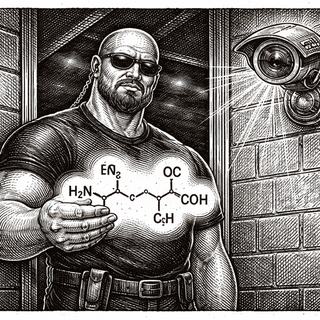
If this were a movie, GABA would be that bouncer at the velvet rope who decides which neurons get to party and which ones need to cool it. And iGABASnFR2? That's the high-def security camera upgrade that finally lets us watch the bouncer work in real time. Before now, we've been squinting at grainy footage, but this new tech just went 4K.
Here's the setup: your brain runs on a delicate balance between neurons that shout "GO!" (excitatory) and neurons that whisper "maybe sit this one out" (inhibitory). GABA (gamma-aminobutyric acid) is the main inhibitory neurotransmitter, basically the neurochemical equivalent of a chill pill. When GABA shows up at the synapse - that tiny gap where neurons chat - it tells the receiving neuron to pump the brakes. Without it, your brain would be a chaotic mosh pit of overactive neurons, which sounds fun until you realize that's basically what a seizure is.
The problem? For decades, scientists have been trying to watch GABA do its thing in living brains, and it's been frustratingly difficult. You can't just sprinkle some dye on it and call it a day. You need a molecular tool that lights up when GABA is around, works in real time, and doesn't mess with normal brain function. The first-generation sensor, iGABASnFR, was a solid proof of concept, but it had issues. Think of it as the iPhone 3G of GABA sensors - revolutionary for its time, but let's be honest, the signal was weak and the response time was sluggish.
The Protein Engineering Speed-Run
So what did the team do? They went full mad scientist and systematically mutated the sensor protein at multiple sites - near-saturation mutagenesis, which is science-speak for "we tried a LOT of variations." They tested thousands of sensor variants in cultured neurons, looking for the ones that lit up brighter and faster when GABA showed up at the synapse.
The result: iGABASnFR2, which is 4.1 times more sensitive than the original and responds 30% faster. That might not sound like a blockbuster improvement until you realize that in neuroscience, those numbers are the difference between "I think I saw something" and "holy crap, look at that!"
They also stumbled onto something weird and useful: a sensor that does the opposite. Instead of getting brighter when GABA binds, iGABASnFR2n gets dimmer. It's like having both a smoke detector and a carbon monoxide detector - if both are going off, you know you're not hallucinating. This negative-going sensor acts as a built-in reality check for experiments.
Your Retina Has Directional Preferences (And We Can Finally See Why)
Here's where it gets wild. Your retina - that thin sheet of neural tissue at the back of your eyeball - doesn't just passively detect light. It does serious computational heavy lifting, including figuring out which direction things are moving. Some retinal neurons are tuned to motion in specific directions, like having built-in movement detectors.
Scientists have known for years that GABA release from specialized cells called starburst amacrine cells is critical for this direction selectivity, but they couldn't directly measure it happening. With iGABASnFR2, the team captured the first real-time measurements of direction-selective GABA release in the retina. Turns out, GABA gets released preferentially when visual stimuli move in certain directions, creating an asymmetric veto system that sculpts the responses of downstream neurons.
That's your eye doing vector calculus before your cortex even gets the memo.
Volume Transmission: GABA's Loudspeaker Mode
The team also used iGABASnFR2 to image GABA release in the somatosensory cortex of living mice - specifically, the part that processes whisker sensation. (Mice use their whiskers like we use fingertips, constantly twitching them to explore their environment.) When they stimulated the whiskers, they saw GABA release that wasn't just confined to individual synapses.
This is volume transmission - GABA spilling out beyond the tight synaptic cleft and affecting nearby neurons. It's less like a targeted text message and more like someone shouting across a room. The original sensor could barely detect this; iGABASnFR2 saw it clearly. This matters because volume transmission may play a bigger role in brain signaling than we thought, especially in how different brain regions coordinate their activity.
Why This Actually Matters
Look, genetically encoded sensors might sound like niche lab toys, but they're rewriting what we know about how brains compute. The reason? Specificity and speed. You can target these sensors to specific cell types, watch neurotransmitters move in real time, and do it in living, behaving animals. That's a different universe from grinding up brain tissue or using electrodes that can only tell you about electrical activity, not chemical signaling.
With tools like iGABASnFR2, researchers can finally ask questions that were previously unanswerable: How does inhibition shape neural circuits during learning? What goes wrong with GABAergic signaling in epilepsy, autism, and schizophrenia? Can we identify new drug targets by watching GABA dynamics go sideways in disease models?
The sensor field is exploding right now. There are next-generation sensors for serotonin, dopamine, and a whole pharmacy's worth of other neurotransmitters, each getting brighter, faster, and more reliable. iGABASnFR2 is part of that wave - a methodological leap that makes previously impossible experiments routine.
The Bottom Line
Your brain is a staggeringly complex network where excitation and inhibition dance in millisecond precision. GABA is the master of ceremonies for the inhibition side, and we've just upgraded our ability to watch it work. From retinal direction selectivity to cortical sensory processing, iGABASnFR2 is opening windows into neural computations that happen too fast and too locally for most other techniques to catch.
That bouncer at the neuronal nightclub? We can finally see exactly who they're letting in, who they're turning away, and how that shapes the whole party.
References
-
Kolb, I., Hasseman, J.P., Matsumoto, A., et al. (2025). iGABASnFR2 is an improved genetically encoded protein sensor of GABA. eLife, 14:e108319. DOI: 10.7554/eLife.108319
-
Marvin, J.S., Shimoda, Y., Magloire, V., et al. (2019). A genetically encoded fluorescent sensor for in vivo imaging of GABA. Nature Methods, 16, 763-770. DOI: 10.1038/s41592-019-0471-2
-
Qian, Y., Barzaghi, C., Schneider, R., et al. (2018). GABA release selectively regulates synapse development at distinct inputs on direction-selective retinal ganglion cells. PNAS, 115(51), E12083-E12090. DOI: 10.1073/pnas.1803490115
-
Siemann, J.K., Muller, C.L., Forsberg, C.G., et al. (2025). A comprehensive review of GABA in autism spectrum disorders. Frontiers in Psychiatry, 16, 1587432. DOI: 10.3389/fpsyt.2025.1587432
-
Unger, E.K., Keller, J.P., Altermatt, M., et al. (2022). Next generation genetically encoded fluorescent sensors for serotonin. Nature Communications, 13, 7525. DOI: 10.1038/s41467-022-35200-w
-
Wu, Z., He, K., Chen, Y., et al. (2024). Genetically encoded sensors for the in vivo detection of neurochemical dynamics. Nature Reviews Neuroscience, 25(4), 271-291. Review article on biosensor development
-
Cleveland Clinic. (2024). Gamma-Aminobutyric Acid (GABA): What It Is, Function & Benefits. Health Reference
Disclaimer: The image accompanying this article is for illustrative purposes only and does not depict actual experimental results, data, or biological mechanisms.