
For years, a lot of motor-learning research has treated sequence learning like a child’s bracelet pattern: red bead, blue bead, red bead, blue bead, everyone clap. Nice. Tidy. Also a little fake. Real movement does not work like that. Walking through a crowd, playing piano, typing, speaking, catching a falling phone before it kisses the pavement - these all run on messy probabilities, not neat little loops.
That is the point of a new review by Mikael Novén and Anke Ninija Karabanov: motor neuroscience may have been asking sequence-learning questions that are too small for the real-world thing it claims to study. Instead of focusing mainly on simple repeated patterns or local transition probabilities, they argue we should study probabilistic systems - broader rule sets that govern which actions are likely, appropriate, or efficient in context Novén & Karabanov, 2025.
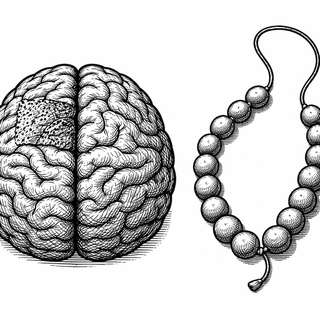
The brain is not memorizing beads
A lot of classic sequence-learning tasks test whether people pick up on recurring orders. Press this, then that, then this again. Maybe with a few probabilistic tweaks. Useful, sure. But it can miss the bigger question: are people learning a specific sequence, or are they learning the grammar that generates many possible sequences?
That distinction matters.
Psycholinguistics has been messing with this problem for years. In artificial grammar learning, researchers do not just ask whether people recognize a trained string. They ask whether people have absorbed the rules well enough to handle new strings generated by the same system. Basically: did your brain memorize the playlist, or did it learn the genre?
Novén and Karabanov argue that motor research should steal this idea immediately. Respectfully. Like a scientist.
Local tricks vs the whole casino
Here is the core issue. A sequence can contain:
- Local statistical regularities - for example, movement A is often followed by movement B.
- Global probabilistic structure - a larger rule system constrains which sequences make sense overall.
If you only test local stats, you may conclude someone learned “the sequence” when they actually learned a few cheap transition tricks. That is like claiming you understand jazz because you noticed saxophones show up a lot.
The review proposes a framework for separating these levels. It discusses how to build movement sequences using algorithms borrowed from artificial grammar research, and how to test whether participants can generalize what they learned to novel sequences that follow the same hidden rules. That last part is the big one. Generalization is where memorization gets exposed. The brain either knows the rules or stands there blinking.
Why this matters outside the lab, where people inconveniently behave like people
Real motor behavior is probabilistic all the way down. You do not move through the world by replaying one exact script. You adapt. You predict. You improvise within constraints.
Think about:
- Sports - opponents are not deterministic robots, sadly for coaches.
- Music performance - style depends on lawful variation, not copy-paste finger choreography.
- Speech and gesture - full of patterned flexibility.
- Rehabilitation - patients need transferable skills, not just one lab trick done very well under fluorescent lighting.
If research only measures learning of narrow patterns, it may underestimate how humans acquire flexible motor knowledge. That has consequences for training, rehab, and theories about whether sequence learning works similarly across domains like language and action.
This cross-domain angle is especially interesting. Reviews in cognitive science have long argued that statistical learning shows up in language, vision, and audition, but whether these rely on shared or partly separate mechanisms remains debated Frost et al., 2015. In motor learning, prediction and adaptation also seem to depend on extracting environmental regularities, often without explicit awareness Maheu et al., 2020. So if motor studies use impoverished sequence designs, comparisons with language-style learning become a bit unfair. Like comparing chess to tic-tac-toe and announcing bold conclusions about “board-game cognition.”
The methods are the message
The paper is also a methodological nudge - fine, a shove.
The authors want researchers to be more explicit about what exactly a task is testing:
- simple repetition?
- local transition probabilities?
- hierarchical constraints?
- genuine acquisition of a probabilistic ruleset?
That sounds dry until you realize whole theories can wobble if the task measures something narrower than the paper claims. Experimental design, in this case, is not boring housekeeping. It is the difference between “people learned a motor grammar” and “people got weirdly good at one specific button sequence.”
Recent work on sequence learning and prediction supports this broader view. Studies of implicit statistical learning suggest humans can acquire structured regularities at multiple levels, though transfer and abstraction depend heavily on task design Conway, 2020. Reviews of motor sequence learning also emphasize that what looks like a single skill often reflects interacting processes - chunking, prediction, habit, explicit strategy, and flexible control Hardwick et al., 2019.
So what now?
If this approach catches on, motor neuroscience could build tasks that look a little less like toy examples and a little more like actual behavior. That would help researchers ask better questions about transfer, flexibility, skill, and whether the brain uses common tricks across movement and language.
Also, frankly, it would make the field harder to fool. Which is always healthy. The brain is a sneaky little gremlin. If you give it a shortcut, it will take it.
And that is really what this paper is about. Not just better sequence learning studies. Better honesty about what people have learned.
References
- Novén M, Karabanov AN. Rethinking probabilistic sensorimotor sequence learning: Focus on probabilistic systems instead of simple patterns. Neurosci Biobehav Rev. 2025; DOI: 10.1016/j.neubiorev.2025.106538
- Frost R, Armstrong BC, Siegelman N, Christiansen MH. Domain generality versus modality specificity: The paradox of statistical learning. Cogn Psychol. 2015;81:1-32. DOI: 10.1016/j.cogpsych.2015.03.001
- Maheu M, Dehaene S, Meyniel F. Brain signatures of a multiscale process of sequence learning in humans. Nat Rev Neurosci. 2020;21(5):287-300. DOI: 10.1038/s41583-020-0271-3
- Conway CM. How does the brain learn environmental structure? Ten core principles for understanding the neurocognitive mechanisms of statistical learning. Ann N Y Acad Sci. 2020;1464(1):13-45. DOI: 10.1111/nyas.14322
- Hardwick RM, Celnik PA, et al. Neural mechanisms of motor sequence learning: A systematic review and meta-analysis. eLife. 2019;8:e47463. PMCID: PMC6609979
Disclaimer: The image accompanying this article is for illustrative purposes only and does not depict actual experimental results, data, or biological mechanisms.