
A Netflix queue that refuses to autoplay. A vending machine that swallows your dollar and just... stares at you. Tiny brain bubbles packed with neurotransmitters that suddenly decide they're not in the mood to do their one job. Three very different things, one shared vibe: systems that have everything they need to work but simply won't.
That last one? That's the real story here, and it's wilder than it sounds.
Your Brain Runs on Tiny Chemical Care Packages
Here's the setup. Your neurons talk to each other by launching little packets called synaptic vesicles across the gap between cells. These vesicles are loaded with neurotransmitters, and when a calcium signal hits, they fuse with the membrane and dump their cargo. Message delivered. It's like the world's most efficient postal service, running billions of deliveries per second.
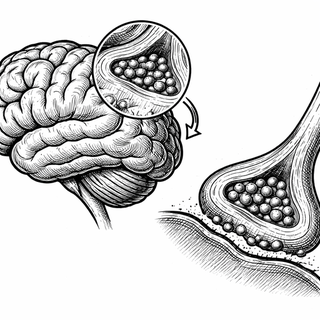
But not all vesicles are equally eager. Some are docked at the membrane ready to go (the "readily releasable pool"), while others hang back in reserve like that coworker who only shows up when the boss is watching. Neuroscientists have known about these different pools for a while. What they didn't fully appreciate was that a vesicle sitting right at the launch pad could just... refuse to launch.
Enter the reluctant vesicle.
GPR55: The Cannabinoid Receptor Nobody Talks About
You've probably heard of CB1 receptors. They're the ones that THC activates to get you high, and they've been studied to death. But lurking in the brain's receptor lineup is GPR55, sometimes called the "third cannabinoid receptor," and it's been flying under the radar since it was cloned back in 1999.
GPR55 is especially abundant in the cerebellum, that wrinkly cauliflower at the back of your brain that handles motor coordination and timing. It responds to endocannabinoids your brain makes naturally and, here's the kicker, it's sensitive to cannabidiol (CBD), the non-psychoactive compound in cannabis that's been slapped on everything from gummy bears to dog treats (Syliangco et al., 2025).
CBD actually works as an antagonist at GPR55, meaning it blocks the receptor rather than activating it. That's a totally different relationship than what THC has with CB1. And as this new study reveals, GPR55 itself plays a very different game than CB1 when it comes to turning down the volume on synaptic signals.
The Plot Twist: Same Result, Totally Different Trick
Researchers Takuma Inoshita and Shin-Ya Kawaguchi at Kyoto University pulled off something technically bonkers. They directly patch-clamped the axon terminals of cerebellar Purkinje cells in rats. These terminals are tiny, and recording from them is like performing surgery on a grain of sand. But the payoff was worth it.
Here's what they found: when GPR55 is activated, neurotransmitter release drops substantially. The inhibitory postsynaptic currents shrank to about 43% of their original size. Sounds a lot like what CB1 does, right?
Wrong. Or rather, same destination, completely different route.
CB1 receptors suppress transmission by reducing calcium influx into the terminal. Less calcium, less signal to trigger vesicle release. Simple plumbing. GPR55 does something sneakier. It leaves the calcium alone. The action potentials fire normally. The calcium floods in exactly as it should. But the vesicles sitting there, surrounded by calcium, just don't respond (Inoshita & Kawaguchi, 2026).
It's like ringing a doorbell in a house full of people and everyone pretends they're not home.
Reluctant Vesicles: When "Ready" Doesn't Mean "Willing"
Using a fluorescent tool called synapto-pHluorin to watch individual vesicles release their contents, the team showed that GPR55 activation converts a large chunk of the readily releasable pool into what they call "reluctant" vesicles. These vesicles are physically in position, biochemically loaded, bathed in calcium, and completely uninterested in fusing with the membrane.
This is a fundamentally different way of dialing down a synapse. Previous work showed that GPR55 signals through G-proteins like Gαq and Gα13, potentially rearranging the cytoskeleton through the RhoA/ROCK pathway rather than dampening calcium channels the way CB1 does (Lauckner et al., 2008). The downstream machinery that normally couples calcium to vesicle fusion gets decoupled. The doorbell works. Nobody answers.
Why This Matters Beyond the Lab Bench
Look. The cerebellum isn't just about catching a ball or walking straight. It's increasingly recognized as a player in cognition, emotion, and even conditions like autism and schizophrenia. Understanding how GPR55 fine-tunes Purkinje cell output matters because these cells are the cerebellum's sole output neurons. Every signal leaving the cerebellar cortex passes through them.
And then there's CBD. With GPR55 emerging as a target for cannabidiol's effects on epilepsy, anxiety, and neuroprotection (Kaplan et al., 2017), knowing exactly how this receptor modulates synaptic transmission isn't just academic trivia. It's the kind of mechanistic detail that could shape future therapeutics.
Previous work had shown GPR55 can actually boost neurotransmitter release at hippocampal synapses (Sylantyev et al., 2013), which means this receptor doesn't have a single "volume knob" effect. It's context-dependent, varying by brain region and synapse type. That complexity is exactly why studies like this one, peeling apart the mechanism at a specific synapse with surgical precision, are so valuable.
The Bottom Line
Two cannabinoid receptors. Same outcome (less neurotransmitter release). Completely different playbooks. CB1 cuts the power. GPR55 convinces the workers to sit down. And somewhere in that distinction might be the key to understanding why CBD does what it does in the brain, and how we could do it better.
References
-
Inoshita, T., & Kawaguchi, S.-Y. (2026). Increased reluctant vesicles underlie synaptic depression by GPR55 in axon terminals of rat cerebellar Purkinje cells. eLife, 14, e105268. DOI: 10.7554/eLife.105268
-
Sylantyev, S., Jensen, T. P., Ross, R. A., & Bhatt, D. (2013). Cannabinoid- and lysophosphatidylinositol-sensitive receptor GPR55 boosts neurotransmitter release at central synapses. Proceedings of the National Academy of Sciences, 110(13), 5193-5198. DOI: 10.1073/pnas.1211204110
-
Lauckner, J. E., Jensen, J. B., Chen, H.-Y., et al. (2008). GPR55 is a cannabinoid receptor that increases intracellular calcium and inhibits M current. Proceedings of the National Academy of Sciences, 105(7), 2699-2704. DOI: 10.1073/pnas.0711278105
-
Kaplan, J. S., Bhatt, A. K., & Bhatt, S. R. (2017). A role of GPR55 in the antiepileptic properties of cannabidiol (CBD). Neurology, 90(15 Supplement), P2.277. DOI: 10.1212/WNL.90.15_supplement.P2.277
-
Syliangco, C. V. P., et al. (2025). Targeting GPR55 with Cannabidiol Derivatives: A Molecular Docking Approach Toward Novel Neurotherapeutics. Processes, 13(10), 3261. DOI: 10.3390/pr13103261
Disclaimer: The image accompanying this article is for illustrative purposes only and does not depict actual experimental results, data, or biological mechanisms.