
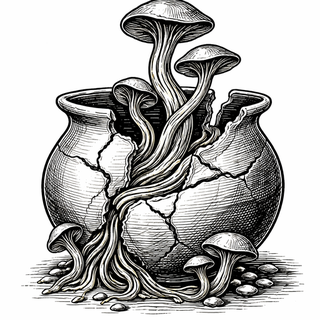
There's a word in Japanese - kintsugi - that has no English translation. It refers to the art of repairing broken pottery with gold, making the repaired object more beautiful than the original. It's a nice metaphor for resilience, but neuroscience doesn't usually deal in metaphors. Except, apparently, when researchers hand psilocybin to rats with brain injuries and watch their neurons start doing something that looks a whole lot like biological kintsugi.
The Invisible Epidemic Nobody's Talking About
Here's a statistic that should make you set down your coffee: up to 75% of women who experience intimate partner violence (IPV) will sustain a traumatic brain injury. Let that sink in. We're not talking about a niche problem. One in three women worldwide experiences IPV in their lifetime, and the vast majority of physical attacks target the head, neck, and face - or involve strangulation (Toccalino et al., 2022). That's a staggering number of brain injuries flying completely under the medical radar.
Unlike a concussion from football (which gets its own primetime documentary), IPV-related brain injury is repetitive, cumulative, and almost never screened for. Many survivors don't even realize they've had a brain injury. They just know something feels off - the memory problems, the fog, the anxiety that never quite goes away. Researchers have started calling this a "distinct phenotype" of brain injury, because combining blunt force trauma with strangulation (which cuts off oxygen to the brain) creates a uniquely nasty cocktail of damage (Esopenko et al., 2024).
Enter the Magic Mushroom (Scientifically Speaking)
This is where things get interesting. A team led by researchers from Monash University, Vancouver Island University, and the University of Victoria decided to ask a question nobody had asked before: could psilocybin - the psychoactive compound in magic mushrooms - help reverse the chronic brain damage caused by IPV?
To test this, they built the first-ever rat model of recurrent IPV-related brain injury. Female rats received daily mild traumatic brain injuries plus 90 seconds of non-fatal strangulation for five consecutive days (science is not for the faint of heart). After 16 weeks of recovery - during which the rats developed anxiety, depression-like behavior, and cognitive problems - the researchers administered psilocybin (Allen et al., 2025).
The results? Pretty remarkable, actually.
Your Brain on Psilocybin (The Good Parts)
Psilocybin reversed anxiety-like and depression-like behaviors in the injured rats. Their performance on memory and learning tasks improved. But the real plot twist was what happened inside their brains.
The researchers found decreased microglial activation in the hippocampus - translation: the brain's inflammatory response, which had been stuck in overdrive for months, finally calmed down. They also saw increased reelin-positive cells, which is a big deal because reelin is basically your brain's project manager for neuroplasticity - it helps neurons grow, migrate, and form new connections (Zhao et al., 2024).
And here's the kicker: when they blocked the serotonin 2A (5-HT2A) receptor - psilocybin's main docking station in the brain - the benefits vanished. So this isn't some vague, hand-wavy "mushrooms make you feel better" situation. There's a specific receptor, a specific mechanism, and a measurable biological outcome.
Why This Actually Matters
Effective treatments for IPV-related brain injury are, to put it diplomatically, scarce. Most brain injury research focuses on athletes and military personnel. Survivors of domestic violence - overwhelmingly women - have been largely left out of the conversation (Sun et al., 2025).
Psilocybin is already showing promise for treatment-resistant depression, PTSD, and anxiety (it was approved for treatment-resistant depression in Australia in 2023). But this study suggests something beyond mood improvement - it points toward actual neurobiological repair. Reduced inflammation. Enhanced plasticity. A brain that's not just feeling better but physically rebuilding itself.
Now, the obligatory reality check: these are rats, not humans. A clinical trial is underway combining psilocybin with Acceptance and Commitment Therapy for IPV survivors with PTSD, but we're still early days. Brains are complicated. (If I had a dollar for every rodent study that didn't translate to humans, I could fund my own clinical trial.)
But the fact that someone finally built an animal model for this type of injury, and that the first treatment they tested actually worked through identifiable biological pathways? That's not nothing. For the millions of women carrying invisible brain injuries from violence they survived, even the possibility of repair is worth paying attention to.
References
-
Allen, J., Sun, M., Baker, T.L., Dames, S., Kryskow, P., Christie, B.R., McDonald, S.J., & Shultz, S.R. (2025). Psilocybin mitigates chronic behavioral and neurobiological alterations in a rat model of recurrent intimate partner violence-related brain injury. Molecular Psychiatry. DOI: 10.1038/s41380-025-03329-x
-
Esopenko, C., et al. (2024). Intimate Partner Violence-Related Brain Injury: Unmasking and Addressing the Gaps. Journal of Neurotrauma, 41(19-20), 2219-2237. DOI: 10.1089/neu.2023.0543 | PMCID: PMC11564844
-
Sun, M., et al. (2025). Pathophysiology, blood biomarkers, and functional deficits after intimate partner violence-related brain injury. Brain, Behavior, and Immunity, 123, 383-396. DOI: 10.1016/j.bbi.2024.09.030
-
Toccalino, D., et al. (2022). The Intersection of Intimate Partner Violence and Traumatic Brain Injury. Journal of Head Trauma Rehabilitation, 37(1), E20-E29. DOI: 10.1097/HTR.0000000000000743
-
Zhao, X., et al. (2024). Psilocybin promotes neuroplasticity and induces rapid and sustained antidepressant-like effects in mice. Journal of Psychopharmacology, 38(5), 489-499. DOI: 10.1177/02698811241249436
Disclaimer: The image accompanying this article is for illustrative purposes only and does not depict actual experimental results, data, or biological mechanisms.