
Touch is tricky. For decades, pain researchers have faced an absurd paradox: to study how animals respond to sensory stimuli, you essentially had to immobilize them - which rather defeats the purpose of understanding natural behavior. It's a bit like trying to study someone's running technique by strapping them to a chair.
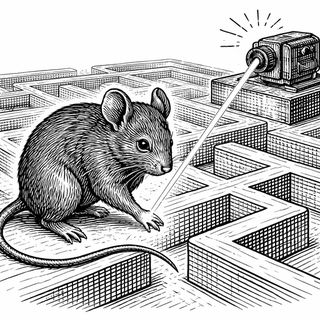
A team at University College London has now built something that elegantly sidesteps this problem: a closed-loop system that tracks mice as they scurry about and zaps their paws with laser precision, all without restraining them or requiring any human intervention whatsoever.
The Old Way Was Rubbish
Traditional pain testing involves restraining rodents in small chambers and poking at their paws with heated plates, mechanical probes, or other implements that would make a medieval torturer nod appreciatively. The problem, beyond the obvious ethical discomfort, is scientific: a restrained, stressed animal doesn't behave like a normal animal. And stress profoundly alters pain perception.
Previous attempts at studying freely moving mice required either imprecise stimulation (heat lamps pointed vaguely at an arena) or tethered optogenetic systems that still limited natural movement. The research community has been stuck choosing between precision and ecological validity - rather like being offered a choice between accurate and useful.
Enter the Robot Paw-Poker
The new system from Parkes and colleagues (DOI: 10.7554/eLife.106033) combines three technologies that have matured considerably in recent years: deep learning-based pose estimation (specifically DeepLabCut-Live), galvanometer-controlled laser targeting, and transdermal optogenetics.
Here's how it works: cameras track the mouse in real-time, machine learning identifies specific body parts frame by frame, and galvo mirrors steer lasers to deliver stimuli with sub-millimeter accuracy - all within about 84 milliseconds of each video frame. The system achieved a 95.5% hit rate on hind paws during normal movement, dropping only during particularly athletic sprints.
The researchers used two types of stimulation: infrared lasers for thermal pain (the classic "hot plate" stimulus, now delivered with sniper precision) and blue lasers for optogenetic activation of genetically modified nociceptors expressing channelrhodopsin-2. Both approaches produced the expected nocifensive behaviors - paw withdrawal, head turning, the whole repertoire - but now observable in mice wandering through mazes rather than pinned under observation.
Why This Matters Beyond Cool Technology
Pain research has a translation problem. Despite decades of work, very few preclinical findings have produced effective new analgesics in humans. One suspected culprit: our models are too artificial. Testing reflexes in restrained animals may tell us something about spinal cord processing, but it says little about how sensory information integrates with ongoing behavior, decision-making, or emotional state.
The UCL system opens several previously inaccessible experimental doors. Researchers can now study how identical stimuli produce different responses depending on what the animal was doing when stimulated. They can examine how sensory events influence decisions in maze navigation. They can watch reflexes unfold in their natural temporal context rather than as isolated twitches.
Perhaps most intriguingly, the system revealed that mice respond differently to stimulation during movement versus when stationary - a finding that sounds obvious but has been remarkably difficult to demonstrate cleanly.
The Quiet Revolution in Behavioral Neuroscience
This work sits within a broader transformation in how we study animal behavior. The combination of markerless pose tracking, closed-loop feedback systems, and targeted optogenetics is enabling experiments that would have seemed fantastical a decade ago. We're moving from asking "does this neuron respond to touch?" toward understanding how sensory systems actually operate in behaving creatures navigating complex environments.
One suspects Charles Sherrington, who coined the term "nociceptor" in 1906, would be quietly pleased. He always insisted on studying the "integrative action" of the nervous system - how its components work together in the intact, behaving organism. We're finally building tools adequate to that vision.
The mice, presumably, have no opinion on the matter. Though they do seem to prefer exploring mazes to sitting in hot plate chambers. One can hardly blame them.
References
-
Parkes I, Schorscher-Petcu A, Gan Q, Browne LE. Precision cutaneous stimulation in freely moving mice. eLife. 2025;13:RP106033. DOI: 10.7554/eLife.106033. PMID: 41817421
-
Lauer J, Zhou M, Ye S, et al. Multi-animal pose estimation, identification and tracking with DeepLabCut. Nature Methods. 2022;19(4):496-504. DOI: 10.1038/s41592-022-01443-0. PMCID: PMC9007739
-
Pereira TD, Tabris N, Matsliah A, et al. SLEAP: A deep learning system for multi-animal pose tracking. Nature Methods. 2022;19(4):486-495. DOI: 10.1038/s41592-022-01426-1
-
Mogil JS. Animal models of pain: progress and challenges. Nature Reviews Neuroscience. 2009;10(4):283-294. DOI: 10.1038/nrn2606
-
Iyer SM, Montgomery KL, Towne C, et al. Virally mediated optogenetic excitation and inhibition of pain in freely moving nontransgenic mice. Nature Biotechnology. 2014;32(3):274-278. DOI: 10.1038/nbt.2834. PMCID: PMC3988230
Disclaimer: The image accompanying this article is for illustrative purposes only and does not depict actual experimental results, data, or biological mechanisms.