
Here's something that'll flip your bedtime lecture on its head: some teenagers who sleep less than eight hours a night are doing just fine. Their brains are basically shrugging and saying, "We got this." Meanwhile, other short-sleeping teens are quietly collecting neurological IOUs that come due with interest. The problem? Until now, we've been treating all of them the same.
Your Brain on Too Little Sleep (Maybe)
A team of researchers led by Yiwei Chen and colleagues just dropped a study in Nature Communications that essentially tells us to stop lumping all short-sleeping adolescents into one worried-parent bucket. Using brain MRI data from over 11,000 kids in the massive ABCD Study - think of it as the census of adolescent brain science - they fed cortical thickness measurements into an algorithm called SuStaIn (Subtype and Stage Inference), a machine learning tool originally built to untangle Alzheimer's subtypes (Young et al., 2018). Turns out, it works on teenagers too.
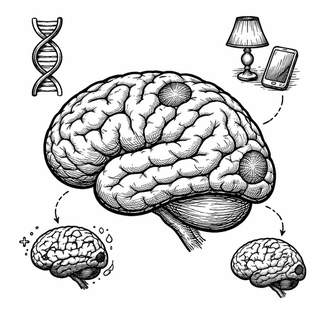
What popped out were three distinct subtypes of adolescent sleep insufficiency, each with its own brain signature, its own backstory, and its own set of implications. Three flavors of "not sleeping enough," and they couldn't be more different.
The Genetic Lucky Ones
The first subtype showed cortical thinning starting in the postcentral cortex - the strip of brain that processes touch and body awareness. But here's the twist: these kids looked totally normal on every other measure. No psychiatric issues. Good sleep hygiene. Fine sleep environments. They just didn't sleep much.
Sound familiar? These are likely natural short sleepers - that rare 1-3% of the population carrying genetic variants in genes like DEC2, ADRB1, and NPSR1 that let them run the full biological night shift in fewer hours (Shi et al., 2021). UCSF geneticist Ying-Hui Fu has described it perfectly: "Whatever their body needs to do with sleep, they can get it done in a short time." The kicker? These kids actually showed advanced brain age and carried higher polygenic scores for short sleep. Their brains aren't falling behind - they might be running ahead.
When Your Bedroom Is the Problem
The second subtype started its cortical thinning in the pericalcarine cortex - visual processing territory, deep in the back of the brain. And these kids had a very different story. Their sleep environments were a mess: light pollution, noise, screens glowing like tiny suns at 2 AM. The works.
Here's what makes this finding genuinely useful: sleep duration statistically mediated the link between bad environments and brain changes. Translation: fix the bedroom, fix the sleep, potentially protect the cortex. This isn't some hand-wavy "sleep is important" message. It's a testable, targetable pathway. Close the blinds, kill the noise, and you might literally preserve brain tissue during one of the most critical developmental windows in a person's life (Anastasiades et al., 2022).
The One That Keeps Researchers Up at Night
The third subtype started in the entorhinal cortex - a region deeply wired into memory, navigation, and emotional processing. These adolescents showed elevated psychiatric risk, and their brain thinning patterns overlapped spatially with neurotransmitter systems tied to psychosis. Serotonin, dopamine, glutamate - the usual suspects when things go sideways.
But it gets weirder: this group showed younger brain age, the opposite of the natural short sleepers. Their brains weren't maturing faster; they were developing differently, in ways that parallel what we see in early psychiatric vulnerability. Research already tells us that adolescent sleep disruption jacks up the risk for depression and anxiety, with some studies showing that sleeping under six hours per school night substantially increases future psychiatric symptoms (Uccella et al., 2023). This subtype might be the neurobiological receipt for that risk.
Why This Actually Matters
Here's the real payoff. For decades, the sleep advice for teenagers has been one-size-fits-all: get your eight hours or face the consequences. And for a lot of kids, that's still solid advice. But this study hands clinicians a potential framework for stratified interventions. The kid who's a genetic short sleeper doesn't need the same treatment as the kid sleeping next to a highway, and neither of them needs the same approach as the kid whose sleep problems are tangled up with emerging psychiatric symptoms.
It's precision medicine for bedtime, and honestly, it's about time someone sorted this out. Not every short-sleeping teen needs a lecture. Some need blackout curtains. Some need a psychiatrist. And some? Some just need everyone to stop worrying.
References
-
Chen, Y., Li, M., Zhao, Z., et al. (2026). Neuroimaging subtypes of adolescent sleep insufficiency stratify natural short sleepers from comorbidity or environment driven insufficiency. Nature Communications. DOI: 10.1038/s41467-026-70135-6
-
Young, A. L., Marinescu, R. V., Oxtoby, N. P., et al. (2018). Uncovering the heterogeneity and temporal complexity of neurodegenerative diseases with Subtype and Stage Inference. Nature Communications, 9, 4273. DOI: 10.1038/s41467-018-05892-0
-
Shi, G., Yin, C., Fan, Z., et al. (2021). Some twist of molecular circuitry fast forwards overnight sleep hours: A systematic review of natural short sleepers' genes. Cureus, 13(10), e18968. DOI: 10.7759/cureus.18968 | PMCID: PMC8547374
-
Anastasiades, P. G., de Vivo, L., Bellesi, M., & Jones, M. W. (2022). Adolescent sleep and the foundations of prefrontal cortical development and dysfunction. Progress in Neurobiology, 218, 102338. DOI: 10.1016/j.pneurobio.2022.102338 | PMCID: PMC7616212
-
Uccella, S., Cordani, R., Salfi, F., et al. (2023). Sleep deprivation and insomnia in adolescence: Implications for mental health. Brain Sciences, 13(4), 569. DOI: 10.3390/brainsci13040569 | PMCID: PMC10136689
Disclaimer: The image accompanying this article is for illustrative purposes only and does not depict actual experimental results, data, or biological mechanisms.