
Bad explanation number one: autism and OCD are basically the same thing wearing different hats. Bad explanation number two: if someone repeats behaviors, the brain is just "stuck," end of story. Bad explanation number three: psychiatry made up too many labels and now we are all trapped in a filing cabinet. The real answer is messier, more interesting, and very on-brand for the brain - autism spectrum disorder, or ASD, and obsessive-compulsive disorder, or OCD, can look similar from the outside while running on partly shared and partly different neural machinery under the hood.
That is the big takeaway from a 2025 systematic review by Pereira, Veenstra-VanderWeele, and Jutla, which pulled together 50 comparative studies on ASD and OCD across genetics, brain imaging, and cognition. And honestly? This is exactly the kind of paper we need, because the brain loves recycling outward behaviors while changing the internal plot completely.
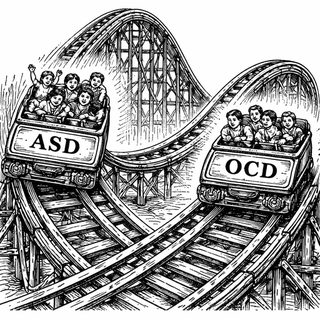
Same roller coaster, different safety inspector
ASD and OCD overlap in ways that can confuse clinicians, families, and probably the occasional exhausted teacher. Both can involve repetitive behaviors, rigid routines, and a strong dislike of change barging in uninvited like a raccoon in a diner.
But the reason for those behaviors may differ.
In OCD, repetitive actions often show up as compulsions - behaviors driven by anxiety, intrusive thoughts, or a desperate need to prevent something bad. It is the brain hitting "refresh" 900 times because it does not trust the page loaded correctly.
In ASD, repetitive behaviors or insistence on sameness may be less about intrusive fear and more about predictability, sensory regulation, deep interests, or cognitive style. Think less "I must do this or disaster will strike" and more "my brain likes the tracks where the ride makes sense."
That distinction matters a lot in real life, because if two behaviors look similar but come from different mechanisms, the best treatment may not be the same.
Genetics: cousins, not clones
The review found evidence that ASD and OCD share some heritability. So yes, there seems to be some overlapping genetic architecture. But before anyone starts yelling "case closed," the authors also point out that polygenic risk studies are still limited.
Translation: we have hints that these conditions share some inherited vulnerabilities, but the fine print is still blurry. The brain, naturally, has chosen to be complicated instead of cooperative.
This fits with broader work showing that many psychiatric and neurodevelopmental conditions share some genetic risk rather than living in neat little boxes with white picket fences around them. Biology did not read the DSM and does not care about our paperwork.
Brain scans: overlap, with a plot twist
On the neuroimaging side, both ASD and OCD were linked to reduced cortical thickness in the temporal lobe. That suggests some converging brain features. But ASD also showed something more specific - increased frontal cortical thickness.
That is a pretty useful clue. If the temporal lobe overlap hints at some shared features, the frontal differences may help explain why the two conditions can diverge in social processing, flexibility, planning, and behavior patterns.
Do brain scans give us a magical diagnostic crystal ball? No. We are not one MRI away from the Sorting Hat of psychiatry. But patterns like these help researchers build better models of what is shared, what is distinct, and where current diagnostic categories may be missing the nuance.
Cognition: the "looks similar, feels different" problem
Cognitively, one of the biggest shared themes was inflexibility. That makes sense. Both conditions can involve difficulty shifting gears - like a mental transmission that occasionally grinds when asked to go from third to fourth.
But the review also found likely differences in facial emotion processing and sustained attention. That is where things get especially interesting. Two people may both seem rigid or repetitive, yet differ in how they read social cues or maintain attention over time.
This is a huge deal clinically. If you mistake one pattern for another, you might aim treatment at the wrong target. And in child psychiatry especially, getting the target right is not a luxury - it changes whether support actually helps.
Why this matters outside academic PowerPoint jail
This review tackles a very real problem: diagnostic overlap can lead to delayed recognition, muddled treatment plans, and a lot of frustration for patients and families. If a clinician assumes all repetitive behavior means the same thing, that is like hearing a weird engine noise and deciding every car needs the exact same repair. Great way to waste time. Possibly also money.
Better mapping of ASD-OCD overlap could improve assessment tools, help personalize therapy, and sharpen research on who responds to what. It could also reduce the all-too-common experience of people bouncing between labels while everyone argues over terminology and the person actually living in the brain is just trying to get through Tuesday.
The authors also emphasize a major problem in the literature: heterogeneity. Studies use different methods, different populations, and often focus more on categories than quantitative traits. That makes it harder to compare findings cleanly. So the field is not at the finish line here. It is still building the ride while taking notes on which bolts seem important.
And honestly, that is what makes this paper fun. It does not pretend the answer is simple. It says, with respectable scientific restraint, "these conditions overlap, diverge, and deserve way more careful study than they have gotten."
Which, for psychiatry, is sometimes the most useful thing a paper can say.
References
Pereira JA, Veenstra-VanderWeele J, Jutla A. Systematic Review: Convergence and Divergence Between Autism Spectrum Disorder and Obsessive-Compulsive Disorder: Genetic, Neuroimaging, and Cognitive Findings. J Am Acad Child Adolesc Psychiatry. 2025. doi:10.1016/j.jaac.2025.06.017. PubMed: 40578755
Fettes P, van Rooij D, Simons CJP, et al. Neuroimaging in obsessive-compulsive disorder: state of the field and future directions. Mol Psychiatry. 2024. doi:10.1038/s41380-024-02578-0
Lord C, Charman T, Havdahl A, et al. The Lancet Commission on the future of care and clinical research in autism. Lancet. 2022;399(10321):271-334. doi:10.1016/S0140-6736(21)01541-5
Taylor MJ. Autism spectrum disorder and obsessive-compulsive disorder: shared features and distinct mechanisms. Curr Opin Psychiatry. 2022;35(2):95-101. doi:10.1097/YCO.0000000000000766
International OCD Foundation. Autism and OCD: Similarities, differences, and treatment considerations. Available from: https://iocdf.org
Disclaimer: The image accompanying this article is for illustrative purposes only and does not depict actual experimental results, data, or biological mechanisms.