
For over a century, scientists studying how plants send electrical signals kept wandering down the same dead-end road: trying to understand plant action potentials by borrowing the playbook from animal neuroscience. Wrong turns piled up. Terminology got confusing. And the Venus flytrap - that gloriously weird little carnivore sitting on your windowsill - kept quietly running an electrical signaling system that nobody fully understood. Until now, when a team finally mapped the whole ionic machinery and handed us something close to a complete wiring diagram.
Your Houseplant Is Basically Texting Itself
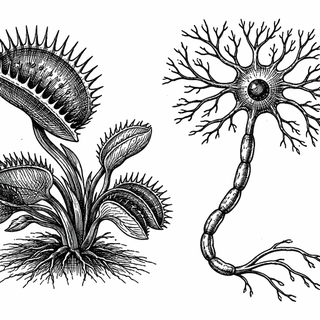
Here's something that'll mess with your head: plants fire electrical signals. Not like your neurons do - plants don't have sodium channels, the molecular workhorses behind every thought you've ever had. Instead, they've rigged up a completely different system using calcium, chloride, and potassium ions to get the same job done.
The Venus flytrap (Dionaea muscipula) is the poster child for this. When a fly brushes against one of those tiny trigger hairs inside the trap, mechanosensitive channels crack open and calcium floods into the cell. That calcium wave travels across the entire trap surface, triggering a chain reaction of ion movements: chloride rushes out, potassium follows, the membrane potential shifts, and proton pumps kick in to reset everything. One action potential lasts about a second and unfolds in five tidy phases. It's basically a neuronal text message, except the plant built the whole system from scratch without copying anyone's homework.
The Plant That Learned to Count
But here's where it gets properly wild. The Venus flytrap doesn't just fire electrical signals - it counts them.
One action potential? Nothing happens. The trap stays open, unfazed. Think of it as the plant's spam filter - maybe that was just a raindrop.
Two action potentials within about 20 seconds? SNAP. The trap closes in under a tenth of a second, faster than you can blink, using a hydroelastic mechanism that stores potential energy like a loaded mousetrap.
Three or more? Now the plant shifts into digestion mode, cranking up jasmonic acid production - the same hormone other plants use to defend against herbivores. The flytrap essentially repurposed its immune system into a stomach. Evolution is a magnificent recycler.
A 2022 study in Current Biology revealed that when the trap enters its electrically excitable stage, it expresses a specialized inventory of ion transporters. The glutamate receptor GLR3.6 showed the most dramatic increase - yes, glutamate, the same neurotransmitter your brain uses for learning and memory. Plants and animals arrived at remarkably similar molecular solutions through completely independent evolutionary paths.
Optogenetics: Shining a Light on Plant Secrets
The latest leap forward? Scientists are now using optogenetics - light-activated ion channels originally borrowed from algae - to remote-control plant electrical signals. A 2024 study published in Nature engineered a channelrhodopsin variant called XXM 2.0 with high calcium conductance, essentially giving researchers a light switch for plant calcium signaling.
When they flipped it on, something unexpected happened. Although both their calcium channel and a separate anion channel triggered membrane depolarization, the downstream plant responses were completely different - different stress genes activated, different metabolic pathways engaged. Same electrical event, different biological meaning. Plants aren't just sending signals; they're encoding information in the specific flavor of ion that moves.
This echoes what Hedrich and Kreuzer lay out in their 2026 review in New Phytologist: we've moved from the "dark times" of calcium signaling research into an era where genetically encoded sensors and light-activated channels let us watch and manipulate ionic events in real time. As they note, the Venus flytrap's trigger hairs even respond to heat, firing action potentials when temperatures hit 37°C and 55°C - likely an ancient wildfire alarm system.
Why Should You Care About Plant Electricity?
Because this isn't just a party trick for carnivorous plants. Electrical and calcium signaling drives stomatal opening (how plants breathe), wound responses (how they defend themselves), and growth regulation. Understanding this ionic language could transform agriculture - imagine crops that respond faster to drought stress or communicate pest attacks more efficiently across their tissues.
The flytrap was where Darwin first noticed something electric was happening in plants, way back in the 1870s. A hundred and fifty years of wrong turns later, we're finally reading the whole conversation.
References
-
Hedrich, R., & Kreuzer, I. (2026). The power of ionic movements in plants. New Phytologist, 249(5), 2232–2240. DOI: 10.1111/nph.70807 | PMID: 41362058 | PMC: PMC12873529
-
Hedrich, R., & Kreuzer, I. (2023). Demystifying the Venus flytrap action potential. New Phytologist, 239(6), 2108–2112. DOI: 10.1111/nph.19113 | PMID: 37424515
-
Scherzer, S., Böhm, J., Huang, S., Iosip, A. L., Kreuzer, I., Becker, D., ... & Hedrich, R. (2022). A unique inventory of ion transporters poises the Venus flytrap to fast-propagating action potentials and calcium waves. Current Biology, 32(20), 4255–4263. DOI: 10.1016/j.cub.2022.08.051 | PMID: 36087579
-
Ding, M., Zhou, Y., Becker, D., Yang, S., Krischke, M., Scherzer, S., ... & Konrad, K. R. (2024). Probing plant signal processing optogenetically by two channelrhodopsins. Nature, 633(8031), 872–877. DOI: 10.1038/s41586-024-07884-1 | PMID: 39198644
Disclaimer: The image accompanying this article is for illustrative purposes only and does not depict actual experimental results, data, or biological mechanisms.