
Picture this: you walk into two kitchens. One has a gas stove, copper pans, and a chef who trained in Lyon. The other has an induction cooktop, cast iron, and someone who learned to cook from YouTube. Both kitchens turn out the exact same perfect risotto. Same creamy result, wildly different setups.
Now replace "kitchens" with "brain circuits" and "risotto" with "coordinated neural activity," and you've basically got the punchline of a new study from EPFL that just landed in Neuron.
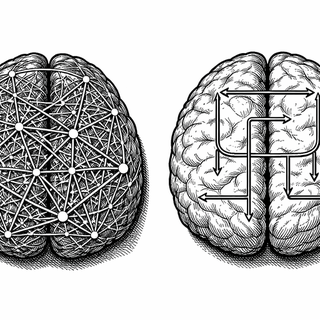
Your Brain Runs on a Surprisingly Simple Playlist
Here's something wild about your brain: you have roughly 86 billion neurons, each one capable of firing independently. In theory, that means the number of possible activity patterns is astronomically large. But your brain doesn't actually use most of them. Instead, neural populations tend to stick to a small set of coordinated patterns, tracing paths along what neuroscientists call a "neural manifold" - basically, a low-dimensional surface hiding inside all that high-dimensional chaos.
Think of it like a subway system. A city might sprawl in every direction, but the trains only run along a handful of lines. Your brain's activity is similar - billions of possible "stops," but the action mostly happens along a few well-worn routes (Mitchell-Heggs et al., 2022; Pang et al., 2016).
Over the past decade, researchers have gotten really good at finding these manifolds using dimensionality reduction - fancy math that squishes complicated data into something your human brain can actually wrap itself around. But here's the thing that's been bugging the field: just because you can see the subway map doesn't mean you know what's happening underground.
The Wiring Problem
Knowing that neural activity lives on a low-dimensional manifold is great, but what creates that manifold? What's the relationship between the physical wiring of neural circuits and the patterns those circuits produce?
Louis Pezon, Valentin Schmutz, and Wulfram Gerstner at EPFL tackled exactly this question (Pezon et al., 2026). They built spiking recurrent network models - computational simulations where virtual neurons actually fire spikes and talk to each other through connections that mimic real synapses - and asked: if we wire up these networks differently, do we get different dynamics?
The answer is both yes and no, which is exactly the kind of response that makes neuroscience so delightfully maddening.
Same Movie, Different Projectors
The team discovered that topologically different circuit structures can produce equivalent low-dimensional dynamics. Two networks with completely different wiring diagrams can trace out the same trajectories on the same manifold. It's like discovering that a symphony orchestra and a synthesizer can produce the same piece of music - the output is identical, but the machinery behind it is totally different.
But - and this is a big but - the degeneracy isn't total. Circuit structure still leaves fingerprints. While the overall low-dimensional dynamics might look the same, the way individual neurons behave within those circuits is constrained by the architecture. The distribution of single-neuron functional properties (how individual cells respond to stimuli, how variable their firing is) carries telltale signatures of the underlying wiring.
So if you're an experimentalist recording from a bunch of neurons, you can actually use these signatures to narrow down which type of circuit is running the show, even if the population-level dynamics alone wouldn't tell you.
Why This Matters (Beyond Being Clever Math)
This work bridges two neuroscience traditions that have been talking past each other for years. On one side, you have the classical circuit modelers who care about precise connectivity - who's wired to whom, and how strongly. On the other, you have the neural manifold crowd using dimensionality reduction to describe population dynamics without worrying much about the plumbing underneath (Langdon et al., 2023).
Pezon and colleagues essentially built a Rosetta Stone between the two. Their framework connects neural field models (a classic approach to modeling cortical circuits) to low-rank recurrent networks (a newer, trendy approach to modeling manifold dynamics). And they provide concrete, testable criteria for matching models to real neural recordings.
That last part is what makes this more than a theoretical exercise. As recording technologies keep scaling up - we're talking thousands of neurons recorded simultaneously - we desperately need principled ways to connect what we observe (manifold dynamics) to what we want to understand (circuit mechanisms). This framework hands experimentalists a checklist: here's how to tell whether your data is consistent with circuit type A versus circuit type B.
It's not going to solve the brain tomorrow. But it's exactly the kind of work that turns "huh, neat pattern" into "oh, now I understand why."
References
-
Pezon, L., Schmutz, V., & Gerstner, W. (2026). Linking neural manifolds to circuit structure in recurrent networks. Neuron. DOI: 10.1016/j.neuron.2025.12.047 | PubMed
-
Langdon, C., Genkin, M., & Engel, T. A. (2023). A unifying perspective on neural manifolds and circuits for cognition. Nature Reviews Neuroscience, 24, 363-377. DOI: 10.1038/s41583-023-00693-x | PMCID: PMC11058347
-
Mitchell-Heggs, R., Prado, S., Gava, G. P., Go, M. A., & Schultz, S. R. (2023). Neural manifold analysis of brain circuit dynamics in health and disease. Journal of Computational Neuroscience, 51, 5-21. DOI: 10.1007/s10827-022-00839-3 | PMCID: PMC9840597
-
Fortunato, C., Bennasar-Vázquez, J., Park, J., et al. (2023). Nonlinear manifolds underlie neural population activity during behaviour. bioRxiv. DOI: 10.1101/2023.07.18.549575 | PMCID: PMC10370078
-
Pang, R., Lansdell, B. J., & Fairhall, A. L. (2016). Dimensionality reduction in neuroscience. Current Biology, 26(14), R656-R660. DOI: 10.1016/j.cub.2016.05.029 | PMCID: PMC6132250
Disclaimer: The image accompanying this article is for illustrative purposes only and does not depict actual experimental results, data, or biological mechanisms.