
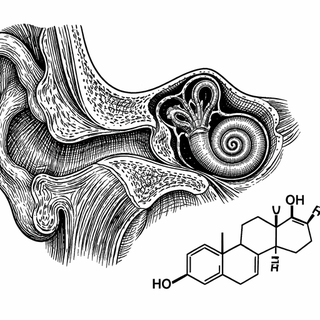
Your ears need estrogen. Yeah, that hormone. The one typically associated with puberty, bone health, and about a thousand other biological processes. Turns out the cochlea - that snail-shaped hearing apparatus in your inner ear - has estrogen receptors just sitting there, waiting for their molecular mail to arrive. And when it doesn't? Things get dicey.
A team of researchers in China just dropped some seriously important findings about Turner syndrome, a genetic condition affecting roughly 1 in 2,000 to 2,500 girls where one X chromosome is either missing or playing hide-and-seek. Among the many challenges these girls face - short stature, heart issues, ovarian insufficiency - hearing loss has been lurking in the background like an uninvited party guest. But until now, nobody really knew if childhood estrogen deficiency was to blame.
The Study That Changed the Conversation
Researchers followed 87 prepubertal girls with Turner syndrome for about three years. They split them into two camps: those with normal estrogen levels and those running on empty. The results? The estrogen-deficient group had a hearing loss rate of 56.3%, compared to just 28.2% in the estrogen-normal group (Huang et al., 2025). That's not a subtle difference. That's nearly double the risk.
But wait, it gets better. When they looked at DPOAE results - a fancy test that measures how well your outer hair cells are functioning - the effect was even more dramatic. Estrogen deficiency almost quadrupled the risk of abnormal readings. Your outer hair cells are basically the amplifiers of your auditory system, and without estrogen, they're apparently phoning it in.
Why Estrogen Matters to Your Ears
Here's where the biology gets wild. Estrogen receptors (specifically ERα and ERβ) have been found throughout the inner ear, including in the stria vascularis - the structure responsible for maintaining the chemical environment your cochlea needs to function - and in spiral ganglion neurons, which transmit sound information to your brain.
The leading theory? Estrogen helps regulate neuron survival and maintains the delicate cellular machinery that converts sound waves into electrical signals. When estrogen levels tank, these cells lose their protective buffer. It's like removing the security system from a building and hoping nobody notices.
Animal studies back this up. Female mice given estrogen replacement after having their ovaries removed showed significantly less hearing damage after noise exposure compared to those without estrogen. The hormone appears to protect outer hair cells and reduce cochlear synaptopathy - the damage to connections between hair cells and auditory neurons.
The Plot Twist: Timing Is Everything
The study's most actionable finding? Starting estrogen replacement therapy around age 12 made a massive difference. Girls who received ERT showed hearing improvements of about 1.24 to 1.85 decibels per year, while those without ERT saw their hearing decline by about 1 dB annually. That might sound small, but over a decade, you're talking about a significant gap.
This aligns with current clinical guidelines recommending ERT initiation at 11-12 years to mimic natural puberty timing. The goal has always been bone health, uterine development, and psychological well-being. Now we can add hearing preservation to that list.
What This Means Going Forward
Turner syndrome affects about 70,000 women and girls in the United States alone. For years, hearing loss in this population was treated as somewhat inevitable - just another item on the long list of things to monitor. This research suggests it doesn't have to be.
The catch? As a recent 2025 scoping review pointed out, we still don't fully understand the pathophysiology of hearing problems in Turner syndrome. Genetics, epigenetics, and hormonal factors all play interconnected roles. But identifying estrogen deficiency as a modifiable risk factor? That's a lever we can actually pull.
For parents of girls with Turner syndrome, this means pushing for early hormone evaluations and discussing hearing monitoring protocols with endocrinologists. For researchers, it opens new questions about whether estrogen-based interventions could help protect hearing in other populations - like postmenopausal women, who show accelerated hearing decline after menopause.
The inner ear, it turns out, has been listening to hormonal signals all along. We just weren't paying attention.
References
Huang, Y., Liang, L., Ye, Y., Zhang, L., Ling, L., Meng, Z., Liu, W., Guo, J., Liu, Z., Zhao, Z., Zhang, Z., & Si, Y. (2025). Estrogen deficiency and risk of hearing loss in pediatric Turner syndrome. The Journal of Clinical Investigation. DOI: 10.1172/JCI197932. PMID: 41774494
Disclaimer: The image accompanying this article is for illustrative purposes only and does not depict actual experimental results, data, or biological mechanisms.