
Most of the time, corticospinal neurons are the celebrities in this story. They are the long-distance operators that let your cortex reach down and boss your spinal cord around so you can pick up a mug, play piano, or dramatically point at things during an argument. When these neurons die, as they do in amyotrophic lateral sclerosis, or when their axons get wrecked in spinal cord injury, voluntary movement takes a brutal hit. And for years, the question has hovered over the field like a storm cloud with a PhD: can we make new ones, on purpose, from cells already living in the adult cortex?
A new eLife paper says maybe yes - at least in mice, and at least with some very clever molecular persuasion Ozkan et al., 2024.
The brain's understudies step onto the stage
The stars here are not mature neurons. They are a subset of cortical progenitor-like cells marked by SOX6 and NG2. If that sounds like a law firm, welcome to neuroscience. NG2 cells are often discussed as oligodendrocyte precursor cells - the versatile, slightly mysterious support-cell-adjacent population scattered through the central nervous system. Scientists have suspected for a while that some of these cells might have more potential than they let on.
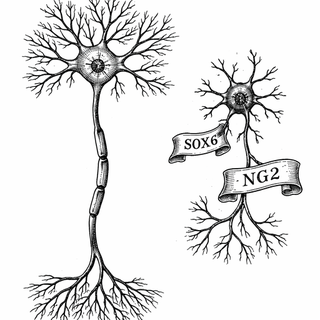
Ozkan and colleagues asked whether endogenous SOX6+/NG2+ cortical progenitors could be pushed to become corticospinal-like neurons - cells resembling the neurons that normally project from cortex to spinal cord. Not just vaguely neuron-ish blobs, but cells with the right markers, morphology, and functional properties.
That distinction matters. The brain is full of neurons, but making the right neuron is the whole game. You do not repair a submarine by replacing the navigation system with a blender. Electrically active is not the same thing as circuit-appropriate.
Why corticospinal neurons are such a pain to replace
Corticospinal neurons are not generic. They are a highly specialized class of projection neuron, born during development through tightly choreographed transcriptional programs involving factors like FEZF2, CTIP2/BCL11B, and SOX5/SOX6. During development, they extend axons all the way to spinal targets through the corticospinal tract, one of the major pathways for voluntary movement (Lodato and Arlotta, 2015).
In diseases like ALS, degeneration does not just hit the spinal motor neurons that actually connect to muscle. It also affects upper motor neurons, including corticospinal neurons, meaning the command chain itself starts to collapse (Ragagnin et al., 2019). In spinal cord injury, the cortical neurons may survive, but their axons get severed and regeneration is notoriously lousy (Hilton and Bradke, 2017).
So the idea of replacing or rebuilding this circuitry has huge appeal. Also huge difficulty. The cortex is not exactly Ikea. You cannot just slot in a part and hope the allen key of destiny does the rest.
The molecular pep talk
The paper's core achievement was directed differentiation - nudging these endogenous progenitors toward a corticospinal-like identity using developmental cues. The authors report that SOX6+/NG2+ cells can be driven toward neurons expressing key corticospinal markers and showing electrophysiological features of functional neurons. In plain English: they did not just look the part. They started acting like neurons too.
That is the exciting bit. Lots of regenerative ideas die in the awkward phase where cells express a couple of trendy markers and everyone politely pretends that means they are ready for prime time. Here, the claim is stronger: the team generated cells with multiple hallmarks of corticospinal-like neurons.
This fits into a broader push in regenerative neuroscience - not merely making neurons, but making specific neuronal subtypes for disease modeling and repair. Recent work has emphasized how essential cell identity is for meaningful reconstruction of damaged circuits (Telley et al., 2019; Perlman et al., 2023).
Why this is cool, and why nobody should start doing backflips yet
If these findings hold up and can be extended, the implications are obvious and slightly dizzying. In principle, you could imagine recruiting local cells in the cortex to replace vulnerable corticospinal neurons in ALS, or to help rebuild descending motor pathways after injury. That is the sort of sentence that makes regenerative medicine people stare into the middle distance and whisper, "go on."
But there are caveats, and they are not decorative.
First, mouse is not human. The mouse brain has taught us a lot, but it has also repeatedly humbled anyone who thought translation would be straightforward. Second, generating a corticospinal-like neuron is not the same as fully restoring a working circuit. A replacement neuron would need to survive, integrate into local cortical networks, send axons over absurd distances, find correct spinal targets, and do all of this without causing chaos. Neurons are less like Lego bricks and more like deep-sea creatures evolved for one very specific trench.
Third, there is the issue of safety. If you start reprogramming endogenous cells in the adult brain, you want exquisite control. Too little conversion and nothing useful happens. Too much, or in the wrong cells, and you may trade one disaster for another.
The bigger picture - the cortex may be less fixed than it looks
The most intriguing part of this study might be philosophical as much as practical. It suggests the adult cortex may contain resident cell populations with more latent flexibility than we assumed. Not infinite flexibility - this is not cellular jazz improv - but enough that, with the right developmental instructions, they can be steered toward a highly specific neuronal fate.
That changes the vibe. The adult brain has often seemed like an old city built on cliffs - beautiful, brittle, impossible to renovate without something collapsing into the sea. Work like this hints that some repair crews may already be standing inside the walls, waiting for better maps.
And that is why this paper is worth watching. Not because it solved neural repair. It very much did not. But because it found a door in a place that looked like solid rock.
References
- Ozkan A, Padmanabhan HK, Shipman SL, Azim E, Kumar P, Sadegh C, Basak AN, Macklis JD. Directed differentiation of functional corticospinal-like neurons from endogenous SOX6+/NG2+ cortical progenitors. eLife. 2024;13:RP100340. DOI: 10.7554/eLife.100340
- Ragagnin AMG, Shadfar S, Vidal M, Jamali MS, Atkin JD. Motor neuron susceptibility in ALS/FTD. Nat Rev Neurol. 2019;15(9):531-550. DOI: 10.1038/s41582-019-0235-7
- Hilton BJ, Bradke F. Can injured adult CNS axons regenerate by recapitulating development? Nat Rev Neurosci. 2017;18(8):465-478. DOI: 10.1038/nrn.2017.171
- Lodato S, Arlotta P. Generating neuronal diversity in the mammalian cerebral cortex. Annu Rev Cell Dev Biol. 2015;31:699-720. DOI: 10.1146/annurev-cellbio-100814-125353
- Telley L, Agirman G, Prados J, et al. Temporal patterning of apical progenitors and their daughter neurons in the developing neocortex. Trends Neurosci. 2019;42(11):775-788. DOI: 10.1038/s41583-019-0194-9
- Perlman K, et al. Cellular reprogramming and neural repair in the central nervous system. Front Cell Neurosci. 2023. PMCID: PMC10469262
Disclaimer: The image accompanying this article is for illustrative purposes only and does not depict actual experimental results, data, or biological mechanisms.