
Not every important discovery in neuroscience involves a flashy new brain region or a mind-blowing psychedelic compound. Sometimes, the real plot twist is finding out that one of the brain's most critical cell types has been carrying a receptor around like a secret phone - and nobody noticed it was making calls.
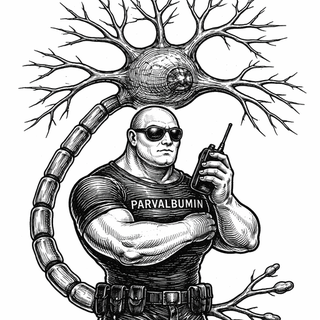
A team at Vanderbilt University just identified an orphan receptor called ADGRA1 that's been quietly running operations inside parvalbumin (PV) interneurons - the brain's fast-spiking inhibitory cells. Think of PV neurons as the bouncers of your hippocampus: they keep excitatory neurons from getting too rowdy, maintaining the delicate balance that lets you form memories, pay attention, and generally not have seizures. Now it turns out those bouncers have a walkie-talkie nobody knew existed.
Wait, What's an Orphan Receptor?
Here's the thing. Your cells are covered in receptors - molecular antennas that pick up signals and trigger responses inside the cell. G protein-coupled receptors (GPCRs) are the biggest family of these, and they're already the target of about a third of all approved drugs. But roughly 130 GPCRs are "orphans," meaning we haven't figured out what natural signal activates them. They're sitting right there on the cell surface, clearly doing something, but we don't know who's calling.
ADGRA1 belongs to the adhesion GPCR subfamily, but it's the black sheep of the family. While its 32 siblings in mice all sport elaborate external structures - think molecular grappling hooks for grabbing onto neighboring cells - ADGRA1 showed up without any of that hardware. No adhesion domains. No GAIN domain. It's basically a receptor that threw away the instruction manual and still somehow got the job done (Tosun et al., 2026).
The Bouncer's New Frequency
The Vanderbilt team, led by Baris Tosun and Richard Sando, found that ADGRA1 isn't just passively sitting on PV interneurons - it's actively shaping how these cells work. When they knocked out ADGRA1 specifically in PV neurons, two things went sideways. First, the neurons became less excitable on their own, like bouncers who suddenly can't be bothered to stand up. Second, the inhibitory signals these neurons send to dentate gyrus granule cells got noticeably weaker.
That's a big deal. The dentate gyrus is your hippocampus's front gate - it filters incoming information before it gets encoded into memory. If the bouncers at that gate get sluggish, the whole filtering system breaks down.
Following the Signal Downstream
So what's ADGRA1 actually doing inside these cells? The researchers found it activates several G proteins, but the standout partner is Gα13. This is particularly satisfying because the same lab previously showed that Gα12/13 signaling is a critical hub for building PV interneuron connections in the hippocampus (Garbett, Tosun et al., 2024). That earlier work demonstrated that disrupting Gα12/13 specifically weakens inhibitory inputs from PV neurons without touching excitatory connections - a surgical precision that mirrors exactly what happens when you delete ADGRA1.
So the picture is coming together: ADGRA1 sits on PV interneuron synapses, activates Gα13, and this pathway builds and maintains the inhibitory wiring that keeps your hippocampus functioning properly.
Why You Should Care (Even If You're Not a Neuroscientist)
PV interneuron dysfunction is implicated in an alarming number of conditions: schizophrenia, epilepsy, autism spectrum disorder, and Alzheimer's disease, to name the headliners (Hijazi et al., 2023). These neurons are exquisitely vulnerable to stress and metabolic disruption, and when they fail, the consequences ripple through entire brain networks.
Finding a new receptor that selectively controls PV neuron function is like discovering a previously unknown thermostat in a building with chronic temperature problems. You can't fix a system you don't understand, and we just got a new piece of the wiring diagram.
What makes ADGRA1 especially tantalizing is that it's an orphan GPCR - and GPCRs are famously druggable. A recent review in Nature Reviews Drug Discovery highlighted how breakthroughs in cryo-electron microscopy are finally enabling small-molecule drug design for adhesion GPCRs (Sun et al., 2026). If someone can figure out what naturally activates ADGRA1 - or design a molecule that does - you'd have a tool that selectively tunes PV interneuron function without messing with everything else.
The Bottom Line
Look. The brain has roughly 86 billion neurons, dozens of cell types, and an absurd number of receptors we're still cataloging. The fact that a structurally weird, previously ignored orphan receptor turned out to be essential for one of the hippocampus's most important cell types is both humbling and exciting. It's a reminder that the brain's operating manual has chapters we haven't even opened yet - and some of the most important ones might be written in a language we're only now learning to read.
References
-
Tosun, B., Honkanen, K., Orput, E., Kulkarni, S., Bui, D. L. H., & Sando, R. C. (2026). The atypical adhesion GPCR ADGRA1 controls hippocampal inhibitory circuit function. Cell Reports, 44, 117255. DOI: 10.1016/j.celrep.2026.117255 | PubMed
-
Garbett, K., Tosun, B., Lopez, J. M., Smith, C. M., Honkanen, K., & Sando, R. C. (2024). Synaptic Gα12/13 signaling establishes hippocampal PV inhibitory circuits. Proceedings of the National Academy of Sciences, 121(51), e2407828121. DOI: 10.1073/pnas.2407828121 | PMCID: PMC11670215
-
Hijazi, S., Smit, A. B., & van Kesteren, R. E. (2023). Fast-spiking parvalbumin-positive interneurons in brain physiology and Alzheimer's disease. Molecular Psychiatry, 28(12), 4954-4967. DOI: 10.1038/s41380-023-02168-y | PubMed
-
Sun, J.-P., Xiao, P., & Liebscher, I. (2026). The therapeutic potential of orphan adhesion G-protein-coupled receptors. Nature Reviews Drug Discovery. DOI: 10.1038/s41573-025-01371-6 | PubMed
-
Leitch, B. (2024). Parvalbumin interneuron dysfunction in neurological disorders: Focus on epilepsy and Alzheimer's disease. International Journal of Molecular Sciences, 25(10), 5549. DOI: 10.3390/ijms25105549 | PMCID: PMC11122153
Disclaimer: The image accompanying this article is for illustrative purposes only and does not depict actual experimental results, data, or biological mechanisms.