
Under a two-photon microscope, the anterodorsal thalamus lights up like a tiny switchboard, its glutamatergic neurons flickering with calcium signals each time a mouse turns its head. These cells are famous for encoding direction - they're part of your brain's internal compass. But zoom in during a seizure, and the picture changes. Those same orderly flickers become a storm, synchronized bursts cascading through circuits that were never meant to carry that much traffic.
That's the scene a team of researchers from China captured in a new study published in Cell Reports, and what they found could reshape how we think about treating temporal lobe epilepsy (Liang et al., 2026).
Your Brain's Navigation System Moonlighting as a Seizure Highway
Here's the setup: temporal lobe epilepsy (TLE) is the most common form of epilepsy in adults, and it's notoriously stubborn. About 70% of TLE patients don't respond well to medications - a statistic that should make anyone uncomfortable. Surgery can help, but it involves removing brain tissue, which is about as irreversible as it sounds.
For years, neurologists have known the anterior nucleus of the thalamus (ANT) plays some role in seizure networks. Deep brain stimulation targeting this region has shown promise in clinical trials, reducing seizures in drug-resistant patients. But here's the thing: the ANT isn't one uniform blob. It has subdivisions, each with different cell types and connections. Stimulating the whole region is like trying to fix a specific leaky pipe by turning off water to the entire building. It works, sort of, but it's not elegant.
Turning Seizures On and Off Like a Light Switch
Liang and colleagues zeroed in on one specific subdivision - the anterodorsal nucleus (AD) - and its glutamatergic (excitatory) neurons. Using calcium imaging in mouse models of TLE, they watched these neurons spring into action during hippocampal seizures. Not a subtle activation, either. These cells were firing like they'd had six espressos.
Then came the clever part. Using chemogenetics - essentially designer drugs that activate or silence specific neurons - the team ran both directions of the experiment. Shut down AD glutamatergic neurons? Seizures were suppressed, both their onset and their spread to other brain regions. Crank those same neurons up? Seizures got worse. It's the kind of clean, bidirectional result that makes neuroscientists sit up in their chairs.
Follow the Wires: The AD-to-Postsubiculum Connection
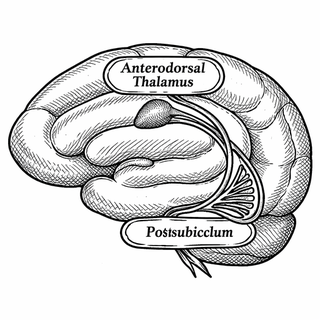
But knowing which neurons matter is only half the story. The team wanted to trace the actual wiring - where do these seizure-promoting signals go? Using trans-monosynaptic tracing (a technique that maps direct neuron-to-neuron connections), they identified the postsubiculum (PoSub) as a key downstream target.
The postsubiculum is known primarily as a cortical hub for head-direction signals, processing information about which way you're facing. In normal circumstances, the AD sends it compass data. During seizures, though, this same highway carries pathological activity. The team showed that calcium signals at AD terminals in the PoSub grew progressively stronger as seizures intensified - a neural amplifier with no volume knob.
When they chemogenetically silenced just the AD-to-PoSub projection, seizures were reduced. Activate it, and seizures worsened. Same clean bidirectional story, but now at the level of a single circuit.
Why This Matters Beyond the Mouse Cage
Thalamocortical circuits have long been implicated in seizure propagation. The thalamus can switch between normal relay firing and synchronized burst patterns that amplify and distribute seizure activity throughout the brain. What's new here is the precision: a specific cell type, in a specific thalamic subdivision, projecting to a specific cortical target.
This matters because current deep brain stimulation for epilepsy targets the ANT broadly. A multicenter registry study has shown that ANT-DBS can reduce seizure frequency, and long-term data suggest sustained benefits over five years. But the effects vary enormously between patients, and side effects include mood and memory disruption - not surprising when you're zapping a region involved in spatial navigation and episodic memory.
If we could target the AD-PoSub glutamatergic circuit specifically - using next-generation neurostimulation, optogenetics, or even gene therapy approaches - the therapeutic window could be wider and the collateral damage smaller. Johns Hopkins researchers are already exploring how to combine neurostimulation with gene therapy for more precise seizure control.
The Bigger Picture
There's something poetically ironic about the brain's navigation system doubling as a seizure superhighway. The same circuits that help you remember where you parked your car can, when they malfunction, steal minutes of your life in uncontrolled electrical storms. This study doesn't just add another pin to the seizure-circuit map. It offers a specific, testable target - a single road that, if blocked, might stop the storm from spreading without shutting down the whole neighborhood.
For the roughly 50 million people worldwide living with epilepsy, and especially those whose seizures laugh in the face of medication, that kind of precision is exactly what the field needs.
References
-
Liang, S., Han, Y., Wang, J., Liu, L., Zhu, M., Zhang, M., Sun, Z., Zhang, X., Wang, Y., & Sun, Y. (2026). Thalamic glutamatergic neurons regulate seizure onset and generalization in temporal lobe epilepsy. Cell Reports, 44, 117246. DOI: 10.1016/j.celrep.2026.117246 | PMID: 41966823
-
Paz, J. T., & Bhatt, D. K. (2023). Thalamocortical circuits in generalized epilepsy: Pathophysiologic mechanisms and therapeutic targets. Neurobiology of Disease, 181, 106109. PMC10192143
-
Nair, D. R., et al. (2024). Deep brain stimulation of the anterior nucleus of the thalamus in drug-resistant epilepsy in the MORE multicenter patient registry. Neurology. DOI: 10.1212/WNL.0000000000206887
-
Cukiert, A., et al. (2025). Long-term efficacy of anterior nucleus of the thalamus deep brain stimulation in drug-resistant epilepsy: A 5-year multicenter study. BMC Medicine. PMC12590770
-
Shink, E., et al. (2017). Prevalence and incidence of drug-resistant mesial temporal lobe epilepsy in the United States. World Neurosurgery, 99, 662-672. PMID: 28034810
Disclaimer: The image accompanying this article is for illustrative purposes only and does not depict actual experimental results, data, or biological mechanisms.